
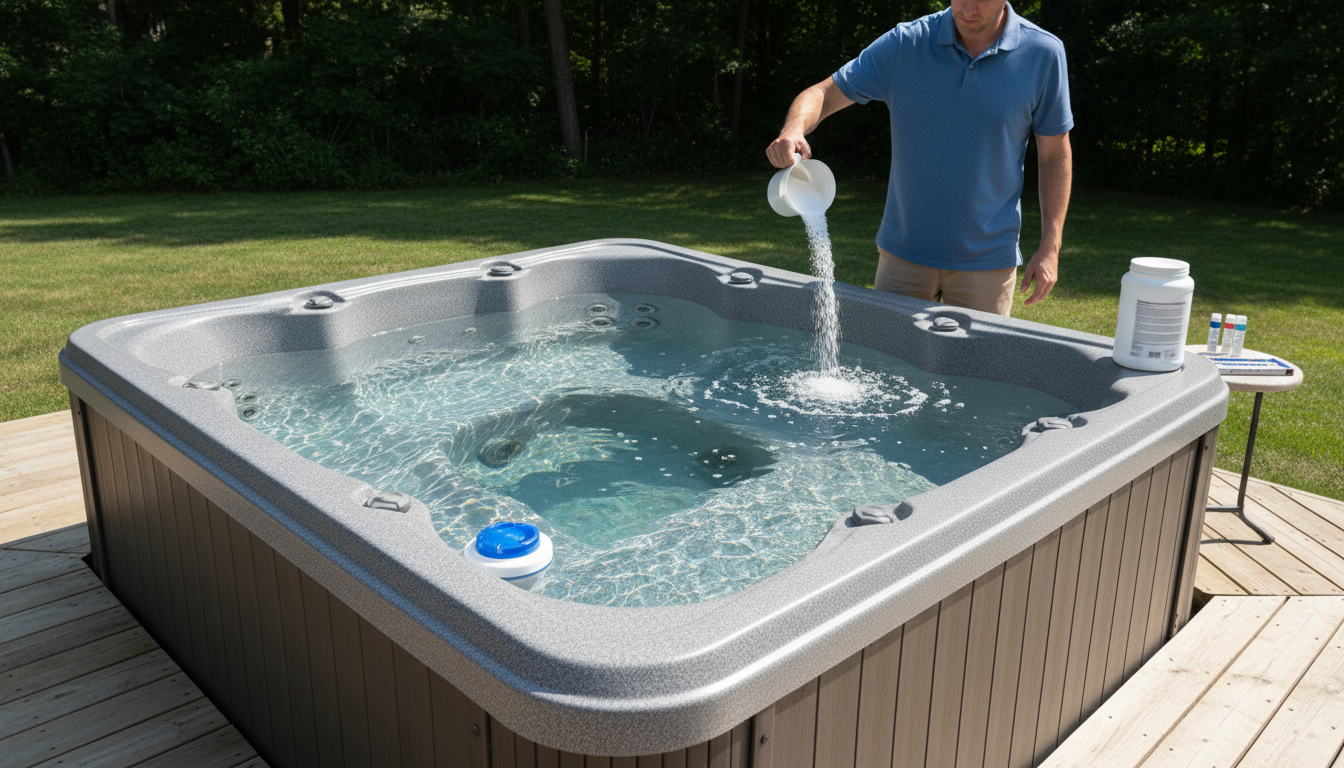
You fill your hot tub with city water, add your usual dichlor dose, and within an hour the water smells like a public pool locker room. You retest and the free chlorine reads almost nothing, yet there is obviously something chlorine-related happening in there. Sound familiar? That combination of odor and low free chlorine is the classic sign that chloramines are running the show.
The short answer is this: for a typical 6-person hard-shell hot tub holding 400 to 500 gallons, you need a breakpoint shock dose of 2 to 3 tablespoons (about 1.5 to 2 oz by weight) of dichlor before your first soak, because high-chloramine city water requires you to destroy existing combined chlorine before a normal sanitizer dose can do any work. This article walks through why chloramines in fill water change the math, how to calculate your exact breakpoint dose, what the ongoing maintenance routine looks like, and how to prevent CYA from creeping up over time.
Why High-Chloramine City Water Is a Different Problem
Municipal water is treated with chlorine or chloramine disinfectants before it ever reaches your hose. Many city systems now use chloramines intentionally because they are more stable in distribution pipes. That means your fill water may already carry 0.5 to 2 ppm of combined chlorine before you have added a single chemical. Pile bather load on top of that and combined chlorine climbs fast, because every body that soaks introduces nitrogen compounds like ammonia that react with free chlorine and produce more chloramines.
The result is water that smells terrible, irritates skin and eyes, and tests low on free chlorine even after you have dosed the tub. As explained in this guide to identifying and fixing hot tub chloramine problems, that sharp chlorine odor is almost never free chlorine at all. It is combined chlorine off-gassing. Free chlorine at normal levels is essentially odorless.
Step 1: Test Before You Add Anything
Before you dose a single gram of dichlor, test the fill water straight from the hose. You want readings on:
- Total Chlorine and Free Chlorine: The difference between these two numbers is your combined chlorine (CC). High-chloramine city water often shows 0.5 to 1.5 ppm CC right out of the tap.
- pH: Target 7.4 to 7.6. Dichlor lowers pH, so knowing your starting point prevents overcorrection.
- Total Alkalinity: Aim for 80 to 120 ppm. This buffers pH swings caused by repeated dichlor additions.
- Cyanuric Acid (CYA): City water usually reads zero, but test anyway. CYA accumulates with every dichlor dose, so knowing your baseline matters.
If you skip this step and go straight to a maintenance dose, you are almost certainly adding less chlorine than you think, because some of what you add will be consumed reacting with existing combined chlorine instead of sanitizing.
Step 2: Calculate Your Breakpoint Shock Dose
Breakpoint chlorination means raising free chlorine to a level high enough to oxidize all combined chlorine. The rule is 10 times the combined chlorine reading. Say your fill water tests at 1 ppm CC. You need to reach 10 ppm free chlorine to break through it. For a 400-gallon tub, that is your target.
Dichlor (sodium dichloro-s-triazinetrione, roughly 56% available chlorine by weight) raises free chlorine by about 1 ppm per tablespoon in a 400-gallon tub. Here is the math worked out:
- 400-gallon tub, 1 ppm CC: Target is 10 ppm free chlorine. You need approximately 10 tablespoons (about 5 oz) of dichlor to reach that level.
- 400-gallon tub, 0.5 ppm CC: Target is 5 ppm free chlorine. Approximately 5 tablespoons (about 2.5 oz) of dichlor will get you there.
- 500-gallon tub, 1 ppm CC: Target is 10 ppm free chlorine. Approximately 12 tablespoons (about 6 oz) of dichlor.
Add the dichlor to the water with the jets running, let it circulate for 30 minutes with the cover off, then retest. Free chlorine should be climbing. Wait until it drops back to 3 to 5 ppm naturally before anyone soaks.
Step 3: The Ongoing Maintenance Routine
Once you have broken through the initial chloramine load, a flat ongoing dichlor dose of 1 tablespoon per 400 to 500 gallons raises free chlorine by roughly 1 ppm. For a 6-person tub used 3 to 4 times per week, a maintenance target of 3 to 5 ppm free chlorine works well. Test before every soak and add accordingly.
The catch with dichlor is that every tablespoon also adds about 0.5 ppm of cyanuric acid to your water. In a hot tub, where you are not topping up from rain or diluting through backwash, CYA builds steadily. Once it passes 50 ppm, it starts shielding chlorine from doing its job. That is why many hot tub owners who use dichlor as their only sanitizer end up chasing chemistry problems after a few months without understanding why.
The solution is the dichlor-then-bleach method. Use dichlor exclusively for the first few weeks of a fresh fill to build up a small CYA reserve (around 20 to 30 ppm), then switch to liquid chlorine (unscented household bleach or pool-grade sodium hypochlorite) for ongoing maintenance. Bleach adds zero CYA. The dichlor-then-bleach method for hot tubs is one of the cleaner long-term approaches specifically because it keeps CYA from accumulating unchecked. AquaDoc’s granular dichlor is sized and labeled for hot tub dosing, which makes the early stabilizer-building phase easier to track tablespoon by tablespoon.
Why These Numbers Matter: A Side-by-Side Look
| Tub Size | Fill Water CC | Breakpoint Target | Dichlor Shock Dose | Maintenance Dose (per soak) |
|---|---|---|---|---|
| 400 gallons | 0.5 ppm | 5 ppm FC | 5 tbsp (~2.5 oz) | 1 tbsp (~0.5 oz) |
| 400 gallons | 1.0 ppm | 10 ppm FC | 10 tbsp (~5 oz) | 1 tbsp (~0.5 oz) |
| 500 gallons | 0.5 ppm | 5 ppm FC | 6 tbsp (~3 oz) | 1.5 tbsp (~0.75 oz) |
| 500 gallons | 1.0 ppm | 10 ppm FC | 12 tbsp (~6 oz) | 1.5 tbsp (~0.75 oz) |
The maintenance dose column assumes free chlorine has dropped below 3 ppm and you are topping it back up to 5 ppm. If you soak less often or have fewer bathers, test first and add only what the test says is needed. Overdosing every soak is the fastest route to a CYA problem.
Common Mistakes to Avoid
- Skipping the initial shock: Adding a maintenance dose to chloramine-laden fill water just feeds more combined chlorine. You get odor, skin irritation, and low free chlorine readings, and you keep adding more dichlor trying to fix it.
- Dosing without testing: Chloramine levels in city water vary by season. Some municipalities run higher combined chlorine in summer. Always test the fill water, not just the tub after dosing.
- Adding dichlor with the cover on: Chloramine gas needs somewhere to go. Always run jets and leave the cover off for at least 30 minutes after a shock dose.
- Ignoring CYA until it is too late: Most owners notice cloudy water or persistent low chlorine readings before they think to test CYA. If your tub has been running on dichlor for three or more months without a water change, test CYA. Readings above 50 ppm mean a partial drain is overdue. If water clarity has already slipped, the guide to clearing cloudy hot tub water covers what to check first.
- Forgetting pH after each dichlor addition: Dichlor has a pH of around 6.5, so repeated doses will push pH down. Check pH weekly and add a pH increaser when it drops below 7.2.
How Often Should You Change the Water?
Even with perfect chemistry, hot tub water accumulates dissolved solids that testing cannot fully capture. A general guideline: drain and refill every 3 months for a 6-person tub used regularly. If you are filling with high-chloramine city water and running dichlor, lean toward the shorter end of that range because CYA builds faster than it does with bleach-based maintenance. Keeping up with winter soaks does not change the drain schedule, but if you want to stay in the tub through cold months without chemistry issues, the guide to winter hot tub use has tips on keeping water balanced when temperatures drop and evaporation slows.
Frequently Asked Questions
How much dichlor do I add to a 6-person hot tub for the first fill?
For a typical 6-person hard-shell hot tub holding 400 to 500 gallons filled with high-chloramine city water, add 2 to 3 tablespoons (roughly 1.5 to 2 oz by weight) of dichlor as a breakpoint shock if city water combined chlorine is at or below 0.5 ppm. If CC is closer to 1 ppm, bump that up to 10 to 12 tablespoons. Let it circulate for at least 30 minutes with the cover off, then retest and confirm free chlorine reads 3 to 5 ppm before anyone gets in.
Why does my hot tub smell like chlorine even after I added sanitizer?
A strong chlorine smell almost always means chloramines, not free chlorine, are present. Chloramines form when free chlorine reacts with nitrogen compounds like ammonia that city water and bathers introduce. The fix is a breakpoint shock dose that raises free chlorine to roughly 10 times the combined chlorine reading, which burns off the chloramines and eliminates the odor.
How often should I add dichlor to a 6-person hot tub?
Most 6-person hot tubs used 3 to 4 times per week need a maintenance dose of about 1 to 1.5 tablespoons of dichlor after each heavy use session. Test free chlorine before every soak and top it up only if the reading falls below 3 ppm. Weekly checks on pH and alkalinity keep the chemistry stable and make each dose more effective.
Can I use dichlor in a hot tub that gets high-chloramine city water every refill?
Yes, but you need to shock on every fill before adding maintenance doses. High-chloramine city water starts with combined chlorine already present, so a standard sanitizer dose alone will not produce enough free chlorine to sanitize properly. A breakpoint shock first, followed by the dichlor-then-bleach method for ongoing maintenance, is the most reliable long-term approach for city water sources.
What happens if I add too much dichlor to my hot tub?
Over-dosing dichlor raises cyanuric acid (CYA) over time because each dose contributes about 57% stabilizer by weight. Once CYA climbs above 50 ppm in a hot tub, it starts blocking free chlorine from working effectively, and you end up adding more sanitizer to chase a number that chemistry prevents from working. If CYA exceeds 50 ppm, a partial drain and refill is the only reliable way to bring it back down.
When you fill a 6-person hard-shell hot tub with high-chloramine city water, your first move is always a breakpoint shock of 10 tablespoons of dichlor per 400 gallons for every 1 ppm of combined chlorine in the fill water, not a standard maintenance dose. Get that right on day one and the ongoing routine stays simple.