
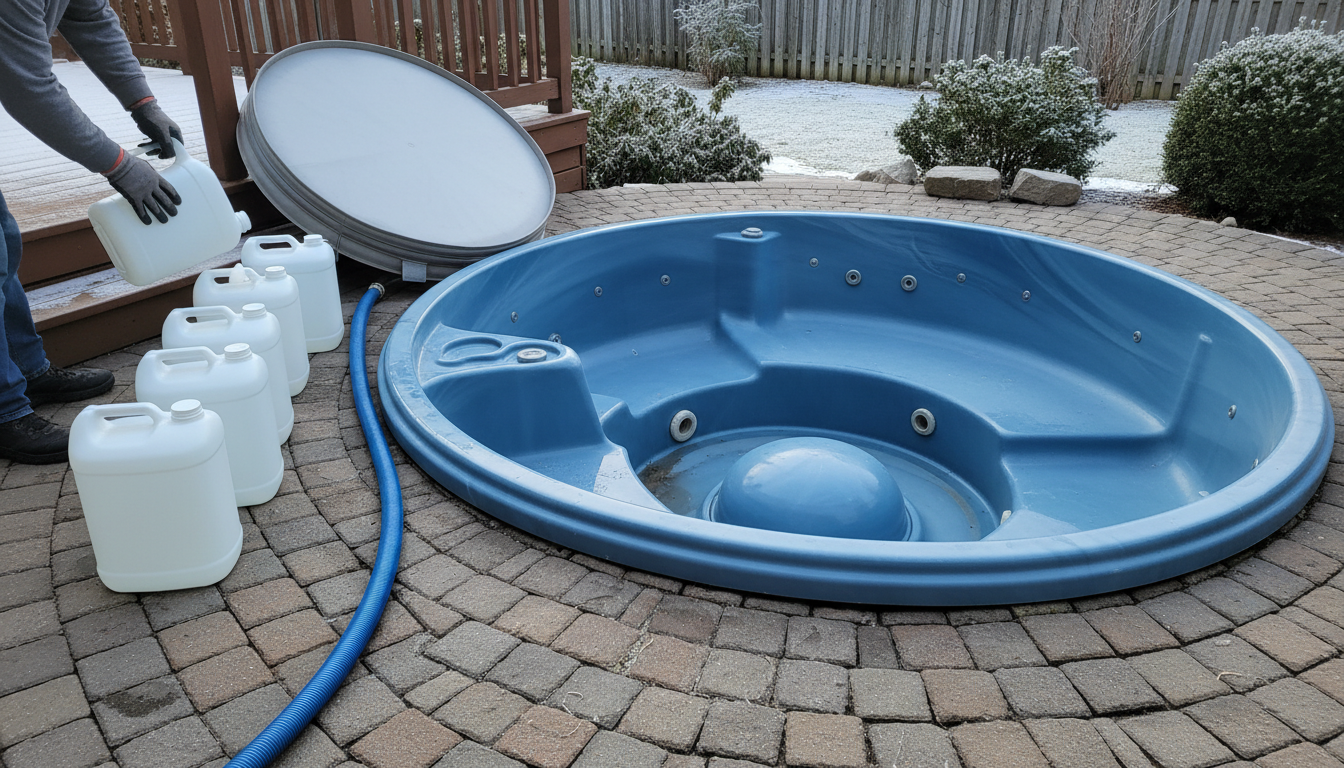
You drained the hot tub, blew out the lines, and felt pretty good about it – until you remembered the foot dome sitting at the bottom of the shell with its own jet ports, its own plumbing manifold, and its own hidden low points where water likes to sit all winter. That moment of doubt is well-founded, because the foot dome is the most commonly under-winterized component on a 6-person spa.
A 6-person hot tub with a dedicated foot dome typically requires 2 to 3 quarts of non-toxic propylene glycol antifreeze total for a complete winterization: roughly 1 to 1.5 quarts for the main jet lines, pump housing, and drain ports, plus a full additional quart specifically for the foot dome circuit. The rest of this article walks through why that breakdown makes sense, how to apply the antifreeze correctly, and what happens when people get the quantity wrong.
Why the Foot Dome Changes Your Antifreeze Math
Standard hot tub winterization guides are written around the main seating jets and the primary circulation pump. A foot dome is a separate plumbing zone. It has its own suction fitting or dedicated return manifold, its own set of jet ports, and – critically – its own low point that may not share a drain path with the main shell. That means blowing out the primary lines does almost nothing for trapped water sitting in the foot dome manifold. You have to treat it as a distinct circuit with its own antifreeze budget.
On most 6-person hard-shell tubs, the foot dome connects to either the main pump via a dedicated valve or to a smaller secondary pump. Either way, the plumbing run is typically 4 to 8 feet of 1.5-inch or 2-inch pipe, plus the manifold header itself. That circuit holds roughly 0.5 to 1 quart of water when full, which means you need at least 1 quart of antifreeze to displace and dilute that residual water down to a safe freeze point.
Propylene Glycol vs. Ethylene Glycol: Only One Is Acceptable
Use non-toxic propylene glycol antifreeze, full stop. It is the only product appropriate for spa plumbing. Automotive antifreeze – ethylene glycol – is toxic, and any residue left in jet lines or the foot dome manifold becomes a contamination risk when you refill in spring. Non-toxic propylene glycol is sold specifically as “swimming pool and spa antifreeze” and is pink or blue in color. It is rated to protect to -50 degrees F at full concentration, and to approximately -26 degrees F at a 50/50 dilution with water.
Why does the dilution point matter? Because when you pour antifreeze into a line that still has a small amount of residual water, you are not getting pure product – you are getting a mixture. If you add only half a quart to a foot dome circuit that still holds a quarter quart of water, your actual freeze protection may only extend to 10 to 15 degrees F, not the -50 degrees the label promises. That is why adequate volume is not optional.
Step-by-Step: How to Winterize a 6-Person Hot Tub With a Foot Dome
- Drain the tub completely. Use the drain spigot to empty the main shell, then use a wet/dry shop vac to pull water out of the footwell and foot dome cavity. Get as much water out physically before you touch a bottle of antifreeze.
- Blow out the main jet lines. Attach a shop vac (blowing, not sucking) or a compressor set to no more than 30 PSI to each jet port and force residual water back through the plumbing. Repeat for every seating zone.
- Blow out the foot dome circuit separately. The foot dome ports need their own blow-out pass. If the foot dome has a dedicated suction fitting, blow through it. If it is valve-controlled from the main pump, open only the foot dome valve and blow through the pump housing.
- Add 1 to 1.5 quarts of antifreeze to the main circuits. Pour roughly a cup into each primary jet port and allow it to gravity-feed down to the pump. Pour a separate measure directly into the pump housing drain port if your model has one accessible from the equipment bay.
- Add 1 quart of antifreeze to the foot dome circuit. Pour it directly into the foot dome’s suction port or into the jet ports themselves using a small funnel. You want the antifreeze to reach the lowest point of the manifold. On some tubs you can tip or press the foot dome slightly to encourage flow to the low end.
- Cap all ports and close all valves. Replace any drain plugs or jet fittings you removed. Close the foot dome diverter valve in a mid-position so antifreeze is not isolated in one segment.
- Cover the tub securely. A well-fitted hard cover prevents temperature swings from dramatically affecting the antifreeze’s performance over the winter months.
How Much Antifreeze by Tub Size and Circuit
Here is a worked example using a typical 6-person hard-shell tub with 40 jets across four seating zones plus a 10-jet foot dome:
- Main jet zones (4 zones): roughly 0.25 quarts per zone = 1 quart total
- Pump housing and circulation lines: 0.25 to 0.5 quarts
- Foot dome manifold and jet circuit: 1 quart
- Total: 2.25 to 2.5 quarts – call it 3 quarts to have a safety margin
Buying a single gallon jug (4 quarts) gives you enough product for the full tub plus a leftover reserve for any lines you need to retreat. That is the practical purchase quantity for this size and configuration.
| Circuit | Estimated Residual Water | Antifreeze Needed | Notes |
|---|---|---|---|
| Main jet lines (4 zones) | 0.5 to 0.75 quarts | 1 quart | Blow out first, then dose |
| Pump housing and heater manifold | 0.25 quarts | 0.25 to 0.5 quarts | Access via equipment bay drain plug |
| Foot dome circuit | 0.5 to 1 quart | 1 quart | Treat as a fully separate circuit |
| Total | 1.25 to 2 quarts | 2.25 to 2.5 quarts | Buy 1 gallon for margin |
Why These Numbers Matter for Your Decision
The residual water column tells you how much dilution your antifreeze faces before it even starts protecting anything. If you pour only 0.5 quarts into a foot dome holding 1 quart of trapped water, you have a 33/67 antifreeze-to-water ratio – which protects to roughly 0 degrees F, not the -26 degrees F you need in most northern climates. Using the full 1 quart in the foot dome pushes the ratio closer to 50/50 and gives you real, reliable freeze protection through a normal cold season.
Common Mistakes That Lead to Cracked Foot Dome Plumbing
- Skipping the foot dome blow-out: Many owners blow out the seating jets and call it done, leaving the foot dome manifold full of standing water that antifreeze alone cannot fully protect if the volume is too large.
- Using one quart for the entire tub: One quart is enough for a 2-person plug-in tub, not a 6-person spa with a foot dome circuit. Spreading too little product across too many lines dilutes everything below its rated protection point.
- Closing the foot dome diverter valve completely: Isolating the circuit means antifreeze you added elsewhere cannot migrate into the foot dome even if you wanted it to. Leave diverter valves in a mid or open position.
- Forgetting the heater manifold: The heater housing on most 6-person tubs holds a small water pocket. If your model has a drain plug on the heater manifold, open it and add a small pour of antifreeze there too.
If you are also thinking about whether to keep your tub running through winter rather than closing it down, running a hot tub in freezing weather is a real option that avoids the winterization process entirely for owners in milder climates – though it comes with its own chemical and energy management questions.
Choosing the Right Antifreeze Product
Look for a label that says “swimming pool and spa antifreeze,” “non-toxic,” and “propylene glycol.” The concentration should be listed as providing protection to at least -40 degrees F undiluted. Some brands – including AquaDoc, which makes a propylene glycol spa antifreeze for this exact use case – are sold in quart and gallon sizes so you can buy exactly what you need without overpaying for a 5-gallon drum. Check that the product is safe for acrylic shells and rubber gaskets, since some industrial-grade propylene glycol formulas contain corrosion inhibitors that can degrade spa equipment seals over time.
For a broader look at how hot tub chemistry and equipment interact across different scenarios, real-world hot tub questions answered with actual science is worth a read before you seal everything up for the season.
Frequently Asked Questions
How much antifreeze does a 6-person hot tub need for winter?
Most 6-person hard-shell hot tubs require 1 to 2 quarts of non-toxic propylene glycol antifreeze for the main plumbing circuits, split across all jet lines, drain ports, and the pump housing. A foot dome adds roughly one additional quart, bringing the typical total to 2 to 3 quarts. Buy a 1-gallon jug to cover the full tub with margin to spare.
Do I need a special antifreeze for a hot tub foot dome?
No special formula is required, but you must use non-toxic propylene glycol antifreeze rated to at least -50 degrees F at full concentration. Standard automotive antifreeze (ethylene glycol) is toxic and must never go into spa plumbing – it can contaminate surfaces and is hazardous if residue contacts skin during spring startup.
Can I skip antifreeze and just blow out the lines on a 6-person hot tub?
Blowing out the lines with a shop vac or compressor removes most of the water, but low spots and trapped pockets in foot dome plumbing almost always hold residual water that a blow-out cannot reach. Adding 1 quart of propylene glycol antifreeze after the blow-out is the standard safety backup, especially in climates that dip below 20 degrees F.
How do I get antifreeze into a hot tub foot dome specifically?
With the tub drained and lines blown out, pour 1 quart of non-toxic antifreeze directly into the foot dome’s suction port or into each foot jet port using a small funnel. If the foot dome has a diverter valve, set it to the open or mid position so the antifreeze can migrate to the lowest point of the circuit before you cap everything for winter.
What happens if I use too little antifreeze in a hot tub foot dome?
Underdosing means residual water dilutes the antifreeze above its effective freeze threshold. A true 50/50 mix of propylene glycol and water protects to about -26 degrees F, but a 25/75 mix only protects to around 0 degrees F. Any sustained cold snap below that level risks cracking the foot dome manifold or its connecting pipes, and manifold repairs on a 6-person tub can run $300 to $800 or more depending on access and parts.
The bottom line: a 6-person hot tub with a foot dome needs 2 to 3 quarts of non-toxic propylene glycol antifreeze, with a dedicated 1-quart dose reserved specifically for the foot dome circuit – treat it as its own plumbing system, blow it out first, and dose it separately, and you will not be calling a repair tech in April.