
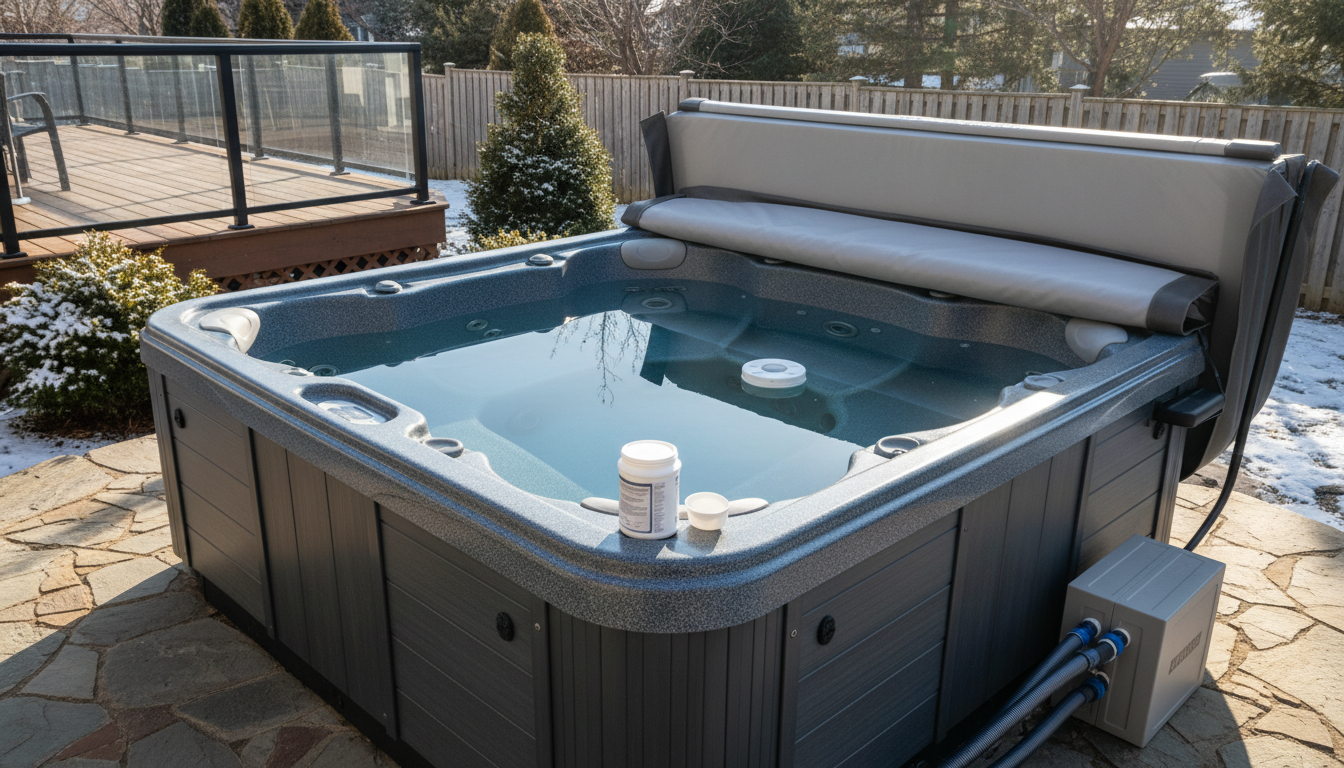
You finally blocked off a weekend to close your saltwater hot tub before the temperature tanks, and then you realize nobody talks about the bromine dose for a salt-system tub specifically. Standard closing guides assume a floater or inline feeder. Yours works differently, and the last thing you want is a science experiment growing in those jet lines all winter.
For a 6-person hard-shell hot tub holding 350 to 400 gallons with a saltwater bromine system, the winter shutdown target is 10 to 15 ppm of bromine – roughly double the normal soaking range. Getting there requires manually adding sodium bromide activator plus an oxidizer (or bromine granules directly), with your salt generator switched off. This article walks through the exact dose calculation, the order of operations for shutting down a salt system, common mistakes that leave water unprotected, and what to check before you button everything up.
Why a Saltwater System Changes the Closing Equation
A saltwater bromine system works by running a low concentration of sodium bromide salt through an electrolytic cell, which converts it to active bromine (hypobromous acid) on demand. During the season that is elegant, but at closing time the cell stops generating the moment you power it down. Whatever bromine is left in the water is all you have, and a normal in-season reading of 3 to 5 ppm will be gone within a week of sitting still. That is nowhere near enough to keep a sealed tub clean for two or three months of winter. The Blu Water Salt System Care guide from Minnesota Hot Tubs makes this point clearly: once the generator is off, the water needs a manually maintained residual to carry it through the dormant period.
The other wrinkle with salt systems is pH stability. Bromine performs best between pH 7.2 and 7.6. If the pH drifts above 7.8 – which happens easily in a tub that is no longer being used or tested – a significant fraction of your bromine becomes hypobromite ion, which is a much weaker sanitizer. Balance your water first, then shock to your closing level. Otherwise some of that bromine dose is just wasted.
How Much Bromine to Add: The Numbers
A 6-person hard-shell hot tub typically holds between 350 and 420 gallons, with 375 gallons being a reasonable midpoint for a mid-size acrylic shell. Here is how to calculate your shutdown dose:
- Test your current bromine level. If you are already at 3 ppm and want to hit 12 ppm, you need to raise it by 9 ppm.
- Use the 1 ppm per 375-gallon rule. A rough rule of thumb: raising 375 gallons by 1 ppm of bromine takes approximately 0.4 oz (about 11 grams) of sodium bromide activator, followed by enough oxidizer to convert it. If your tub holds closer to 400 gallons, scale slightly up.
- Do the math. To raise 375 gallons from 3 ppm to 12 ppm – a 9 ppm lift – you need roughly 3.5 oz of sodium bromide (about 6 to 7 tablespoons) plus a corresponding non-chlorine shock dose at the label rate for 375 gallons.
- Or use bromine granules directly. If your closing product is a combined bromine granule (BCDMH-based), add 3 to 4 oz to a 375-gallon tub to reach the 10 to 15 ppm target. Check your specific product label because concentration varies by brand.
Say your tub reads 4 ppm and holds exactly 400 gallons. You want to land at 13 ppm, so you need a 9 ppm increase. Multiply: 9 ppm x 0.4 oz per ppm x (400/375) correction factor = roughly 3.8 oz of sodium bromide activator, plus oxidizer. Round up to 4 oz, add it with the jets running, and retest after 30 minutes. That is the kind of specific worked number that keeps you from guessing.
For a quick reference, here is how the math stacks up across common tub sizes near the 6-person range:
| Tub Volume | Current Bromine | Target Bromine | Sodium Bromide Needed | Non-Chlorine Shock (approx.) |
|---|---|---|---|---|
| 300 gallons | 3 ppm | 12 ppm | ~2.9 oz | ~1.5 oz |
| 375 gallons | 3 ppm | 12 ppm | ~3.6 oz | ~2 oz |
| 400 gallons | 4 ppm | 13 ppm | ~3.8 oz | ~2 oz |
| 420 gallons | 4 ppm | 14 ppm | ~4.3 oz | ~2.2 oz |
Why These Differences Matter
Even a 70-gallon difference between tub sizes changes your dose by nearly half an ounce of sodium bromide – enough to land you below 10 ppm if you dose for a smaller tub than you actually have. Check your owner’s manual or measure your actual volume (length x width x average depth x 7.48 for a rough rectangular estimate) rather than guessing from seat count alone.
Step-by-Step Closing Sequence for a Saltwater Bromine Tub
- Step 1: Test and balance water chemistry first. Adjust pH to 7.2 to 7.4, total alkalinity to 80 to 120 ppm, and calcium hardness to 150 to 250 ppm. Do this the day before you add your shock dose.
- Step 2: Turn off the salt generator. Power down the electrolytic cell completely. Do not add chemicals through a running generator – it distributes unevenly and can shorten cell life.
- Step 3: Add sodium bromide activator with jets running. Pour the calculated amount directly into the water near a jet return, not into the skimmer, with the jets on high.
- Step 4: Follow immediately with oxidizer. Add non-chlorine shock (potassium monopersulfate) or a chlorine-based shock at the label dose for your volume. This converts the bromide ions into active hypobromous acid.
- Step 5: Circulate for 30 to 45 minutes. Run all jets, including any low-flow or seat jets, to push treated water through every branch of the plumbing. A 6-person tub with 40-plus jets needs the full 45 minutes. The Salt Bromine Hot Tub Maintenance Checklist from Dazzle Water Care recommends ensuring full plumbing circulation before any shutdown step.
- Step 6: Retest and confirm 10 to 15 ppm. Use a bromine test kit or strips rated for that range. According to the ideal bromine level guide at WaterCare Club, the 10 to 15 ppm window gives you meaningful protection without corroding internal components over a long closure.
- Step 7: Drain, blow out lines, and cover – or leave filled with cover on, depending on your climate. See below.
Drain and Winterize vs. Leave It Filled
If your climate drops below 32 degrees F for more than a few nights, drain the tub fully, blow out the jet lines with a shop vac or compressor, and remove any remaining water from the pump and heater housing. A filled tub with no active heat and circulation will freeze, and cracked jet fittings or a cracked pump volute are expensive fixes. Polynesian Pool and Spa’s winterizing guide walks through the drain-and-blow-out process in detail if you want the full mechanical steps alongside this chemical guide.
If you are in a mild climate and plan to leave the tub filled but unused, that 10 to 15 ppm closing dose is critical. The bromine will dissipate slowly, so check the level monthly and add maintenance doses of sodium bromide plus oxidizer to keep it above 5 ppm. Keeping the cover on tightly slows chemical loss significantly.
If you are not closing at all but just soaking less in winter, a useful reference is our piece on winter hot tub use and keeping your spa running in cold weather, which covers the maintenance differences between active winter use and a true dormant closure.
Common Mistakes That Leave Your Tub Unprotected
- Skipping the oxidizer step: Sodium bromide alone does nothing until it is oxidized to active bromine. Many owners add bromide and walk away, then wonder why their test strip reads zero. You always need the oxidizer to activate it.
- Leaving the salt cell on: Adding a large shock dose through an active cell stresses the electrode plates and creates uneven chemistry in the water. Always switch the generator off first.
- Testing too soon: Bromine readings taken within 5 to 10 minutes of adding shock are not accurate. Wait at least 20 to 30 minutes after circulation before testing.
- Ignoring pH: A closing dose added to water at pH 8.0 may read fine on a strip but deliver far less actual sanitizing power than the same dose added at pH 7.3. Fix pH first, every time.
- Dosing by seat count instead of actual gallons: “6-person” is a marketing term. Actual capacity varies from 300 to over 450 gallons depending on the shell design. If you are dosing by seat count you may be off by 30 percent or more. AquaDoc’s bromine products list dose rates by gallon range specifically to avoid this problem.
If you have ever closed the tub, come back in spring, and found a cloudy, foul-smelling mess, one of those five mistakes is almost certainly the reason. For a deeper look at why sanitizer levels collapse in a sitting tub, our article on why your hot tub won’t hold a sanitizer reading covers the chemistry behind sanitizer demand and depletion.
Frequently Asked Questions
How much bromine do I add when closing a 6-person saltwater hot tub for winter?
Target 10 to 15 ppm of active bromine. For a 375-gallon tub starting at 3 to 4 ppm, that means roughly 3.5 to 4 oz of sodium bromide activator plus a non-chlorine shock dose sized for your volume, added with the salt generator off and jets running. Retest after 30 minutes to confirm you landed in range before covering or draining.
Do I need to turn off my salt system before adding the shutdown bromine dose?
Yes, always turn the electrolytic cell off before adding your closing dose. Running the generator while dumping in a large shock dose creates uneven distribution and can stress the cell plates over time. Add chemicals manually, circulate for 30 to 45 minutes, confirm the reading, then power down fully.
What bromine level should a hot tub be at before closing for winter?
10 to 15 ppm is the standard target for a winter closure. Normal soaking range is 3 to 5 ppm, but the elevated closing dose suppresses bacterial and biofilm growth during weeks or months of sitting water. Do not let anyone soak at those levels – it is a preservation dose, not a maintenance level.
Can I leave my saltwater hot tub filled all winter instead of draining it?
Only if temperatures in your area reliably stay above freezing or you have a freeze-protection system that cycles the pump automatically. In climates where air temps drop below 32 degrees F, a filled, inactive tub will freeze and can crack the shell, plumbing, or pump housing. If you are in a true cold-weather region, drain completely and blow out the lines.
How long should I circulate the bromine before closing the hot tub?
Run the jets for at least 30 minutes after adding the shutdown dose. For a 6-person tub with 40 or more jets, extend that to 45 minutes so the treated water reaches the far ends of every plumbing branch. Skipping this step is one of the most common reasons owners find unprotected water in the lines when they reopen in spring.
The short answer: 10 to 15 ppm, manually added with the salt generator off, circulated for at least 30 to 45 minutes. Get that number confirmed on your test kit before you walk away, and your plumbing will stay clean until spring.