
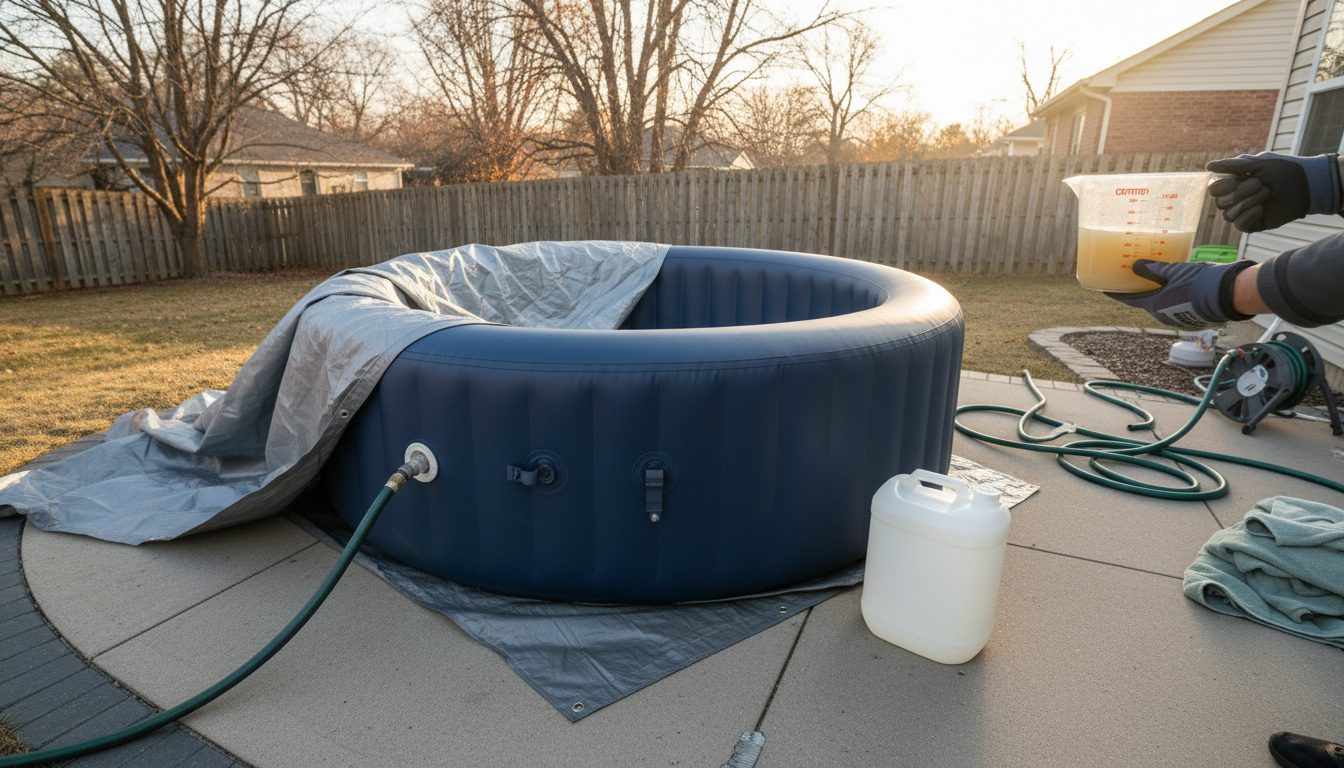
You got through the whole season, you are finally ready to close the tub down for winter, and now you are standing there wondering whether you actually need to add chemicals before you drain it – and if so, how much. It feels like the kind of question that should have a simple answer, but the internet keeps throwing vague ranges at you without telling you what they mean for your specific tub.
For a 4-person inflatable hot tub, the target is a bromine level of 10 to 20 ppm in the water before you drain. That is roughly double your normal maintenance level, and it gives the water a strong final sanitizing pass through the shell, jets, and plumbing before everything goes dormant for months. This article walks you through how to get there: the exact amounts to add based on your tub’s volume, how long to let it work, and what to check before you pull the drain plug.
How Many Gallons Is a 4-Person Inflatable Hot Tub?
Before you measure anything, you need to know your tub’s water volume. Most 4-person inflatable hot tubs hold between 200 and 300 gallons, with 220-250 gallons being the most common range for round and square models in that seat count. If you can find your tub’s manual or product page, it will list the exact volume. If you cannot, check the specs on the manufacturer’s website or look for a water capacity label on the side of the tub near the drain.
Why does this matter so much? Because every bromine dose is calculated per gallon. If you assume your tub holds 300 gallons when it actually holds 220, you will overdose. If you underestimate, you will not hit 10 ppm. Getting the volume right is the one step that makes every number in this article actually work for your tub.
Target Bromine Level for Winter Closing
Normal hot tub bromine maintenance runs between 3 and 5 ppm. For a winter shutdown, you want to push that to 10 to 20 ppm – high enough to kill any bacteria, organic residue, or biofilm that has built up in the water and on the shell over the season. This elevated dose also reaches into the jet plumbing and hose connections, where water tends to linger even after draining.
You do not need to go higher than 20 ppm. Beyond that, you are wasting product and risking irritation to the vinyl shell material. Stick to that 10-20 ppm window, confirm it with a test strip or liquid kit, and you are in good shape.
Exact Bromine Amounts to Add
Bromine products work differently depending on whether you are using granules, tablets, or a two-part sodium bromide system. Here is how each one breaks down for a 4-person inflatable tub at the typical 220-250 gallon volume.
| Product Type | Amount for 220 Gallons | Amount for 250 Gallons | Notes |
|---|---|---|---|
| Bromine granules (BCDMH) | 1.5 to 2 oz (3-4 tbsp) | 2 to 2.5 oz (4-5 tbsp) | Dissolve in a bucket of water first, then add |
| Bromine tablets in a floater | 2-3 tablets, 24-48 hrs before drain | 3-4 tablets, 24-48 hrs before drain | Set floater to fully open to release faster |
| Sodium bromide + MPS activator | 2 tbsp sodium bromide + 2 oz MPS | 2.5 tbsp sodium bromide + 2.5 oz MPS | Add sodium bromide first, activate after 10 min |
Why These Differences Matter
Bromine granules are the fastest route to a specific ppm – you dissolve them, add them, and test an hour later. Tablets work more slowly but are convenient if you already have them on hand from regular maintenance; the trade-off is that you need to give them 24-48 hours to raise the water to the 10-20 ppm range. The sodium bromide plus MPS activator method is what many hot tub owners using a bromide bank system already have on hand, and it works well as long as you add the activator after the bromide, not at the same time.
A worked example: your tub holds 240 gallons and your current bromine level is 2 ppm. You need to raise it by roughly 15 ppm to hit the middle of the 10-20 ppm target range. Using granules, that is about 1.75 oz, or just under 3.5 tablespoons. Dissolve them in a plastic cup of warm water, pour evenly around the tub with the jets running, and test after 60 minutes. Adjust from there if needed.
Step-by-Step: Adding Bromine Before You Close
- Test the current water chemistry. Check bromine, pH, and total alkalinity. Your pH should be 7.4-7.6 and alkalinity 80-120 ppm before adding any sanitizer. Bromine works much less efficiently outside that pH range, so correct chemistry first if needed.
- Calculate your dose. Use your tub’s actual gallon count and the table above to figure out how much bromine to add to reach 10-20 ppm from your current level.
- Dissolve granules or load a floater. Never add granules directly to the tub dry – always pre-dissolve in a bucket of warm water. If using tablets, load the floater and set it to fully open.
- Add the bromine with jets running. Pour the dissolved granules around the perimeter, or drop the floater in. Run the jets for 15-20 minutes to circulate the chemical through the plumbing.
- Let it soak for 24-48 hours. Run the jets for 15-20 minutes two or three more times during this window. This pushes treated water through the jet heads and any connected hoses.
- Test again before draining. Confirm bromine is in the 10-20 ppm range. If it has dropped below 10 ppm, add a small top-up dose and wait another few hours.
- Drain, rinse, and dry thoroughly. Once the chemical soak is done, drain completely, rinse the shell with fresh water, and let it air dry before folding and storing the tub.
Common Mistakes That Undermine the Whole Process
- Skipping the pH adjustment: Bromine loses roughly half its effectiveness when pH climbs above 7.8. If your water is alkaline heading into the shutdown dose, you are burning through chemical without actually sanitizing.
- Draining too quickly after adding bromine: Adding bromine and draining within an hour defeats the purpose. The 24-hour minimum soak is what lets the chemical reach biofilm inside the plumbing, not just the water itself. If you find yourself struggling to maintain any bromine reading at all even during regular use, it is worth reading about why your hot tub won’t hold a sanitizer reading before you close – there may be an underlying organic load issue driving that.
- Not running the jets during the soak: Still water only treats still water. The jets push treated water into the lines and jet housings, which is exactly where bacteria survive the winter if left untreated.
- Using leftover tablets without testing first: If you drop three tablets in and the water hits 35 ppm, that is not better – it can bleach and degrade the vinyl shell. Always test and confirm you are in range before you walk away.
- Leaving water in the tub after draining: Any pooled water in the bottom of the shell or in hose connections can freeze and crack fittings. After draining, tilt the tub to remove every drop, then let it air dry.
What Happens If You Skip the Bromine Step Entirely?
Draining without a final sanitizer dose means any bacteria or organic residue coating the shell goes straight into storage. Over a winter, that residue does not just sit there – it dries onto the vinyl, hardens, and can cause discoloration and odor by spring. Biofilm inside the jet plumbing has months to establish itself undisturbed. When you refill in spring, that contamination is the first thing that hits the fresh water, which is why so many people open their tub in April to find instant foam, cloudiness, or a reading they cannot get under control. If you plan to keep soaking rather than close the tub this winter, the chemistry approach is different – see how to keep using your hot tub safely through freezing temperatures for that side of things.
AquaDoc makes a bromine granule formula specifically sized for hot tub volumes that dissolves without cloudiness, which makes it a practical choice for this kind of precision dosing on a smaller tub where every ounce counts.
Frequently Asked Questions
How much bromine do I add to a 4-person inflatable hot tub before closing for winter?
Add enough bromine to bring the water to 10-20 ppm before draining. For a typical 220-250 gallon tub, that is roughly 1.5 to 2.5 oz of BCDMH granules, depending on your starting level. Always test before and after adding, and give the water at least 24 hours to circulate before you drain.
What bromine level should a hot tub be at before winterizing?
The target bromine level at shutdown is 10 to 20 ppm – about double the normal maintenance range of 3-5 ppm. This elevated level gives the water a strong final sanitizing pass through the shell and plumbing before the tub goes into storage for the season.
Can I just drain my inflatable hot tub without adding chemicals first?
You can drain without chemicals, but it leaves bacteria, biofilm, and organic residue on the shell and inside the jet plumbing. That contamination dries in place over winter and causes cloudiness, foam, and odor when you refill in spring. A 24-48 hour bromine soak before draining prevents all of that with very little extra effort.
How long should bromine sit in the water before I drain the hot tub for winter?
Let the treated water soak for at least 24 hours, and ideally 48 hours. Run the jets for 15-20 minutes two or three times during that window to push the treated water through the plumbing lines and jet housings. Testing at the end of the soak confirms you stayed in the effective 10-20 ppm range throughout.
Is bromine or chlorine better for closing an inflatable hot tub in winter?
Bromine is generally the better choice for vinyl inflatable tubs because it is less harsh on the shell material and stays active across a wider pH range. If bromine is already your regular sanitizer, sticking with it for the shutdown dose keeps things simple and avoids any chemical interaction from switching products at the last step.
For a 4-person inflatable hot tub, the bromine shutdown dose is 10-20 ppm, achieved with roughly 1.5 to 2.5 oz of granules for a 220-250 gallon tub, followed by a 24-48 hour soak with the jets running before you drain. Get that right, and your tub will be clean, odor-free, and ready to go when you fill it back up in spring.