
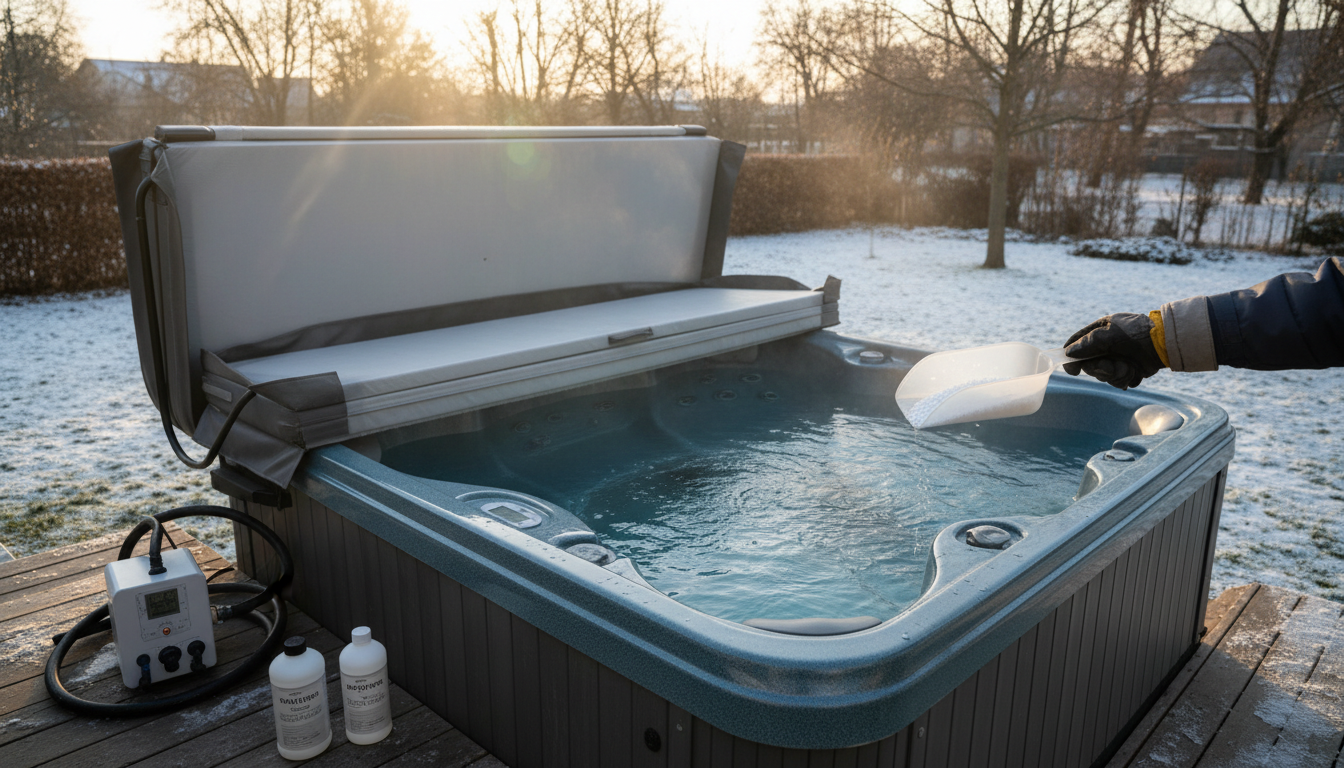
You’ve already figured out you’re not just doing a water change – you’re putting your hot tub to bed for the winter, and you want to do it right. Closing a 2-person hard-shell hot tub with a saltwater system adds a layer of complexity that most generic winterizing guides skip right over.
The short answer: for a 2-person hard-shell hot tub holding 300-350 gallons, you need to bring your bromine level to 10-20 ppm at shutdown – roughly 2-4 times your normal operating level of 3-5 ppm. That takes about 1.5 to 2 oz of bromine-based shock (or 2-3 tablespoons of sodium bromide activated with a non-chlorine oxidizer), applied manually after turning off your salt generator. This article walks through why that number matters, how your salt system changes the process, and the exact sequence of steps to close your tub without leaving anything to chance.
Why a Saltwater System Changes the Shutdown Equation
A standard bromine salt generator works by electrolyzing sodium bromide dissolved in your water, converting it into active bromine on demand. During normal operation, it’s dialed in to hold 3-5 ppm, which is the ideal range for regular hot tub use. That’s great for a Saturday soak, but it’s not remotely enough protection for water that will sit stagnant through a winter with no heat, no circulation, and no one testing it.
The second issue is the cell itself. Your salt cell contains titanium plates coated in precious metal oxides, and if water freezes inside it, those plates can crack or delaminate. Running the generator right up until closing day also deposits scale on the cell if you haven’t balanced calcium hardness beforehand. The upshot: turn the generator off before adding your shutdown dose, and winterize the cell separately.
How Much Bromine to Add: The Exact Math for a 2-Person Tub
Most 2-person hard-shell hot tubs hold between 300 and 350 gallons. A few compact models come in around 250 gallons, and some “romantic spa” designs push toward 400. Know your actual volume before you dose – check the owner’s manual or look for the spec plate on the cabinet exterior.
Here’s a worked example. Say your tub holds 325 gallons and your current bromine reading is 3 ppm. You need to raise it to at least 10 ppm, so you’re adding 7 ppm. To raise bromine by 1 ppm in 1,000 gallons, you need roughly 0.75 oz of sodium bromide plus an activating oxidizer. Scaled down to 325 gallons and 7 ppm:
- Sodium bromide needed: 0.75 oz x (325/1000) x 7 = approximately 1.7 oz
- Non-chlorine oxidizer (activator): follow the product label, typically 1-2 oz per 500 gallons at shock dosage
If you’re using a pre-formulated bromine shock tablet or granule product instead of the two-part sodium bromide system, dose at the “shock” rate on the label – usually 1-2 oz per 300-400 gallons – and test after 30 minutes to confirm you’ve hit at least 10 ppm. AquaDoc’s bromine shock granules are one option pool and spa owners use for exactly this kind of one-time boost, since they dissolve quickly without clouding the water before you drain.
Target 10-15 ppm if you’re draining the tub after shutdown. Target the upper end, 15-20 ppm, if you’re leaving a small amount of water in the lines for any reason – though for a hard-shell tub in a freezing climate, full drain and blowout is always the safer call.
Balancing Chemistry Before You Add the Shutdown Dose
Don’t add the shutdown bromine to water that’s already out of balance. If your pH is high (above 7.6), bromine becomes dramatically less effective – you’ll burn through your shutdown dose in hours instead of weeks. Get your chemistry in order first, in this sequence:
- Adjust pH to 7.2-7.4. Lower pH means bromine works harder. Use a pH decreaser (dry acid or muriatic acid diluted and added slowly) to bring it down if needed.
- Set total alkalinity to 80-120 ppm. Alkalinity buffers pH, so fix it before pH or you’ll chase your tail.
- Check calcium hardness: 150-250 ppm. Low calcium hardness lets water pull calcium from your shell and plumbing. Adjust if needed before closing.
- Turn off the salt generator. Do this before adding the shutdown dose.
- Add the bromine shock dose with jets running.
- Run the jets for 15-20 minutes to circulate treated water through every jet line and the heater plumbing.
- Test and confirm 10-20 ppm bromine before moving to drain steps.
Skipping the chemistry balance is one of the most common closing mistakes. The other one is adding the shock dose and immediately draining – that 15-20 minute circulation window is what actually sanitizes your jet lines and prevents biofilm from taking hold over winter.
Winterizing the Salt System Itself
Your bromine salt generator needs its own winterizing steps separate from the water chemistry. After you’ve dosed and circulated, here’s what to do with the system:
- Remove the salt cell: Unplug and pull the cell from its housing. Rinse it with fresh water, let it dry completely, and store it indoors above freezing. Even a single hard freeze can crack the housing or warp the electrode stack.
- Drain the flow chamber: Any water left in the cell housing or flow switch housing can freeze and split the plastic. Use a shop vac or blow it out with compressed air.
- Store the controller indoors if possible: Some topside controllers and inline units are rated for outdoor winter storage, but cold snaps below -20F can damage LCD displays and PCBs. When in doubt, bring it inside.
- Record your salt level: Note the current salt ppm before closing (typically 1,500-2,500 ppm for hot tub systems). You may need to top up or partially drain and refill in spring depending on how much fresh water you use to rinse out the tub.
For the full physical drain and blowout sequence – including how to clear jet lines and the heater bypass – this winterizing walkthrough from Polynesian Pool and Spa covers the mechanical steps clearly and is worth reading alongside your chemical checklist.
Timing: When to Add the Dose Before You Drain
Add your shutdown bromine dose 12-24 hours before you drain, not 5 minutes before you pull the plug. The water needs time to circulate through all the plumbing and for the bromine to do its work on any biofilm or bacteria lurking in the jets and heater lines. If you dose and drain the same afternoon, you’ve essentially wasted your chemicals.
Why 24 hours specifically? Bromine builds up a protective reservoir in the water called a “bromamine reserve” that keeps working even as free bromine drops slightly. Giving it a full day at 10-20 ppm ensures that every surface the water touches – the shell, the jets, the heater housing, the plumbing – is thoroughly sanitized before you leave it dark and cold for three or four months. Buds Pools’ winter closing guide echoes this timing and includes a good reminder about running the blower (if your tub has one) to push treated water into the air channels too.
If you’re not draining fully and instead plan to keep the tub in a minimal-heat “away” mode through winter – which works in milder climates – check out this guide on winter hot tub use for how to manage chemistry when the tub stays active in the cold. A full drain-and-close is a different process entirely from frost-protection mode.
Common Mistakes That Leave Your Tub Vulnerable
- Relying on the salt generator for shutdown: The generator cannot reach 10-20 ppm on its own at normal settings. Always add a manual shock dose at closing.
- Skipping pH adjustment: Bromine at pH 7.8 is only about 30% as effective as at pH 7.2. Bring pH down first, every time.
- Leaving the cell in the tub: A salt cell left in a frozen tub is almost guaranteed to crack. Remove it and store it inside.
- Not running jets after dosing: Dead-leg jet lines that never see your shock dose are where biofilm survives the winter and greets you with a foam-filled, funky-smelling tub in spring. If your tub has been struggling to hold a sanitizer reading even before closing, that’s worth investigating – the causes are usually the same ones that complicate your winter dose.
- Adding chemicals to cold water: Heat your tub to at least 80F before adding the shutdown dose. Chemicals dissolve and circulate poorly in cold water, and you won’t get an accurate test reading.
If you’ve been fighting sanitizer issues before closing, this breakdown of why hot tubs won’t hold a sanitizer reading is worth a read before you finalize your closing chemistry – some of those same root causes (high organic load, biofilm in lines, pH swings) will affect how much shutdown dose you actually need.
Quick Reference: 2-Person Saltwater Hot Tub Shutdown Doses
| Tub Volume | Target Shutdown Bromine | Sodium Bromide (approx.) | Bromine Shock Granules (approx.) |
|---|---|---|---|
| 250 gallons | 10-20 ppm | 1.0-1.5 oz | 1.0-1.5 oz |
| 300 gallons | 10-20 ppm | 1.3-1.8 oz | 1.3-1.8 oz |
| 350 gallons | 10-20 ppm | 1.5-2.0 oz | 1.5-2.0 oz |
| 400 gallons | 10-20 ppm | 1.8-2.4 oz | 1.8-2.4 oz |
These ranges assume you’re starting from a normal operating level of 3-5 ppm and targeting a minimum of 10 ppm. If your current bromine is near zero, add toward the higher end of each range and retest before draining.
Frequently Asked Questions
How much bromine do I add when closing a 2-person saltwater hot tub for winter?
For a 300-350 gallon 2-person hard-shell hot tub, add enough bromine to reach 10-20 ppm – roughly 1.5 to 2 oz of bromine shock granules or an equivalent sodium bromide plus oxidizer combination. Always test after 30 minutes of jet circulation and adjust before draining. Do not rely on the salt generator to hit this level; add the dose manually.
Do I need to turn off the salt system before adding the bromine shutdown dose?
Yes, turn off your bromine salt generator before adding the shutdown dose. The generator is calibrated for a 3-5 ppm maintenance level and cannot reliably produce the 10-20 ppm shutdown concentration. Running it during the process also risks over-stressing the cell and produces inaccurate readings on the controller display.
What bromine level should a hot tub be at before closing for winter?
Target 10-20 ppm free bromine at closing. Normal operating range is 3-5 ppm, so your shutdown dose is about 2-4 times the maintenance level. The elevated concentration protects the shell, jets, and plumbing through weeks or months without active circulation or heating.
Can I just let the salt system run instead of adding a manual bromine dose at closing?
No. A bromine salt generator at normal settings will not reach 10-20 ppm, and leaving it running as you close also puts the cell at risk of freeze damage. You need a manual shock dose at closing, followed by powering down and physically removing the salt cell for indoor storage before temperatures drop below freezing.
How long before draining should I add the shutdown bromine dose to a 2-person hot tub?
Add the shutdown dose 12-24 hours before draining, with jets running for at least 15-20 minutes after dosing. This gives bromine time to circulate through jet lines, the heater plumbing, and any blower channels, fully sanitizing surfaces before the tub sits empty all winter. Dosing and draining the same day leaves jet lines undertreated.
Bottom line: for a 2-person hard-shell saltwater hot tub, hit 10-20 ppm bromine manually before closing, balance your water first, turn off and remove the salt cell, and give the chemicals a full 12-24 hours to circulate before you drain. That’s the sequence that keeps your tub clean and your equipment intact until spring.