
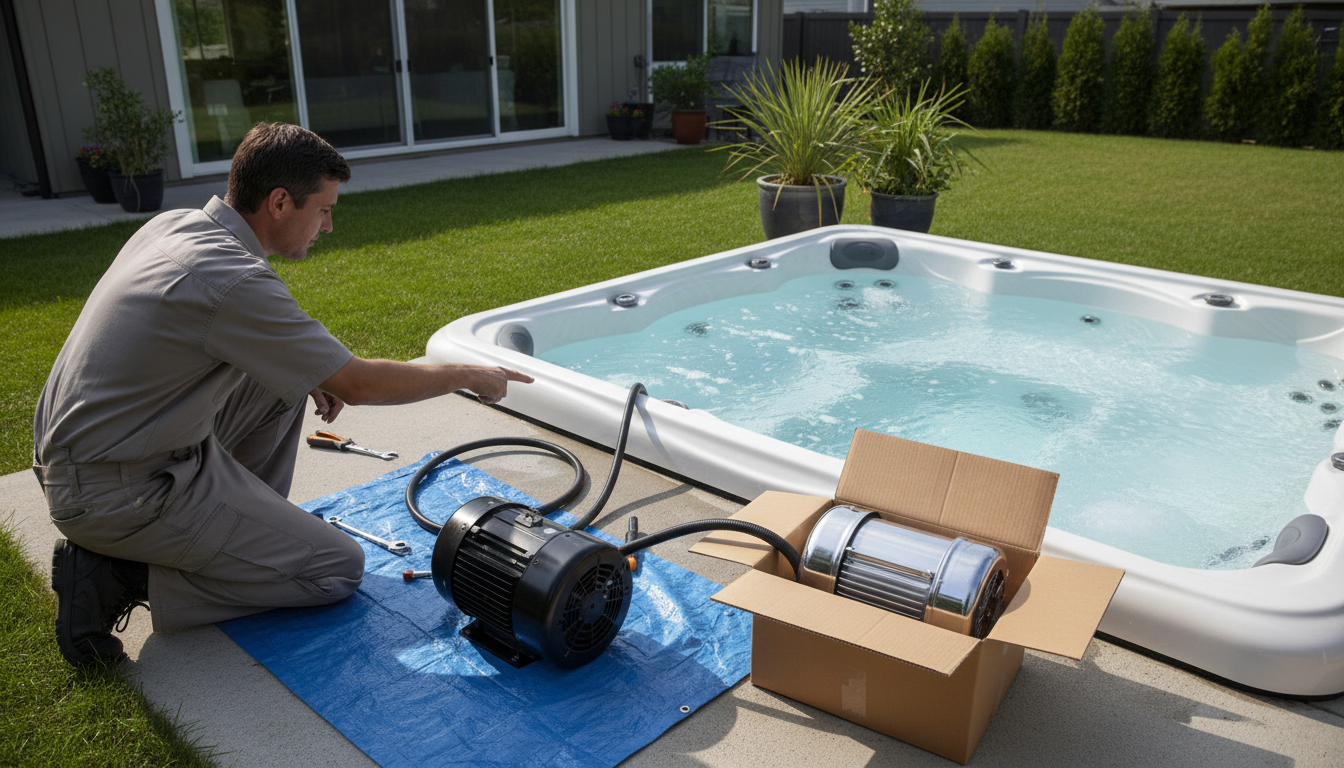
You turn on the blower, wait for that satisfying rush of air bubbles through the water, and get – nothing. Maybe a hum, maybe a burning smell, maybe a tripped breaker. Whatever the symptom, a dead blower motor is one of those spa problems that goes from annoying to expensive-feeling fast, especially when you have no idea what the repair should actually cost.
The short answer: replacing a hot tub blower motor typically costs $150 to $600 total, with parts running $80 to $300 and labor adding $75 to $200 on top of that. The rest of this article walks through what drives that range, how to get an accurate quote for your specific tub, when to DIY it, and when to call a tech – so you can walk into this repair with a realistic number in your head.
What a Hot Tub Blower Motor Actually Does
The blower motor is a separate component from your jet pump. It forces air – not water – through a dedicated line and into air injectors built into the shell floor and seats. That’s what creates the soft, fizzy bubbles you feel against your back and legs. The jet pump handles pressurized water massage; the blower handles the aeration effect. They’re controlled independently, which is why your jets can work perfectly while your blower sits dead.
Most residential hot tubs use a 1 HP or 1.5 HP blower running on either 120V or 240V, depending on the spa’s overall electrical setup. The motor is housed in the equipment compartment, usually behind a side panel, and connects directly to the spa pack’s relay. Because it’s an air-only device, it doesn’t see water – but it does see heat, moisture, and continuous on/off cycling, all of which wear it out over time.
Hot Tub Blower Motor Replacement Cost Breakdown
Parts Cost: $80 to $300
The blower motor itself is the main expense. Here’s how the price range breaks out by category:
- Generic/compatible replacement motors: $80 to $140. These are aftermarket units built to common HP and voltage specs. They work fine in most tubs and are the go-to option when the original brand is discontinued.
- OEM-compatible branded motors: $140 to $220. Motors sold under names tied to specific spa brands or with guaranteed compatibility for Balboa, Gecko, or similar control systems. Worth the premium if your spa pack is finicky about amperage draw.
- Premium or specialty motors: $220 to $300+. Higher-output models, variable-speed blowers, or units for swim spas and commercial-grade hot tubs with larger plumbing.
Before ordering, pull the label off your existing blower. You need to match horsepower, voltage (120V vs 240V), amperage, and the frame size (the bolt pattern that holds it to the housing). Getting voltage wrong is the most common ordering mistake – a 120V motor wired to a 240V circuit will fail immediately.
Labor Cost: $75 to $200
A spa technician typically charges $75 to $150 per hour, and a blower motor swap is usually a one-to-two hour job. That puts labor in the $100 to $200 range in most markets. Some techs charge a flat rate for this specific repair instead, often around $125 to $175 including the service call, which can save you money if they’re efficient. According to HomeGuide’s hot tub repair cost data, the average total cost for a spa motor replacement – parts and labor combined – sits around $250 to $500 for most homeowners.
A Real-World Example
Say you own a six-person 240V hard-shell hot tub and the 1.5 HP blower quits after eight years. A compatible replacement motor runs $160 online. Your local spa tech charges a $75 service call plus $100 per hour. The swap takes 90 minutes. Total bill: $160 in parts, $225 in labor, coming out to roughly $385. That’s solidly mid-range, and it’s the kind of number you should expect for a standard residential tub in most U.S. markets.
What Drives the Price Up or Down
- Tub age and brand: Older tubs from discontinued brands often require hard-to-find motors, which pushes parts costs up. A tub that’s 15+ years old may need a custom-fit motor that runs $250 or more.
- Access: Some equipment bays require removing cabinetry panels or even a portion of the decking to reach the motor. What should be a one-hour job becomes two or three hours if access is blocked.
- Local labor rates: Spa technicians in major metro areas or coastal markets charge more. Rural areas may have fewer techs available, which can inflate rates or require a travel fee.
- Capacitor vs. full motor: If your motor hums but doesn’t spin, the capacitor – a small $15 to $40 component – may be all that’s failed. A good technician will test this first before recommending a full motor replacement.
- Control system compatibility: If your new motor’s amperage draw doesn’t match what the spa pack relay expects, you may need a relay swap too. This adds $50 to $100 in parts plus additional labor time.
Signs Your Blower Motor Has Failed
Diagnosing the blower correctly before you buy parts matters. For a thorough walkthrough of what to check before assuming the motor itself is the problem, this spa air blower troubleshooting guide covers the diagnostic steps in detail. The quick list of what to look for:
- No airflow, no sound: The motor isn’t receiving power or has seized completely. Check the relay on your spa pack first.
- Humming without spinning: The motor is receiving power but can’t turn – often a failed start capacitor rather than the whole motor.
- Burning smell from the equipment bay: The motor windings are overheating. Replace the motor before it takes out the relay or the spa pack.
- GFCI trips specifically when the blower runs: A grounding fault in the motor. Don’t reset and ignore this – it’s a safety issue that needs immediate attention.
- Intermittent airflow: The motor runs sometimes but cuts out, often heat-related, meaning the motor is on its way out but not fully dead yet.
DIY vs. Hiring a Technician
The mechanical side of a blower motor swap is genuinely manageable for a handy homeowner – typically four bolts holding the motor to its mounting plate and a few wire terminals. The part that requires care is the wiring. You must match the wire connections exactly from the old motor to the new one, and the circuit must be fully de-energized before you touch anything. If you’re comfortable with basic electrical work and can photograph the existing wiring before disconnecting it, this is a reasonable DIY job. If you’re not certain, the $100 to $200 labor cost is cheap insurance compared to damaging your spa pack – which can run $400 to $900 to replace, as covered in the Hot Tub Spa Pack Replacement Cost breakdown on this site.
One thing worth checking before any motor work: make sure your water chemistry is balanced and not contributing to equipment stress. Corrosive water (low pH, high chloramines) can accelerate wear on electrical components in the equipment bay. If your hot tub’s pH has been running high or swinging, get that dialed in alongside the motor repair. AquaDoc makes a pH reducer formulated for hot tubs that a lot of spa owners use to keep that number stable between service calls.
Blower Motor vs. Full Blower Assembly: What’s the Difference?
| Component | What It Includes | Typical Cost (Parts Only) | Best When |
|---|---|---|---|
| Motor Only | Electric motor, no housing | $80 to $220 | Housing and impeller are undamaged |
| Full Blower Assembly | Motor, housing, impeller, mounting flange | $120 to $300 | Housing is cracked or impeller is damaged |
| Capacitor Only | Start/run capacitor | $15 to $40 | Motor hums but won’t start spinning |
The full assembly costs more upfront but saves labor time on older tubs where everything is worn at once. If the housing shows cracks or the impeller blades are chipped, replacing just the motor means you’ll be back in there within a year. When in doubt, ask your technician to inspect the housing before you order parts.
Frequently Asked Questions
How much does it cost to replace a hot tub blower motor?
Most hot tub owners pay between $150 and $600 total for a blower motor replacement. The motor itself runs $80 to $300 depending on horsepower and brand compatibility, and a spa technician typically charges $75 to $150 per hour, with the job taking one to two hours. Mid-range tubs with standard 1 HP or 1.5 HP motors usually come in around $250 to $400 all-in.
How do I know if my hot tub blower motor is bad?
The most common signs are no air bubbles from the air injectors, a humming sound with no airflow, a burning or electrical smell near the equipment bay, or a GFCI breaker that trips specifically when the blower runs. If the motor hums but won’t spin, the capacitor may be the only part that needs replacing, which costs $15 to $40 – always test that first before buying a full motor.
Can I replace a hot tub blower motor myself?
Yes, if you’re comfortable working around 120V or 240V wiring and can follow the original wire connections carefully. The mechanical swap is not complicated – typically four bolts and a couple of wire terminals – but any wiring mistake can damage your spa pack or create a shock hazard. Photograph the existing wiring before disconnecting anything, and cut power at the breaker, not just the panel’s soft switch.
What size blower motor does my hot tub need?
Most residential hot tubs use a 1 HP or 1.5 HP blower rated at 120V or 240V. Check the label on your existing unit before ordering – voltage and amperage must match exactly. Using an undersized motor produces weak airflow; oversizing can overload your spa pack’s relay and cause nuisance trips or relay failure.
Is it worth replacing a hot tub blower motor, or should I skip the repair?
If the rest of the tub is in good shape, yes – the blower is one of the cheaper components to fix, and air injection is a core part of the spa experience. If the spa pack, shell, or heater element also need attention, get a full diagnosis before committing to any single repair. A tech who checks everything at once can help you decide whether the total repair bill makes sense relative to the tub’s age and replacement value.
A blower motor replacement is one of the more affordable spa repairs you can face – most owners land between $250 and $450 all-in. Confirm the diagnosis (capacitor first, then full motor), match the voltage and horsepower exactly when ordering parts, and the fix is usually straightforward and well worth doing.