
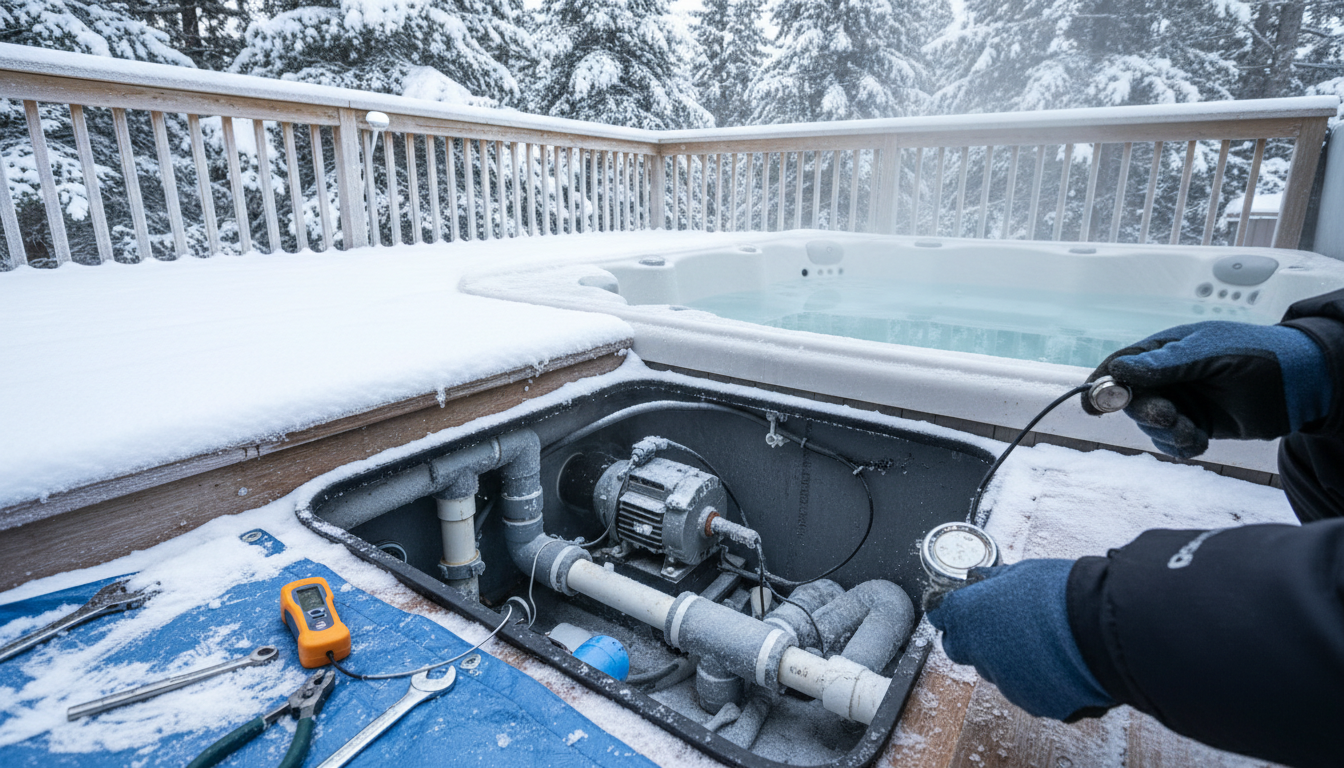
Your hot tub just threw an error code in the middle of January, the temperature outside is 14 degrees, and you have no idea whether the spa is protecting itself or slowly freezing solid. If that scenario sounds familiar, you already understand why a bad freeze sensor is not something you can put off until spring.
Replacing a hot tub freeze sensor in a cold climate costs $150 to $400 in most cases, covering both the part and a technician’s labor. The sensor itself is inexpensive – typically $20 to $80 – but cold-climate service calls carry a premium, and a misdiagnosis can turn a simple fix into a much larger bill. This article walks through what the part costs, what labor runs in northern and mountain regions, when DIY makes sense, and what to watch for so you are not paying twice.
What a Freeze Sensor Actually Does
A freeze sensor is a small thermistor – a temperature-sensitive resistor – mounted on the exterior plumbing, the equipment compartment wall, or occasionally inside the heater manifold. When it reads ambient or pipe temperature below a set threshold (usually around 40°F to 45°F), it signals the spa pack to run the circulation pump continuously. Moving water does not freeze as quickly as standing water, so that simple response protects your pipes, jets, and heater from cracking in a hard freeze. You can read more about the full range of freeze protection strategies in this guide on how to keep your hot tub from freezing in cold weather.
A freeze sensor is different from a high-limit sensor. The high-limit sensor cuts power to the heater when water temperature climbs dangerously high – usually above 110°F to 118°F. Some spa packs use a single dual-sensor probe that handles both jobs; others use two separate probes. Knowing which type your tub uses matters before you order a replacement part.
Part Costs: What the Sensor Itself Runs
Freeze sensor prices vary by brand and whether your spa pack uses a proprietary connector or a standard thermistor. Here is what you should expect to pay at the part level:
- Generic thermistor sensors: $20 to $40. These work with many older tubs and budget spa packs, but you need to confirm the resistance rating (10K ohm at 77°F is common) matches your control board’s spec.
- OEM freeze sensors for major brands: $40 to $80. Balboa, Gecko, and Dimension One tubs often use brand-specific connectors. Buying OEM avoids compatibility headaches and usually comes with a one-year warranty.
- Dual-sensor assemblies (freeze plus high-limit combined): $50 to $120. If your spa pack uses a single probe for both functions, replacing just the freeze portion is not possible – you replace the whole assembly.
The resource at Bath and Spa Parts on replacing hot tub temperature and high-limit sensors walks through how to identify your sensor type and pull the correct part number – worth a read before you order anything.
Labor Costs in Cold-Climate Regions
Here is where cold-climate owners feel the pinch. A spa technician in Phoenix might charge a $75 service call minimum. The same call in Denver, Minneapolis, or the Vermont mountains routinely runs $125 to $200 before the technician touches anything, because demand spikes every time temperatures drop hard. Total labor for a freeze sensor swap – which is genuinely a 20 to 45-minute job once the tech is on-site – runs $100 to $300 depending on your region.
Add the part and you land in that $150 to $400 total range. If the technician finds that a failed freeze sensor triggered a longer freeze event and cracked a fitting or the heater manifold, that repair can push the total bill to $600 or more – and that is before any spa pack damage is assessed. For context on what a full spa pack replacement runs, the Hot Tub Spa Pack Replacement Cost breakdown on this site gives you the full picture.
| Scenario | Part Cost | Labor Cost | Total Estimate |
|---|---|---|---|
| DIY with generic sensor | $20 to $40 | $0 | $20 to $40 |
| DIY with OEM sensor | $40 to $80 | $0 | $40 to $80 |
| Pro repair, mild-climate area | $40 to $80 | $75 to $150 | $115 to $230 |
| Pro repair, cold-climate area | $40 to $80 | $125 to $300 | $165 to $380 |
| Sensor failure caused freeze damage | $40 to $120 | $250 to $600+ | $290 to $720+ |
Why Cold-Climate Costs Run Higher
It is not just the service call minimum. Cold-climate technicians often deal with frozen ground covers that have to be removed carefully, cabinet panels that need extra time to open without cracking cold acrylic, and equipment compartments that may have moisture damage alongside the sensor failure. That extra diagnostic and access time gets billed at $60 to $120 per hour. If your tub sits under a deck or in an enclosed area with poor winter access, expect the labor estimate to land at the high end. Ajax Pool and Spa’s guide to hot tub repairs in Colorado winters spells out exactly which issues tend to compound in hard-freeze climates – worth reading if you are in a mountain or northern plains region.
Emergency or same-day calls during a cold snap can add another $50 to $100 on top of standard rates. If you call on a weekend when temperatures are forecast to drop below zero, that premium is essentially unavoidable.
DIY vs. Calling a Pro: How to Decide
A freeze sensor swap is one of the more beginner-friendly hot tub repairs, but there are real ways to get it wrong. Here is an honest breakdown:
- DIY makes sense if: you can locate your spa pack model number, pull up the wiring diagram, and confirm the sensor uses a plug-in connector (not hardwired). Most Balboa and Gecko packs use spade or Molex-style connectors that unplug with no tools beyond a screwdriver.
- Call a pro if: your tub is throwing multiple error codes, the sensor replacement does not clear the fault, or you suspect water got into the equipment bay during a freeze. Multiple failures together suggest the spa pack itself may be compromised.
- Never guess on the part: ordering a sensor with the wrong ohm rating will not destroy your tub, but it will not fix the problem either – you will just buy the part twice. Match the part number or the resistance spec from your manual.
A worked example: say you own a 7-year-old Balboa-controlled 6-person tub in Wisconsin. Your topside panel is showing an FZ code. You pull the spa pack cover, find a two-wire plug-in sensor on the exterior plumbing, and look up the Balboa part number. A direct replacement runs $55 shipped. Total fix: $55 and about 30 minutes. If you called a tech in Milwaukee in February, that same repair would likely run $220 to $280 including the service call minimum.
Common Mistakes That Cost Extra Money
The biggest mistake is assuming the freeze sensor is the only problem after a hard freeze. If your tub lost circulation for even a few hours in sub-freezing temps, check the plumbing for cracks before refilling. A cracked jet fitting or split union can look fine until you apply water pressure. Running the pump to test circulation before inspecting the plumbing is how a $60 sensor job turns into a $400 plumbing repair.
The second most common mistake is ignoring early warning signs. A freeze sensor that is drifting – reading slightly off but not completely failed – may cause the pump to cycle on and off erratically in cold weather without throwing a clean error code. If your circulation pump seems to be running at odd times on cold nights, do not wait for a hard fault. For a broader look at what repair bills look like when problems compound, the general overview at Epic Hot Tubs on hot tub repair costs gives useful context across multiple failure types.
One final note on water chemistry during a sensor fault: if your tub shut down and sat cold for a day or more, test and rebalance before you heat back up. Cold, stagnant water tends to drift low on sanitizer fast. AquaDoc’s chlorinating granules are what a lot of hot tub owners keep on hand for exactly this kind of restart situation, because you can dose precisely by weight rather than guessing with a floater.
Frequently Asked Questions
How much does it cost to replace a hot tub freeze sensor?
Most hot tub owners pay between $150 and $400 total for a freeze sensor replacement, including parts and labor. The sensor itself usually runs $20 to $80, and a technician visit in a cold-climate area typically adds $100 to $300 depending on your region and the service call minimum. DIY replacement with the right OEM part can bring that total down to $40 to $80.
Can I replace a hot tub freeze sensor myself?
Yes, many freeze sensors are plug-in components that require no soldering – just a screwdriver and a compatible replacement part. The main risk is buying the wrong sensor for your control board, so match the part number from your spa pack manual or the existing sensor’s label before ordering. If your tub is still showing fault codes after the replacement, call a technician rather than guessing at the next component.
What happens if a hot tub freeze sensor fails in winter?
A failed freeze sensor may cause the spa pack to throw an FZ error and shut the tub down, or in some failure modes it simply stops activating the circulation pump when temperatures drop below the threshold. Either outcome leaves standing water in the pipes exposed to freezing temperatures, which can crack fittings, jets, or the heater manifold. Repair costs from freeze damage can run $300 to $700 or more on top of the sensor replacement itself.
How do I know if my hot tub freeze sensor is bad?
Common signs include an FZ, FL, or freeze-protection error code on the topside panel, the circulation pump running continuously even in mild weather, or the tub shutting off unexpectedly during cold snaps. A technician can confirm the diagnosis by testing the sensor’s resistance with a multimeter – a functioning 10K-ohm thermistor should read close to 10,000 ohms at 77°F and shift predictably as temperature changes.
Is a freeze sensor the same as a hot tub high-limit sensor?
No, they are different components with different jobs. The high-limit sensor cuts the heater if water temperature climbs above 110°F to 118°F. The freeze sensor monitors low ambient or pipe temperature and triggers circulation to prevent freezing. Some spa packs use separate probes for each function; others combine both into a single dual-sensor assembly that must be replaced as one unit, typically costing $50 to $120 for the assembly alone.
A freeze sensor replacement is one of the cheaper hot tub fixes you will face – usually $150 to $400 with a pro, $40 to $80 if you do it yourself – but in a cold climate, the real cost of ignoring it is much higher than the part itself.