
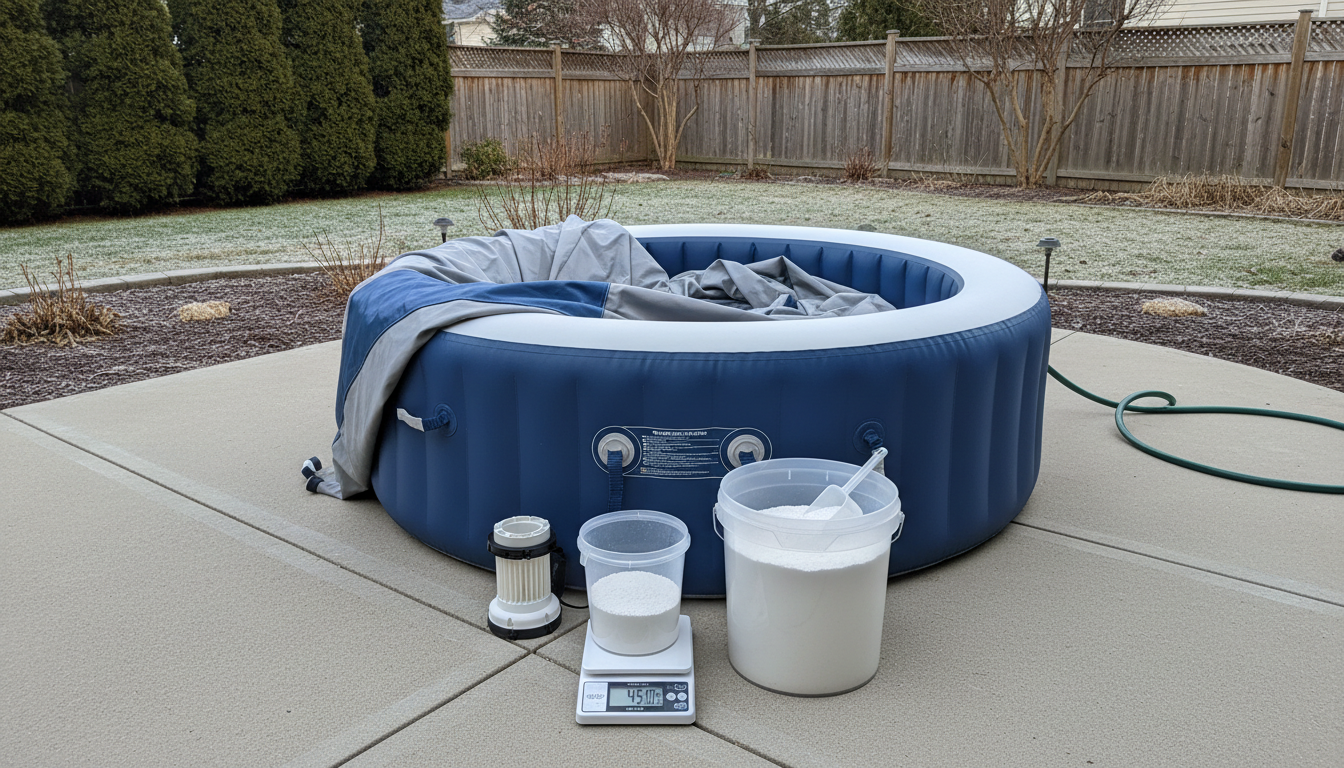
You finally made it to the end of hot tub season, the cover is grimy, the temperature is dropping, and your inflatable is just sitting there. Before you drain it and stuff everything in the garage, there’s one step that most people skip – and it’s the reason they open a tub in spring to find a slimy, bacteria-laden mess.
For a standard 6-person inflatable hot tub holding 250 to 350 gallons, you need 2 to 3 tablespoons (1 to 1.5 oz by weight) of dichlor granular shock to bring chlorine up to the 10-15 ppm range needed for a proper winter shutdown. This article walks through why that dose works, how to apply it step by step, how to handle the water afterward, and what mistakes to avoid so your tub survives winter in good shape.
Why Dichlor Is the Right Shock for This Job
Dichlor (sodium dichloro-s-triazinetriene) dissolves fast, is pH-neutral compared to other chlorine sources, and is safe for the vinyl and PVC materials inflatable hot tubs are made from. It raises free chlorine quickly without the calcium buildup you get from cal-hypo, which makes it ideal for a small-volume tub where you’re about to drain the water anyway. The quick-dissolving formula also means you get consistent distribution in a low-volume tub without heavy mixing. If you want to see how these principles apply to a tub you’re keeping running, the hot tub chemistry science deep-dive on this site covers the full picture.
The goal of a shutdown shock is different from a weekly maintenance shock. You’re not just oxidizing organics from a weekend soak. You’re blasting chlorine high enough to kill any bacteria or biofilm hiding in the jets, plumbing lines, and shell surface before the water sits stagnant or gets drained onto your lawn. That calls for 10-15 ppm of free chlorine, which is roughly double what you’d target for regular use.
How Many Gallons Does a 6-Person Inflatable Actually Hold?
This is where a lot of people go wrong. “6-person” is a marketing designation, not a volume spec. Most 6-person inflatables hold between 250 and 350 gallons when filled to the fill line, but some larger models push 400 gallons. Check your owner’s manual before you dose – the difference between 250 and 400 gallons changes your calculation by about 60%.
If you can’t find the manual, a rough estimate: most round 6-person inflatables with an interior diameter of 67 to 71 inches and a water depth of about 24 inches hold approximately 280 to 320 gallons. Use 300 gallons as your working number if you have no other reference point.
Calculating the Exact Dose
Standard dichlor granules contain roughly 56% available chlorine. To raise a 300-gallon tub from a starting point of 2-3 ppm (end-of-season chlorine) to 15 ppm, you need to add approximately 12 ppm of chlorine. Here’s the math at a practical level:
- 1 teaspoon of dichlor (about 0.17 oz) in 100 gallons raises chlorine by roughly 5-6 ppm.
- 300-gallon tub at 2 ppm starting chlorine needs about 12-13 ppm added to hit 15 ppm.
- That works out to 2 tablespoons (6 teaspoons), or about 1 oz by weight.
To give yourself a buffer and account for any organic load still in the water, bump that to 2.5 tablespoons for a 300-gallon tub. If your tub holds 400 gallons, use 3 tablespoons. Always measure by weight with a kitchen scale if you want precision – a tablespoon of dichlor can vary by density depending on the brand and granule size. For reference, guidance for shocking a Lay-Z-Spa (one of the most common 6-person inflatables) recommends a similar dose range for maintenance shocks, so a closing shock at the higher end of that range is well supported.
| Tub Volume | Starting Chlorine | Target Chlorine | Dichlor Dose |
|---|---|---|---|
| 250 gallons | 2-3 ppm | 10-15 ppm | 1.5 tablespoons (0.75 oz) |
| 300 gallons | 2-3 ppm | 10-15 ppm | 2 to 2.5 tablespoons (1 to 1.25 oz) |
| 350 gallons | 2-3 ppm | 10-15 ppm | 2.5 to 3 tablespoons (1.25 to 1.5 oz) |
| 400 gallons | 2-3 ppm | 10-15 ppm | 3 tablespoons (1.5 oz) |
These numbers assume you’re starting with reasonably balanced water. If your pH is way off or your water looks cloudy, balance chemistry first – shock works poorly in water with pH above 7.8 or heavy organic contamination.
Step-by-Step: How to Apply the Closing Shock
- Test your water first. Check pH (target 7.4-7.6), alkalinity (80-120 ppm), and current chlorine level. Adjust pH if needed before shocking, since high pH reduces chlorine’s effectiveness by up to 70%.
- Heat the water to at least 80°F. Warm water helps dichlor dissolve fully and distribute evenly. Do not add granules to cold, stagnant water.
- Turn the jets on. Run the circulation system at full blast. This distributes the shock through the jets and plumbing lines – exactly where biofilm hides over winter.
- Pre-dissolve the dichlor. Add your measured dose to a clean bucket of warm water (about a quart), stir briefly, then pour the solution slowly around the perimeter of the tub. Never pour granules directly onto the vinyl shell – concentrated dichlor can bleach or degrade the material.
- Run jets for 30 minutes. Keep the circulation going so the shocked water reaches every inch of the plumbing. Proper shocking technique for inflatable hot tubs consistently recommends at least 30 minutes of jet run time to get full plumbing coverage.
- Let it soak for 8-12 hours. Leave the cover on and let the high-chlorine water do its job. This contact time is what kills bacteria and biofilm, not just the initial shock.
- Test chlorine before draining. Confirm chlorine is still elevated (above 5 ppm confirms the water is still sanitized). Then drain per your local guidelines.
Draining and Storing the Tub
Most cities allow draining hot tub water to a lawn or garden bed if chlorine is below 1 ppm – check your local rules, because some areas require it to go to the sanitary sewer. If your chlorine is still high after the soak period, wait another 24 to 48 hours or add a small amount of sodium thiosulfate (chlorine neutralizer) to bring it down before draining. AquaDoc makes a concentrated chlorine neutralizer that pool and spa owners use for exactly this situation – a small dose drops residual chlorine quickly without affecting the shell.
Once drained, wipe down the interior shell with a clean towel to remove residual water and prevent mold growth. Remove the filter cartridge, rinse it thoroughly, and let it dry completely before storing – a wet filter stored in a bag is a mildew factory by spring. Deflate the tub only after it’s fully dry inside. A complete winterizing checklist, including what to do with your pump and heater unit, is covered in this step-by-step hot tub winterization guide.
Common Mistakes That Cost You in the Spring
- Skipping the pre-shock balance: Shocking water with pH above 7.8 wastes most of your dichlor. The chlorine converts to forms that barely sanitize. Always balance first.
- Adding granules directly to the shell: Undissolved dichlor sitting on vinyl will bleach or weaken the material. Always pre-dissolve in a bucket.
- Draining immediately after shocking: If you drain within an hour, the plumbing lines don’t get adequate contact time. Eight to twelve hours is the minimum for a true shutdown treatment.
- Skipping the filter: The filter cartridge holds more organic material than anywhere else in the tub. Remove it, soak it in a dilute filter-cleaning solution, rinse, and dry before storing.
- Storing the tub damp: Any moisture trapped inside the folded vinyl over winter will grow mold. Dry it thoroughly – a few extra hours of patience saves a nasty surprise in April.
If you’re on the fence about closing down at all – maybe your winters are mild or you have an insulated cover – the guide on keeping an inflatable hot tub running through winter lays out what it actually takes to maintain one in freezing temperatures. For many people in colder climates, a clean shutdown is still the smarter call for a tub without built-in freeze protection.
Frequently Asked Questions
How much dichlor shock do I need to close a 6-person inflatable hot tub?
Add 2 to 3 tablespoons (roughly 1 to 1.5 oz by weight) of dichlor shock to a 6-person inflatable hot tub before closing for winter. This raises chlorine to the 10-15 ppm range needed to kill bacteria and biofilm before the water is drained or left to sit. Scale toward the higher end if your tub holds more than 300 gallons or if the water looks cloudy.
Can I leave the dichlor shock in the water overnight before draining?
Yes, and leaving it overnight is actually the right move. Let the shocked water circulate with jets running for at least 30 minutes, then leave it covered for 8 to 12 hours before draining. That contact time is what ensures the sanitizer reaches biofilm in the jets and plumbing, not just the open water.
What if my 6-person inflatable holds more than 300 gallons?
Some 6-person inflatables hold up to 400 gallons. For every 100 gallons over 300, add roughly one extra teaspoon of dichlor to maintain the same target ppm. Confirm your tub’s exact capacity in the owner’s manual – “6-person” is a seating rating, not a volume spec, and getting the gallons right is what makes the dose accurate.
Is dichlor better than non-chlorine shock for winterizing an inflatable hot tub?
Dichlor is the better choice for a true shutdown shock because it raises free chlorine in addition to oxidizing organics. Non-chlorine shock (potassium monopersulfate) oxidizes well but leaves no chlorine residual to kill bacteria during the soak period before draining. For a closing treatment where you want maximum kill and the water won’t be used again, dichlor wins.
Do I need to neutralize the chlorine before draining my inflatable hot tub?
Most municipalities allow draining hot tub water to a lawn or garden if chlorine is below 1 ppm. After an 8-12 hour soak, chlorine will often drop on its own – test it before draining. If it’s still above 1 ppm, wait another 24 hours or add a small dose of sodium thiosulfate neutralizer to bring it down before letting it run off. Check your local water authority’s rules, since some areas require discharge to the sewer regardless of chlorine level.
For a 6-person inflatable holding 250 to 400 gallons, 2 to 3 tablespoons of dichlor shock is all it takes to close your tub the right way. Pre-dissolve it, run your jets for 30 minutes, let it soak overnight, and drain to a dry, clean tub that’s ready to go the moment spring shows up.