
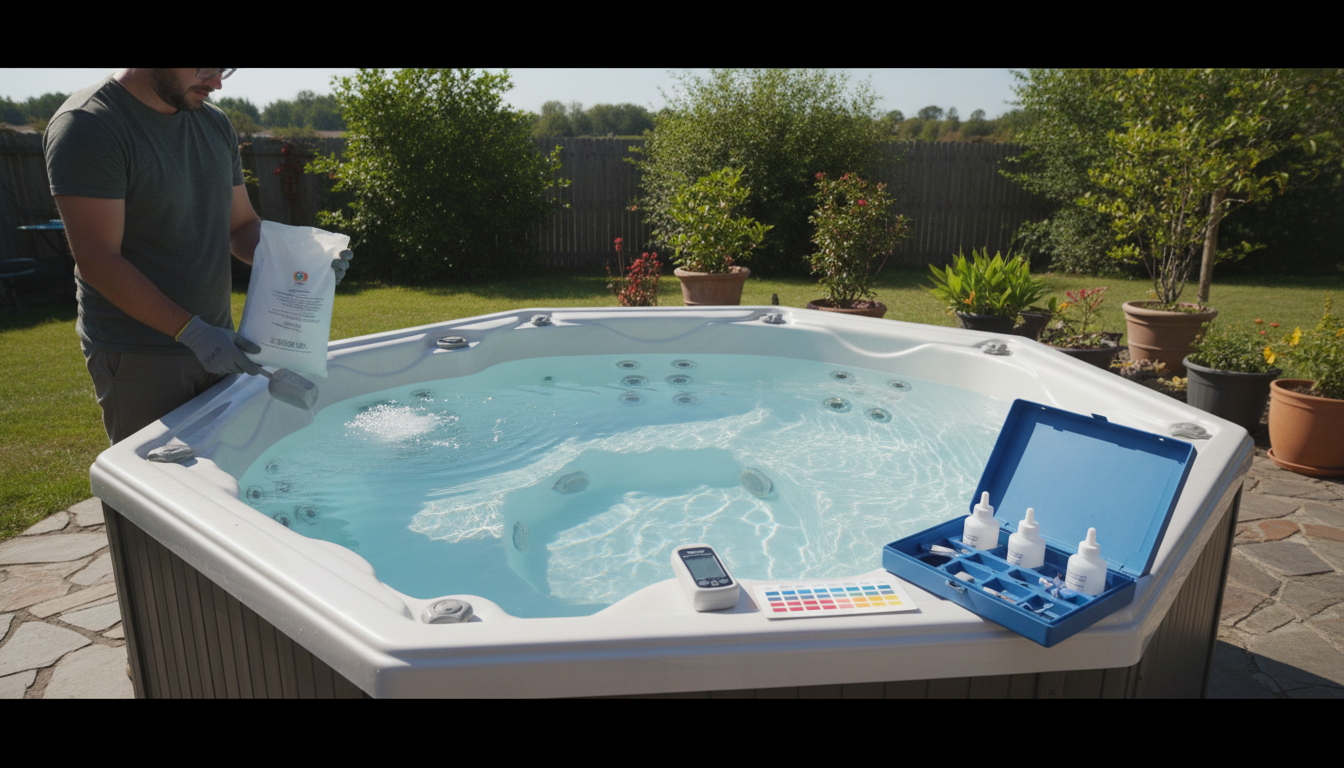
You dip a test strip into your hot tub, hold it up, and the alkalinity block is practically colorless – way below the scale. Now you’re standing in your kitchen wondering whether the box of Arm and Hammer in the pantry is actually the right fix, and if so, how much of it you’re supposed to dump in.
The short answer: yes, baking soda (sodium bicarbonate) raises total alkalinity in a hot tub, and for a typical 6-person hard-shell hot tub holding 350 to 450 gallons, you need about 1.5 tablespoons per 10 ppm of rise you want. The target range is 80 to 120 ppm. This article walks through the exact dose for every realistic starting level, explains why the amount matters so much in a small body of water, and gives you a step-by-step process so you don’t overshoot.
Why Alkalinity Control Is Harder in a Hot Tub Than in a Pool
Hot tubs are small. A 6-person hard-shell spa typically holds 375 to 450 gallons, with 400 gallons being a reasonable working number. That small volume means every chemical dose has a much bigger effect per ounce than it would in a 15,000-gallon pool. Add half a cup too much baking soda and your alkalinity can jump 30 ppm past your target. That’s why the “handful” approach that sometimes works in a pool will get you into trouble in a spa.
Low alkalinity – anything below 80 ppm – causes pH to swing wildly between uses. One person soaks, carbon dioxide from breathing and skin contact pushes pH down, and your sanitizer starts eating through acrylic and metal fittings. High alkalinity above 120 ppm locks pH high, causes scale, and makes your water look cloudy. If you’ve been dealing with persistently hazy water, cloudy hot tub water has several possible causes, and alkalinity out of range is one of the most common ones.
How Much Baking Soda Raises Alkalinity in 400 Gallons
The math is simpler than it looks. One pound of sodium bicarbonate raises alkalinity by roughly 10 ppm in 12,000 gallons of water. Scale that down to 400 gallons and you get about 22 grams, or roughly 1.5 tablespoons, to raise alkalinity by 10 ppm. Resources like Aqualife Hot Tubs’ alkalinity guide and Hot Tub Owner HQ’s dosing breakdown confirm this 1.5-tablespoon-per-10-ppm benchmark for standard spa volumes.
Use the table below to find your starting alkalinity level and read across to the dose you need. All doses assume a 400-gallon hot tub. If your tub is closer to 350 gallons, subtract about 12% from each dose. If it’s 450 gallons, add about 12%.
| Starting Alkalinity (ppm) | Target (ppm) | Rise Needed (ppm) | Baking Soda (tablespoons) | Baking Soda (grams) |
|---|---|---|---|---|
| 40 | 100 | 60 | 9 tbsp | 130 g |
| 50 | 100 | 50 | 7.5 tbsp | 110 g |
| 60 | 100 | 40 | 6 tbsp | 88 g |
| 70 | 100 | 30 | 4.5 tbsp | 66 g |
| 80 | 100 | 20 | 3 tbsp | 44 g |
| 90 | 100 | 10 | 1.5 tbsp | 22 g |
Why These Dose Differences Matter
The gap between starting at 40 ppm versus 70 ppm is not trivial. At 40 ppm you need 9 tablespoons of baking soda – and you should never add all of that at once. Dumping a large alkalinity correction in a single shot can temporarily push pH sky-high and cloud the water with carbonate precipitation. At 70 ppm you only need 4.5 tablespoons and can often do it in one addition if you add it slowly with the jets running.
The rule of thumb from Backyard Mastery’s alkalinity guide and others in the industry: never add more than 3 tablespoons (roughly 44 grams) at one time in a 400-gallon spa. If your deficit is bigger than 20 ppm, split the dose across two additions at least 2 hours apart.
Step-by-Step: Adding Baking Soda to a 6-Person Hard-Shell Hot Tub
- Test first, dose second. Use a reliable liquid test kit or digital meter. Test strips vary and can read alkalinity 10 to 20 ppm off in hot water. Know your actual starting number before you calculate anything.
- Calculate your dose from the table above. Round your hot tub volume to the nearest 50 gallons and adjust the dose proportionally. If your tub holds 375 gallons, multiply the 400-gallon dose by 0.94.
- Turn the jets on. You want good circulation so the baking soda disperses evenly and doesn’t sit on the shell.
- Pre-dissolve the baking soda. Mix your dose into a bucket of warm spa water before adding it. This speeds dissolution and avoids white powder settling on the floor of the tub. Calgary Hot Tub Services recommends pre-dissolving specifically to prevent spotting on acrylic shells.
- Pour slowly near a jet return. Add the dissolved mixture near a return jet, not directly into the skimmer.
- Wait 2 to 4 hours with the jets running, then retest. Don’t test immediately. CO2 off-gassing takes time, and testing too soon gives a falsely high reading.
- Repeat if needed. If you’re still below 80 ppm, dose again with the remaining amount from your calculation. Never add more than 3 tablespoons per correction pass.
A Worked Example: Starting at 50 ppm
Say your test shows total alkalinity at 50 ppm and your 6-person hot tub holds 400 gallons. Your target is 100 ppm, so you need a 50 ppm rise. From the table, that’s 7.5 tablespoons (about 110 grams) of baking soda. Split that into three passes: add 3 tablespoons, wait 2 hours, retest. If you’re at 75 ppm, add another 3 tablespoons, wait 2 more hours, and retest again. A final small trim with 1.5 tablespoons gets you to 100 ppm. Three additions over one afternoon, and you’re dialed in. Trying to do all 7.5 tablespoons at once risks a pH spike above 8.0 and milky water that takes a day to clear.
Common Mistakes That Throw Off the Dose
- Testing in hot water with strips: High water temperature degrades reagent accuracy on test strips. Let a small water sample cool to room temperature before testing, or use a liquid drop kit rated for spas.
- Not accounting for actual volume: A 6-person tub marketed as “400 gallons” might actually hold 350 gallons when filled to normal operating level with bathers inside. Check your owner’s manual or measure with a flow meter during fill. A 50-gallon error shifts your dose by about 12%.
- Ignoring pH before correcting alkalinity: If your pH is also low (below 7.2), fix alkalinity first. Baking soda will gently nudge pH up alongside alkalinity, which is actually helpful. If pH is already above 7.8, fix that before adding baking soda, or you’ll make an existing high-pH problem worse. For ongoing chemistry management, understanding the order of chemical adjustments will save you a lot of troubleshooting.
- Using old baking soda: Baking soda stored in an opened box absorbs moisture and loses potency. Use a fresh, sealed container and store it in a dry location. Old baking soda can underperform by 10 to 20%.
Baking Soda vs. Dedicated Alkalinity Increaser
Pool and spa alkalinity increaser products are sodium bicarbonate – the same compound as baking soda, just repackaged. The dose is identical. The only reasons to choose a branded product over pantry baking soda are packaging convenience and the guarantee of purity. Some pool owners use AquaDoc’s alkalinity increaser because it comes in a resealable bag sized for spa doses, which reduces the guesswork with tablespoon measuring. Grocery store baking soda works equally well as long as it’s 100% sodium bicarbonate with no added starch or anti-caking agents – check the label. As One Hot Tub’s overview notes, purity is the only thing that actually matters when choosing between the two.
Frequently Asked Questions
How much baking soda do I add to raise alkalinity in a 6-person hot tub?
A 6-person hard-shell hot tub holds roughly 400 gallons. To raise total alkalinity by 10 ppm in 400 gallons, add about 1.5 tablespoons (roughly 22 grams) of baking soda. For a larger jump – say from 60 ppm to 100 ppm – you need about 6 tablespoons total, added in two separate doses spaced 2 hours apart so you don’t spike pH.
What is the ideal total alkalinity for a hot tub?
The target range for total alkalinity in a hot tub is 80 to 120 ppm, with 100 ppm being the sweet spot most technicians aim for. Keeping alkalinity in this band stabilizes pH between soaks and reduces how often you need to adjust other parameters.
Can I use regular grocery store baking soda in my hot tub?
Yes. Plain sodium bicarbonate from the grocery store is chemically identical to spa alkalinity increaser. Use a product that is 100% sodium bicarbonate with no additives. The box in your pantry works perfectly fine and costs far less per ounce than branded spa products.
What happens if I add too much baking soda to my hot tub?
Overdosing baking soda pushes total alkalinity above 120 ppm, which locks pH high (often above 7.8), promotes scale on the shell and jets, and can turn the water cloudy. If you overshoot, lower alkalinity with muriatic acid or dry acid (sodium bisulfate) in small increments, testing after each addition. Never try to correct a large overshoot all at once.
How long after adding baking soda should I retest my hot tub water?
Wait at least 2 hours with the jets running before retesting, and ideally 4 hours. The circulation disperses the baking soda fully and lets dissolved carbon dioxide off-gas, which is what gives you an accurate alkalinity reading. Testing too soon – even 30 minutes after dosing – typically reads 10 to 15 ppm higher than the true settled level.
Getting alkalinity right in a 6-person hard-shell hot tub comes down to knowing your actual starting level and adding baking soda in doses no larger than 3 tablespoons at a time, with a retest after each one. Aim for 100 ppm and you’ll find that pH, sanitizer, and water clarity all become much easier to maintain.