
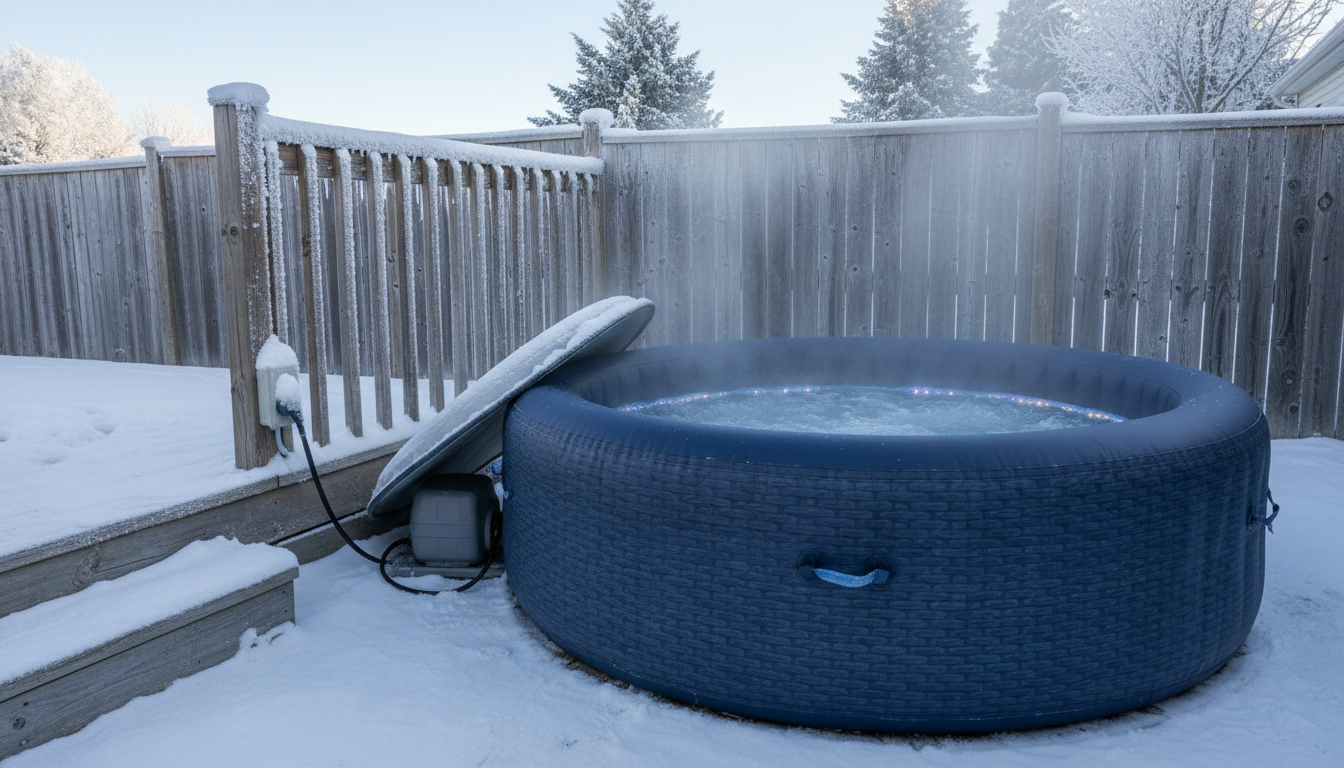
Running an inflatable hot tub in a cold climate costs roughly two to three times more than running the same tub in a mild one. In practical terms, that means $75 to $150 per month in a region where winter temperatures hover near or below freezing, compared to $25 to $55 per month where winters stay comfortably above 45°F. The gap comes down to one simple physics problem: the colder the air around the tub, the harder the heater works, and the longer it runs.
If you bought an inflatable hot tub expecting low operating costs and then opened your first winter electricity bill, you are not alone. The purchase price is easy to find online, but the ongoing cost by climate zone rarely gets a straight answer. This article walks through how the numbers actually stack up, what drives the difference, how to calculate your own cost, and which low-effort steps bring the bill down the most.
Why Climate Has Such a Big Effect on Heating Cost
An inflatable hot tub holds around 200 to 300 gallons of water and targets a water temperature of 100°F to 104°F. The heater runs whenever the water temperature drops below your set point. How often that happens depends almost entirely on the gap between the water temperature and the air temperature around the tub, a figure engineers call the differential.
A tub in Miami with an air temperature of 65°F in January has a differential of roughly 39°F to maintain. The same tub in Minneapolis, where January air averages 16°F, is fighting an 88°F differential. The heater does not care about your electricity bill; it just runs until the water is warm. That is why real-world winter hot tub operating data shows such wide cost swings by region.
Inflatable tubs make this worse than rigid acrylic spas for two reasons. First, their vinyl walls are thin, typically 0.1 to 0.2 inches of PVC with an air bubble core, compared to the foam-injected cabinet walls on a hard-shell spa that can be 2 to 3 inches thick. Second, most inflatable tubs sit directly on the ground with no insulation underneath, so the earth pulls heat out of the water from below as fast as the air pulls it out from the sides.
The Real Numbers: Cold Climate vs Mild Climate
A standard 110V inflatable hot tub has a heater rated at 1,200 to 1,500 watts. At the US average electricity rate of about $0.16 per kWh, one hour of full heating costs roughly $0.19 to $0.24. The question is how many hours per day the heater actually runs. Here is how that plays out across climates:
| Climate Zone | Avg Winter Air Temp | Est. Daily Heater Runtime | Daily Cost (at $0.16/kWh) | Monthly Cost |
|---|---|---|---|---|
| Very Cold (Zone 6-7, e.g. Chicago, Denver) | 10°F to 25°F | 14 to 20 hours | $2.69 to $3.84 | $80 to $115 |
| Cold (Zone 5, e.g. Kansas City, Portland OR) | 26°F to 40°F | 8 to 14 hours | $1.54 to $2.69 | $46 to $80 |
| Mild (Zone 3-4, e.g. Dallas, Atlanta) | 41°F to 55°F | 3 to 7 hours | $0.58 to $1.34 | $17 to $40 |
| Warm (Zone 1-2, e.g. Miami, Phoenix winter) | 56°F to 70°F | 1 to 3 hours | $0.19 to $0.58 | $6 to $17 |
Why These Differences Matter for Your Budget
The table above assumes a covered tub with a reasonable insulating ground mat, which is already an optimistic scenario for most inflatable tub owners. Remove the cover, skip the mat, or leave the tub uncovered between uses and those runtime hours climb 30 to 50 percent. A Chicago owner running an uncovered tub on bare concrete could realistically hit $140 to $170 per month in January, more than some utility bills for the whole house.
It is also worth noting that most inflatable tub heaters are single-speed at around 1,500 watts and do not modulate. They are either fully on or fully off. So unlike a heat pump that ramps up gradually, every time the tub calls for heat it is pulling the full wattage. That makes an insulated cover not just helpful but genuinely critical in cold weather. As this cold-weather inflatable hot tub guide points out, up to 60 percent of heat loss on an inflatable tub escapes through the top surface when the cover is off.
Worked Example: A 240-Gallon Tub in Minneapolis vs Austin
Say you own a popular 240-gallon inflatable tub set to 102°F and your electricity rate is $0.14 per kWh. In Minneapolis in January, ambient air averages around 16°F. The water-to-air differential is 86°F, and the tub’s heater runs approximately 16 hours a day to hold temperature. At 1,500 watts: 1.5 kW times 16 hours times $0.14 equals $3.36 per day, or about $104 per month.
The same tub in Austin in January faces an average air temperature of roughly 46°F. The differential is only 56°F, and the heater runs maybe 5 hours a day. Same math: 1.5 kW times 5 hours times $0.14 equals $1.05 per day, or about $32 per month. That is a $72 monthly difference from geography alone, not from anything you did or did not do as an owner.
How to Cut the Bill in a Cold Climate
You cannot change where you live, but you can close most of the gap with a few targeted steps. These are ranked by impact, not by cost:
- Use the insulated cover every time: A good thermal cover reduces surface heat loss by up to 60 percent. Even a 20-minute soak means covering the tub the moment you get out, not an hour later when you remember.
- Add a foam ground mat: A 1-inch closed-cell foam mat under the tub costs $20 to $60 and cuts conductive heat loss through the floor by roughly 20 to 30 percent. This is one of the highest-return upgrades you can make.
- Lower your holding temperature: Dropping from 104°F to 98°F between soaks reduces the heater’s on-time significantly. You lose nothing practically because the tub reaches 104°F in 15 to 30 minutes when you want it.
- Add a thermal blanket on the water surface: A floating spa blanket sits directly on the water under the cover and traps a second layer of heat. These run $15 to $40 and pair well with any existing cover.
- Schedule soaks during off-peak rate hours: Many utilities charge 20 to 40 percent less per kWh during off-peak windows. Running a pre-heat cycle at night before morning off-peak rates end can shave real dollars monthly.
- Wrap or shelter the tub: Placing the tub in a sheltered spot out of wind, or wrapping the sides with an insulating jacket, reduces convective heat loss. Wind can double the effective heat loss on the exposed vinyl walls.
Keeping your water chemistry stable also plays into efficiency. Cloudy or foamy water is often a sign of chemical imbalance that leads owners to drain and refill more often, and refilling means reheating hundreds of gallons from cold tap water. AquaDoc makes a line of hot tub chemical starter kits that help new inflatable tub owners get chemistry dialed in from day one, so you are not draining and reheating unnecessarily.
For a broader look at whether the ownership costs make sense at all, this honest breakdown of whether inflatable hot tubs are worth it covers both the benefits and the realistic downsides that most sellers gloss over. And if you ever decide to upgrade to a hard-shell unit and move it to a new location, knowing the actual hot tub moving cost ahead of time saves a lot of budget surprises.
What About 240V Inflatable Tubs?
A growing number of inflatable tubs now come in 240V versions with heaters in the 2,000 to 3,000 watt range. These heat faster, which actually improves efficiency in cold climates because they spend less total time bringing cold top-off water up to temperature. However, their higher wattage also means they draw more power per hour when running. The net monthly cost is usually similar to a 110V tub but the daily swings are smaller because the heater bursts are shorter and more efficient. If you are in a cold climate and replacing a 110V inflatable tub, the 240V models are worth considering for cold-weather performance, though they require a dedicated circuit installed by an electrician, adding a one-time cost of $200 to $600.
Frequently Asked Questions
How much does it cost per month to run an inflatable hot tub in winter?
In a cold climate where temperatures regularly drop below 20°F, expect to pay $75 to $150 per month in electricity just to keep an inflatable hot tub at 104°F. In a mild climate with winters averaging 45°F to 55°F, the same tub typically costs $30 to $55 per month during the cooler months. The full range of hot tub operating costs also includes chemicals and water, which add another $20 to $40 per month on top of electricity.
How much electricity does an inflatable hot tub use per day?
A typical 110V inflatable hot tub draws 1,200 to 1,500 watts when the heater is running. In cold weather it may run the heater 10 to 16 hours a day, consuming 12 to 24 kWh daily. In mild weather the heater cycles far less, using roughly 3 to 6 kWh per day. At a rate of $0.16 per kWh, that is $1.92 to $3.84 per day in cold conditions versus $0.48 to $0.96 in mild ones.
Is it worth running an inflatable hot tub in winter in a cold climate?
It can be, but you need to insulate aggressively. Adding a ground mat, a thermal cover, and an insulating wrap can cut heating time by 30 to 40 percent and keep monthly costs closer to $60 to $90 rather than $150. Without those steps, the electricity cost often surprises owners who assumed the low purchase price meant low running costs too. See this pros and cons guide for inflatable hot tubs for a realistic picture of total ownership costs.
What temperature is too cold for an inflatable hot tub?
Most inflatable hot tub manufacturers set a minimum safe operating temperature of around 40°F ambient air. Below that, the heater may struggle to reach or hold 104°F, and prolonged exposure risks damage to the pump housing and liner. At or below freezing you should drain and store the tub unless it is well insulated, sheltered, and actively monitored.
How can I reduce my inflatable hot tub electricity bill in winter?
The four most effective steps are: use the insulated cover every time the tub is not in use, place a foam ground mat underneath, set a holding temperature of 95°F to 98°F between soaks rather than 104°F, and schedule soaks during off-peak electricity hours. Together these changes can cut monthly heating costs by 25 to 40 percent. If your spa pack or heater unit is aging and cycling inefficiently, replacing it can also meaningfully improve energy performance.
The bottom line: an inflatable hot tub in a cold climate costs roughly $80 to $150 per month to run in winter, two to three times what the same tub costs in a mild climate. Good insulation and cover discipline close most of that gap, but geography sets your floor.