
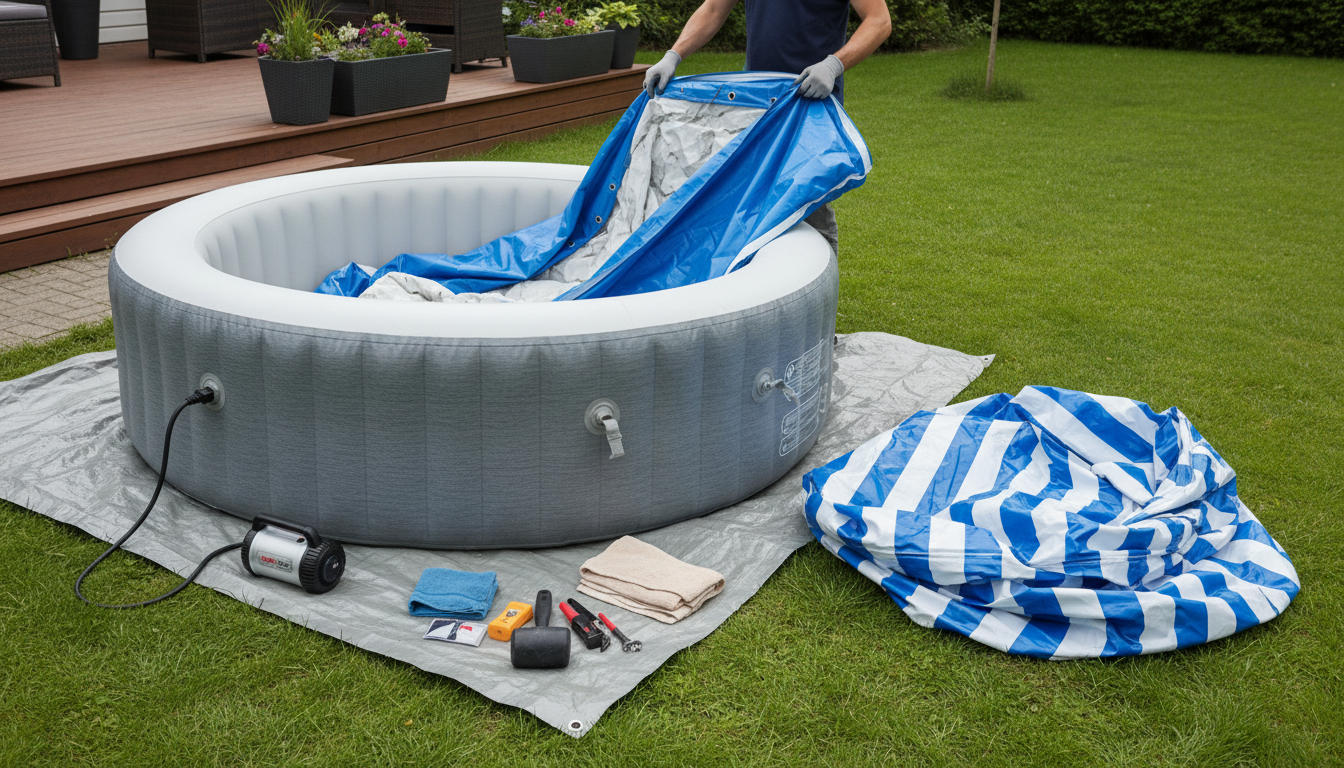
You blew up the inflatable hot tub, filled it, got the water chemistry dialed in, and then noticed a slow but unmistakable sag on one side. Or maybe you found a seam failure after winter storage. Either way, you’re now staring at a deflated tub and wondering whether a patch, a liner replacement, or an entirely new unit is the answer.
For a 4-person inflatable hot tub, liner repair costs range from $5 for a basic vinyl patch kit to $300 for a full OEM shell replacement, with most real-world fixes landing somewhere between $20 and $150. This article breaks down every cost scenario – patch vs. liner replacement vs. buying new – so you can make a smart call without overspending on a tub that may not be worth fixing.
What “Liner” Actually Means on an Inflatable Hot Tub
Unlike a vinyl liner in an inground pool, the “liner” on an inflatable hot tub is the entire structural shell: the outer PVC skin, the inner water-holding bladder (sometimes the same layer, sometimes separate), and the inflatable walls that give the tub its shape. On most 4-person models, these layers are laminated together as a single unit. That matters for repair decisions because you can’t just peel off one layer and swap it out the way you might with a pool liner.
Brands like Intex and Coleman use a tri-tech or fiber-tech laminate construction, typically 3-ply PVC, that runs about 0.3 to 0.5 mm per layer. Premium inflatable spas use reinforced drop-stitch panels similar to paddleboard construction. The repair approach and replacement cost differ significantly between these two designs.
Patch vs. Repair Kit vs. Full Liner Replacement: The Three Scenarios
Before you spend anything, figure out which scenario you’re actually in. The size and location of the damage determines which approach makes sense.
- Pinhole or small puncture (under 1 inch): A vinyl repair kit handles this reliably. These kits cost $5 to $20 at hardware stores and include PVC-compatible adhesive and patch material. Dry the area thoroughly, rough it up lightly with the included abrasive, apply adhesive, press the patch down, and let it cure for 24 hours. Success rate is high when the surrounding vinyl is still sound.
- Larger tear or seam failure (1 to 6 inches): A standard patch kit can work on tears, but you’ll need a seam-grade adhesive rather than basic contact cement, and the repair is more labor-intensive. Expect to spend $15 to $40 on materials. Some owners use a two-part PVC weld adhesive for seam repairs, which creates a stronger bond than a patch alone. If the seam has delaminated over a long stretch, that’s usually a sign the whole shell is nearing end of life.
- Shell structural failure or multi-point leaks: At this stage, patching is just delaying the inevitable. A full liner (shell) replacement is the call, and cost depends almost entirely on whether your brand offers one as a spare part.
Full Liner Replacement Cost for a 4-Person Inflatable Hot Tub
Here’s where the numbers vary most. A handful of brands sell replacement shells as spare parts; most do not. For the brands that do, expect to pay $80 to $200 for a compatible replacement liner, plus $20 to $50 for shipping on something that size and weight. If your tub is an OEM brand with good parts availability – Intex is the clearest example – replacement shells are findable through the manufacturer’s parts department or third-party distributors, typically in the $100 to $150 range for a 4-person model.
For off-brand tubs purchased through discount retailers, replacement liners are rarely available as separate parts. The manufacturer designed the product as a disposable unit, and when the shell fails, the intended path is a new tub. That’s a frustrating reality, but it’s the honest answer.
Installation labor is essentially zero: inflatable hot tub liners replace by deflating the old shell, removing the pump unit, transferring it to the new shell, and reinflating. It takes 30 to 60 minutes. There’s no professional service required, which keeps the total cost strictly to parts.
Cost Comparison: Patch, Replace the Liner, or Buy New
| Scenario | Typical Cost | Time to Complete | Best For |
|---|---|---|---|
| Vinyl patch kit (small puncture) | $5 – $20 | 30 min + 24 hr cure | Pinhole leaks, abrasion holes |
| PVC weld / seam repair | $15 – $40 | 1 – 2 hours + 24 hr cure | Seam separations, 1-6 inch tears |
| OEM replacement liner | $80 – $200 + shipping | 30 – 60 min to swap | Multiple leaks, UV-degraded shell |
| New entry-level 4-person inflatable tub | $300 – $600 | 1 – 2 hours to set up | Tub under $400 original cost, aging pump |
Why These Differences Matter for Your Decision
The patch route makes obvious sense for small, isolated damage on a tub that’s otherwise in good shape. The liner replacement route only pencils out if the tub originally cost $600 or more and the pump system is still functioning well. If your tub cost $350 and needs a $150 liner, you’re better off buying a new unit – especially since that aging pump is probably close behind. As a general rule, repair cost should not exceed 40% of the tub’s original purchase price. Beyond that threshold, replacement wins on economics every time.
What Causes Liners to Fail Prematurely (and How to Avoid It)
Most liner failures aren’t random. A few specific causes account for the majority of premature shell damage on 4-person inflatable hot tubs.
- Unbalanced water chemistry: Low pH (below 7.2) degrades PVC vinyl faster than almost anything else. The acid attacks the plasticizers in the material, making it brittle and prone to cracking. Keep pH between 7.4 and 7.6 consistently, and the liner will outlast tubs where chemistry was ignored.
- UV exposure: Direct sunlight breaks down PVC over time, causing discoloration and brittleness. A UV-blocking cover when the tub is not in use extends liner life meaningfully – two to three additional years is a realistic estimate.
- Ground surface contact: Sharp gravel, rough concrete, or even a single protruding root can work through the bottom of the liner over months of use. Always place the tub on a tarp, foam mat, or purpose-made ground cloth. The tarp adds $10 to $30 and saves you a $150 liner.
- Improper winterization: Water left inside a deflated or partially deflated tub through a freeze cycle will expand inside the PVC layers and crack them. A proper chemical shutdown before storage prevents both liner damage and expensive pump and spa pack failures that tend to follow freeze damage.
- Overfilling: Filling beyond the marked fill line puts constant stress on the seams. Seam failures are expensive to repair and typically signal the shell is reaching end of life.
The Chemistry Factor: Liner Damage You Can’t See
This part catches a lot of owners off guard. PVC liner degradation from chemical imbalance is slow, invisible, and cumulative – you won’t see it until the shell starts to feel stiff or loses its elasticity. Chlorine levels above 5 ppm sustained for weeks at a time accelerate oxidation of the vinyl. Calcium hardness below 100 ppm in aggressive soft water causes the water to pull minerals from whatever surface it contacts, including your liner. For a 400-gallon 4-person inflatable (which is the typical volume range), maintaining calcium hardness at 100 to 150 ppm keeps the water from attacking the shell.
AquaDoc makes a calcium hardness increaser formulated for small-volume inflatable spas, which is one of those products that matters more than it sounds when your liner is the first thing soft, aggressive water goes after.
Keeping a tight chemical routine doesn’t just protect the water – it protects the $150 to $300 shell underneath it. If you’ve already had to deal with a liner issue, the exact chemical doses for a 4-person inflatable hot tub by volume are worth bookmarking so you’re not guessing next time.
Frequently Asked Questions
How much does it cost to replace a 4-person inflatable hot tub liner?
A full liner replacement for a 4-person inflatable hot tub typically costs $80 to $300, depending on the brand and whether you can source an OEM shell or a compatible aftermarket unit. Budget-tier tubs from off-brand manufacturers often lack replacement liners entirely, making a full unit replacement the only practical option.
Can you patch an inflatable hot tub instead of replacing the liner?
Yes, and for small punctures under 1 inch, a patch is almost always the right call first. A vinyl repair kit costs $5 to $20 and takes about 15 minutes to apply. The patch holds reliably if the surrounding liner PVC is still structurally intact with no brittleness or delamination.
How long does an inflatable hot tub liner last?
Most inflatable hot tub liners last 3 to 7 years with proper care. UV exposure, unbalanced water chemistry, and abrasion from rough surfaces are the three fastest ways to cut that lifespan short. Keeping pH between 7.4 and 7.6 and storing the tub under a UV-blocking cover when not in use adds measurable life to the shell.
What causes inflatable hot tub liners to fail prematurely?
The most common culprits are low pH (below 7.2 degrades vinyl faster), prolonged sun exposure without a UV-blocking cover, sharp debris underneath the tub, and overfilling that stresses the seams. Poor winterization – leaving water frozen inside the shell – can crack the liner irreparably in a single season, and the damage often doesn’t show until the following spring.
Is it worth replacing the liner on a cheap inflatable hot tub?
If the tub originally cost under $400 and a liner replacement runs $150 or more, the math rarely works in favor of repair. At that point, a new entry-level unit often makes more financial sense, especially if the pump or heating system is also aging. For tubs that originally cost $600 or more, a liner replacement almost always beats buying new – particularly when the pump is still in good condition, since moving a replacement unit and setting it up carries its own hidden costs.
A liner repair or replacement on a 4-person inflatable hot tub is a $5 job if you catch a small puncture early, or a $150 to $300 project if you need a full shell swap – and the difference almost always comes down to how quickly you caught the problem and whether you kept the water chemistry balanced along the way.