
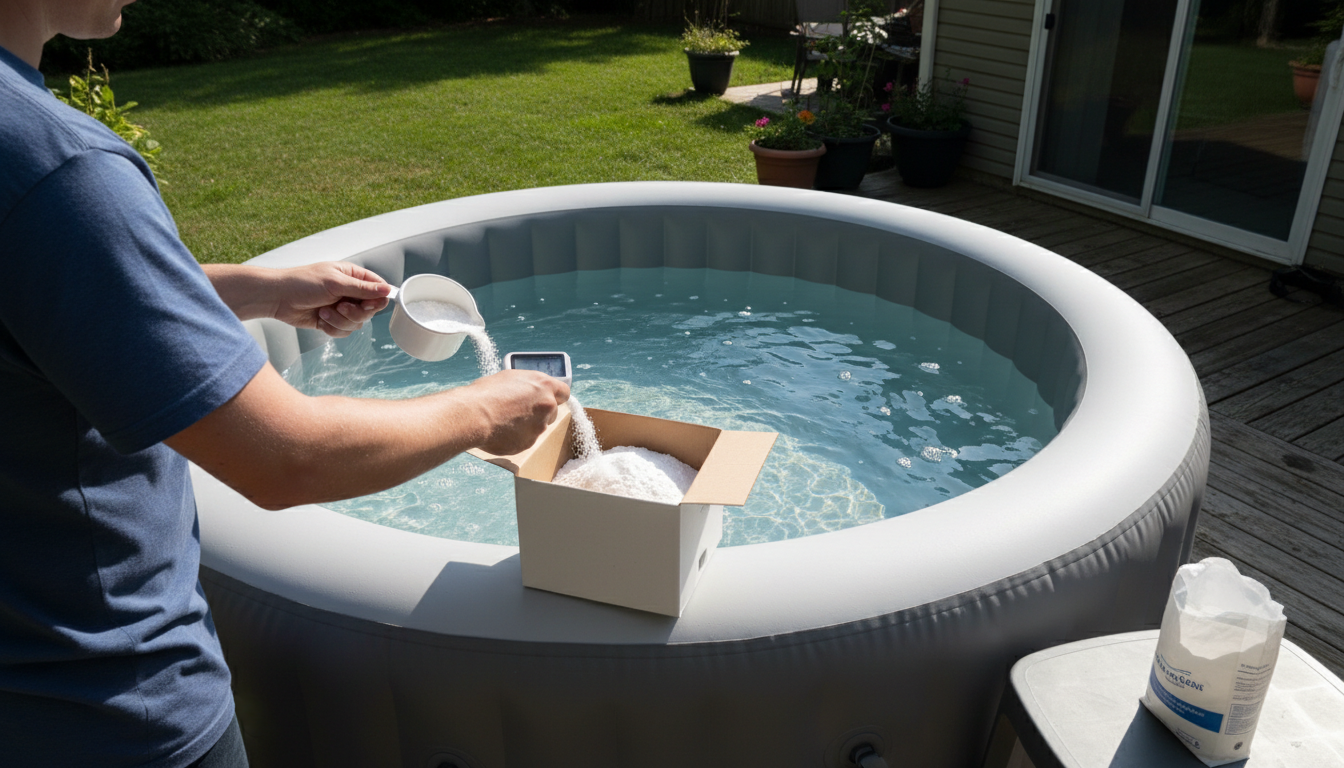
You test your inflatable hot tub’s water, look down at the strip, and the alkalinity is somewhere in the basement – maybe 40 or 50 ppm when it should be sitting close to 100. Now you’re staring at a box of baking soda wondering whether a pinch will do it or whether you need to dump in half the box.
For a 300-gallon inflatable hot tub, the dose is roughly 1.5 tablespoons (about 21 grams) of baking soda per 10 ppm of alkalinity you need to raise. That’s the number that matters most, and everything below explains where it comes from, how to apply it correctly, and what to do if one dose isn’t enough. This article also covers why alkalinity drops in the first place, how baking soda compares to dedicated alkalinity increaser products, and the one mistake that wastes half your chemical and your time.
Why Total Alkalinity Matters in a Small Hot Tub
Total alkalinity (TA) is the buffer that keeps your pH from bouncing around. When TA is too low, usually below 80 ppm, pH becomes unstable – it can swing from 6.8 to 8.0 between uses without you touching a thing. A low-alkalinity hot tub is harder on skin and eyes, rougher on the inflatable liner material, and less effective at sanitizing because chlorine or bromine efficiency drops sharply outside a pH range of 7.2 to 7.6. In a 300-gallon tub, these swings happen faster than in larger spas because every variable – bather load, product additions, even aeration from the jets – has an outsized impact on a small water volume. Calgary Hot Tub Services explains the relationship between baking soda and hot tub water balance well if you want more background on the chemistry side.
The target range for total alkalinity in any hot tub, regardless of size, is 80 to 120 ppm, with 100 ppm as the practical bullseye. Below 80 ppm, fix it before you worry about pH. Above 120 ppm, pH tends to creep high and water can cloud – which is a whole separate headache (and one covered in detail in the guide on cloudy hot tub water causes and fixes).
Baking Soda vs. Alkalinity Increaser: Are They the Same Thing?
Short answer: yes, mostly. Standard alkalinity increaser sold at spa shops is sodium bicarbonate – exactly the same compound as plain baking soda. Some branded products contain 100% sodium bicarbonate; a few are slightly different formulations (sodium carbonate, or soda ash), which raises alkalinity and pH together more aggressively. If you’re buying a product labeled “alkalinity increaser,” read the ingredient list. If it says sodium bicarbonate, the dosing math in this article applies directly. If it says sodium carbonate, use the manufacturer’s dose instead, since it’s stronger per gram.
Plain grocery store baking soda works fine in a hot tub. The cost difference is significant: baking soda runs about $1 per pound at the supermarket versus $5 to $10 per pound for branded spa alkalinity increaser. For a 300-gallon tub, you’ll never need more than a few tablespoons at a time, so either option is affordable – but it’s good to know you’re not missing anything by going the grocery store route. OneHotTub’s breakdown of baking soda dosage and safe use walks through this distinction clearly.
The Dose: Exact Numbers for a 300-Gallon Hot Tub
The standard reference point used across the industry is 1.5 lbs of sodium bicarbonate per 10,000 gallons to raise total alkalinity by 10 ppm. Scaling that down to 300 gallons gives you:
- Per 10 ppm increase needed: 300 / 10,000 x 1.5 lbs = 0.045 lbs, which converts to roughly 20-21 grams, or about 1.5 tablespoons of baking soda.
- Per 20 ppm increase needed: 3 tablespoons (about 42 grams).
- Per 30 ppm increase needed: 4.5 tablespoons (about 63 grams).
Here’s a worked example. Say you test your 300-gallon inflatable and get a reading of 70 ppm. Your target is 100 ppm, so you need a 30 ppm increase. Using the math above: 3 x 1.5 tablespoons = 4.5 tablespoons of baking soda. Add that amount, let the jets circulate for 20 to 30 minutes, then retest. Don’t dump in the full 4.5 tablespoons and assume you’re done – always retest, because test strips and readers have some margin of error, and water temperature affects how quickly baking soda dissolves and disperses. Backyard Mastery’s alkalinity guide includes a similar scaling approach if you want a second reference.
| Alkalinity Increase Needed | Baking Soda (tablespoons) | Baking Soda (grams) |
|---|---|---|
| 10 ppm | 1.5 tbsp | ~21 g |
| 20 ppm | 3 tbsp | ~42 g |
| 30 ppm | 4.5 tbsp | ~63 g |
| 40 ppm | 6 tbsp | ~84 g |
| 50 ppm | 7.5 tbsp | ~105 g |
These figures are useful benchmarks, but if your alkalinity is off by more than 40 ppm, it’s worth correcting it in two separate doses spaced a few hours apart rather than adding everything at once. Overdosing alkalinity leads to high pH, scaling, and cloudy water – all of which take more time to fix than the alkalinity problem you started with.
Step-by-Step: How to Add Baking Soda Correctly
Adding baking soda the right way matters. Dump a pile of powder directly onto the inflatable liner and you risk bleaching or degrading the material in that spot, even though sodium bicarbonate is mild. Here’s the process:
- Test first. Use a reliable test strip or a liquid drop test kit to get your current total alkalinity reading. Note the number and calculate how far you are from 100 ppm.
- Measure your dose. Use the table above or the formula: (ppm increase needed / 10) x 1.5 tablespoons.
- Dissolve it first if possible. Stir the measured amount into a bucket with about a quart of warm water from the tub until the powder is mostly dissolved. This speeds up distribution.
- Add with jets running. Pour the dissolved solution slowly near a jet return with the tub running. The circulation distributes it evenly.
- Wait 20 to 30 minutes. Let the jets run so the water mixes thoroughly.
- Retest. Take another reading. If you’re still below 80 ppm, add a second smaller dose and repeat. If you’re in the 80 to 120 ppm range, you’re done.
- Check pH after. Baking soda raises TA with minimal effect on pH, but small tubs can still shift. Confirm pH is in the 7.2 to 7.6 range before using the tub.
A common mistake is testing right after adding the chemical, before the water has fully mixed. Give it the full 20 to 30 minutes or you’ll get a false reading and potentially overdose on the second round. Comfort Habitat’s step-by-step guide to raising hot tub alkalinity emphasizes this same waiting period and it’s worth the patience.
Why Alkalinity Keeps Dropping in a 300-Gallon Tub
If you find yourself adding baking soda every week, the small volume is working against you. In a 300-gallon tub, these factors consume alkalinity faster than they would in a larger spa:
- Sanitizer use: Chlorine and bromine are mildly acidic as they break down, gradually pulling alkalinity down over time.
- Bather load: Body oils, sweat, and personal care products lower pH and alkalinity. Two adults in a 300-gallon tub is a much higher bather-to-water ratio than in a full-size spa.
- Jet aeration: Jets introduce air into the water, which off-gasses carbon dioxide and causes pH and TA to drift down. The more you run the jets, the faster this happens.
- Fresh water additions: If you’re topping off after splashing or evaporation, the fill water may itself be low in alkalinity, diluting what you’ve already balanced.
Testing weekly is the only way to stay ahead of it. For a 300-gallon inflatable, a small kit or digital meter pays for itself quickly. AquaDoc makes a straightforward alkalinity increaser formulated specifically for small-volume spas, which some inflatable hot tub owners use when they’d rather not measure tablespoons of grocery store baking soda every session – but the chemistry is identical either way.
Frequently Asked Questions
How much baking soda does a 300-gallon hot tub need to raise alkalinity by 10 ppm?
A 300-gallon hot tub needs roughly 1.5 tablespoons (about 21 grams) of baking soda to raise total alkalinity by 10 ppm. The standard reference dose is 1.5 lbs of baking soda per 10,000 gallons per 10 ppm, which scales down to about 1.5 tablespoons for 300 gallons. Always test after waiting 20 to 30 minutes with jets running before adding more.
Can I use regular grocery store baking soda in my inflatable hot tub?
Yes, plain sodium bicarbonate from the grocery store is exactly the same compound as the product sold as “alkalinity increaser” at pool supply stores. The only difference is cost and packaging. Use the same dosing math either way, and avoid products labeled “soda ash” or “sodium carbonate” unless you need to raise both alkalinity and pH simultaneously.
What should total alkalinity be in a 300-gallon inflatable hot tub?
Total alkalinity in any hot tub, including small inflatables, should be kept between 80 and 120 ppm. The sweet spot most spa technicians aim for is 100 ppm. Below 80 ppm, pH becomes unstable and equipment can corrode; above 120 ppm, pH tends to drift high and the water can cloud. Hot Tub Owner HQ’s alkalinity guide covers this target range in more detail.
How long after adding baking soda can I use my inflatable hot tub?
Wait at least 20 to 30 minutes with the jets running after adding baking soda, then retest the water. If levels are in the 80 to 120 ppm range and pH is between 7.2 and 7.6, the tub is safe to use. There is no chemical hazard from baking soda itself, but you want the water fully mixed and confirmed in range before soaking.
Why does alkalinity drop so fast in a small inflatable hot tub?
Small hot tubs lose alkalinity faster than large ones because every bather, every chemical addition, and every jet session has a bigger proportional impact on 300 gallons than on a 1,000-gallon spa. Sanitizer breakdown, aeration from jets, and bather load all consume alkalinity continuously. Testing weekly and making small corrections as needed is far easier than trying to recover from a big drop.
For a 300-gallon inflatable hot tub, the bottom line is simple: add 1.5 tablespoons of baking soda for every 10 ppm of alkalinity you need to raise, dissolve it in a bucket first, run the jets for 20 to 30 minutes, and retest before adding more. Keep that formula handy and you’ll spend less time chasing chemistry and more time actually using your tub.