
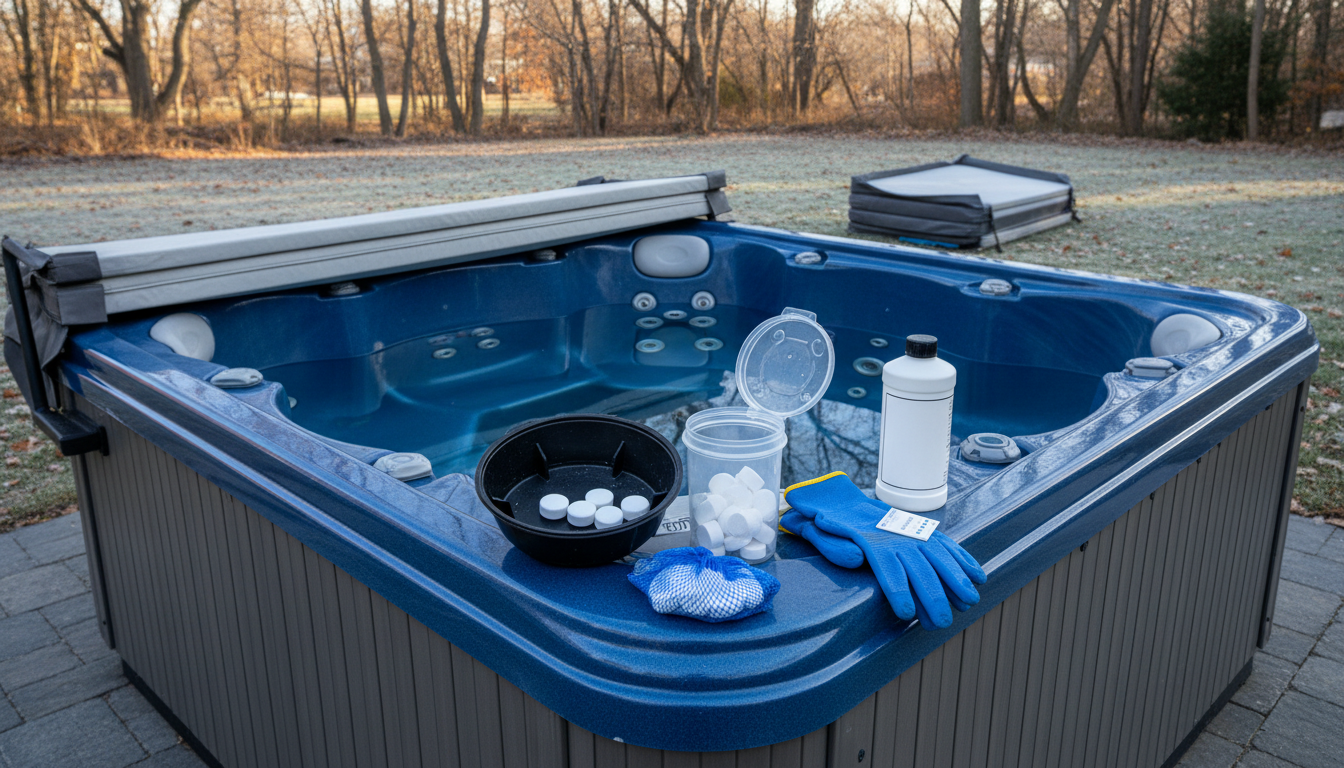
Closing your hot tub for the winter sounds simple until you’re standing there with a tube of bromine tablets wondering exactly how many to drop in before you button everything up. Too few and you’ll open the tub in spring to a swamp; too many and you risk bleaching the shell and degrading the gaskets over months of idle time.
For a standard 6-person hard-shell hot tub holding 350 to 450 gallons, the right closing dose is 4 to 6 bromine tablets (1-inch tablets) in a fully open floater, targeting a residual of 4 to 6 ppm in the water before you seal the cover. This article walks through how to calculate that for your specific tub volume, how to shock and test before you add the tablets, the exact closing steps in order, and what to avoid so you don’t damage equipment over a long off-season.
How Many Gallons Is a 6-Person Hard-Shell Hot Tub?
Before you dose anything, you need a real gallon count. Most 6-person hard-shell hot tubs hold between 350 and 500 gallons, with 400 gallons being a solid middle-ground estimate for a typical acrylic shell model. Check your owner’s manual for the factory spec – it’s usually listed in the technical section alongside jet count and pump horsepower. If you can’t find it, the tub’s serial tag or the manufacturer’s website almost always lists it.
Why does the exact number matter? Because bromine tablets dissolve over time, and the amount of chemistry they release is directly tied to water volume. A 350-gallon tub and a 500-gallon tub are both “6-person” in marketing language, but they’re 40% apart in water volume – and that gap affects how fast your residual climbs and whether you end up over- or under-sanitized through the winter.
The Right Bromine Residual Before You Close
The target bromine residual going into winter storage is 4 to 6 ppm. That range is high enough to suppress bacteria and algae through months of cold, dark storage, but low enough that it won’t slowly attack rubber gaskets, jet o-rings, and acrylic surfaces the way a 15 to 20 ppm level would. According to general hot tub bromine guidance, routine bromine levels in active tubs run 3 to 5 ppm, so for a closed, unoccupied tub you want to stay at or just above that normal ceiling.
Do not aim for 10 ppm or higher thinking “more is safer for winter.” A highly concentrated bromine solution sitting in a sealed tub with zero dilution or aeration for four to five months is a very different situation from daily-use chemistry. High residuals in storage conditions can discolor the shell, stiffen gaskets, and corrode the chrome on jet faces.
Step-by-Step: Bromine Tablet Closing Process
Follow these steps in order. Skipping the shock step is the most common mistake – it leaves dead combined bromines in the water that inflate your test reading without actually providing real sanitizing power.
- Balance the water first. Before you touch sanitizer, get your chemistry in range: pH 7.2 to 7.6, total alkalinity 80 to 120 ppm, calcium hardness 150 to 250 ppm. Unbalanced water closes in a bad state and can scale or corrode over winter. The pH step is especially important for a bromine tub – bromine works most efficiently at pH 7.2 to 7.4.
- Shock with a non-chlorine oxidizer (MPS). Add 2 oz of MPS shock per 300 to 400 gallons, which comes out to roughly 2 oz for a 400-gallon tub. Run the jets for 20 minutes with the cover off to circulate. This oxidizes the organic load and reactivates combined bromines into free bromine before you close. Wait at least 20 to 30 minutes after shocking before you test.
- Test your bromine level. Use a reliable test strip or a drop-based kit. If the free bromine reads below 3 ppm after shocking, add 1 to 2 tablets to the floater and run the jets another 15 minutes before re-testing. If it reads 4 ppm or above, move to the next step.
- Load the floater with 4 to 6 tablets and set it to fully open. A fully open floater setting maximizes the dissolving surface area. The tablets will continue releasing bromine slowly as the water sits, maintaining your residual over the off-season even as some bromine off-gasses or reacts with trace organics. For a full guide on floater behavior in different tub sizes, this overview of bromine use in spas covers how dissolution rates change with temperature and flow.
- Run the jets one final time for 10 minutes. This distributes the fresh bromine from the floater evenly through the plumbing and shell.
- Close and lock the cover. A tight-fitting cover keeps UV light out (UV degrades bromine fast) and prevents debris from getting in. If your cover has cracks or a sagging waterlogged foam core, this winter is a good time to address it – a compromised cover lets bromine off-gas faster and undermines everything you just did.
Why Tablet Count Matters More Than You Think
Here’s a worked example. Say your tub holds 400 gallons. Each standard 1-inch bromine tablet weighs about 1 oz and raises bromine in a 300-gallon tub by roughly 2 ppm as it fully dissolves. In 400 gallons, one tablet raises levels by about 1.5 ppm. To get from a post-shock level of 2 ppm up to 5 ppm, you need to add about 2 ppm – that’s roughly 1 to 2 tablets of additional dissolving chemistry, with the floater continuing to release bromine as it sits.
So why load 4 to 6 tablets total if you only need 1 to 2 to hit the target? Because the floater doesn’t dissolve all at once. With a fully open floater, tablets dissolve gradually over weeks. The goal is to have enough tablet mass in there to maintain the residual across a 3 to 5 month off-season, not just to spike the level on closing day. Four tablets in a fully open floater in a 400-gallon sealed tub is a reasonable supply for a full winter. Six tablets gives you a bit more buffer if your closing is in October and you’re not reopening until late April.
Common Mistakes When Closing a Bromine Tub
- Skipping the shock step: Your test strip might show 4 ppm, but if you haven’t shocked recently, much of that could be combined bromine (bromamines) that doesn’t actually sanitize. Always oxidize before you close so what you’re reading is working free bromine.
- Leaving the floater in a drained or near-empty tub: If you’re draining the tub for winter, remove the floater first. Concentrated tablets sitting against a dry or nearly dry shell surface will bleach and etch the acrylic. Take them out before you drain.
- Ignoring pH before adding tablets: Bromine tablets are acidic. Six tablets slowly dissolving in a sealed tub over winter will push pH down. Starting with pH at 7.4 to 7.6 gives you a buffer against that drift. Starting at 7.0 means you may open in spring to pH below the safe range, which is corrosive to jets and fittings.
- Over-loading the floater “just to be safe”: Ten or more tablets in a small, sealed tub is a real problem. Bromine levels above 10 to 15 ppm, sustained over months, will degrade rubber components and fade the shell finish. More is not better here.
If you find your bromine levels are hard to stabilize even before closing, it’s worth reviewing what’s eating your sanitizer – this breakdown of why hot tubs won’t hold a sanitizer reading covers the most common causes, from bather load to water chemistry imbalances that make bromine burn off faster than expected.
Bromine vs. Chlorine for Winter Closing: Quick Comparison
| Factor | Bromine Tablets | Dichlor Shock (Chlorine) |
|---|---|---|
| Form for closing | Tablet floater (slow dissolve) | Granular, one-time dose |
| Residual longevity | Weeks to months via floater | Dissipates in days to weeks |
| pH impact | Gradually acidic | Mildly acidic |
| Works in hot tubs already on bromine | Yes, no system switch needed | Can disrupt bromine bank |
| Risk of over-dosing in storage | Moderate if floater overfilled | Low if dosed once at close |
If your tub runs on bromine all season, stick with bromine for the closing dose. Switching to chlorine at closing disrupts the bromide bank in the water and means you’ll need to re-establish bromine chemistry from scratch in the spring. AquaDoc makes bromine tablets sized specifically for hot tub floaters – the 1-inch format dissolves more evenly in a small water volume than pool-sized 3-inch tablets, which are easy to accidentally over-dose in a 400-gallon tub.
And if you’re on the fence about whether to close at all – some owners in mild climates keep using their tub year-round – the guide to using a hot tub through winter lays out what that maintenance schedule actually looks like, which is a different chemistry picture entirely from a tub you’re putting to sleep.
Frequently Asked Questions
How many bromine tablets should I add to a 6-person hot tub before closing for winter?
Add 4 to 6 bromine tablets (1-inch tablets) to a fully open floater in a 6-person hard-shell hot tub holding roughly 350 to 450 gallons. Your target is a free bromine residual of 4 to 6 ppm in the water before you seal the cover for the off-season.
What bromine level should a hot tub be at before winter closing?
Aim for 4 to 6 ppm of free bromine before closing. Below 4 ppm leaves the water under-sanitized during storage; above 10 ppm can bleach the acrylic shell and attack rubber gaskets and jet fittings over months of sitting idle.
Can I just leave my bromine floater running through winter instead of draining?
Only if you are not draining and plan to actively maintain the tub through cold weather. If you are closing and draining, remove the floater before you drain – tablets resting against a dry shell surface will bleach and etch the acrylic at concentrated contact points.
Do I need to shock a bromine hot tub before closing it for winter?
Yes. A non-chlorine MPS shock at roughly 2 oz per 400 gallons, applied 24 hours before closing, oxidizes organic waste and reactivates the bromine bank. This ensures the residual you measure is free, active bromine rather than combined bromamines that look good on a test strip but don’t sanitize.
What happens if I add too many bromine tablets before winterizing?
A bromine level above 10 to 15 ppm sustained in a sealed, unoccupied tub for months can bleach the acrylic shell, stiffen rubber gaskets, and corrode metal jet components. Stick to 4 to 6 tablets in a fully open floater to stay in the safe 4 to 6 ppm residual range.
For a 6-person hard-shell hot tub, 4 to 6 bromine tablets in a fully open floater – preceded by an oxidizing shock and balanced water chemistry – is the right closing dose to keep your water clean through winter without damaging the equipment sitting idle inside.