
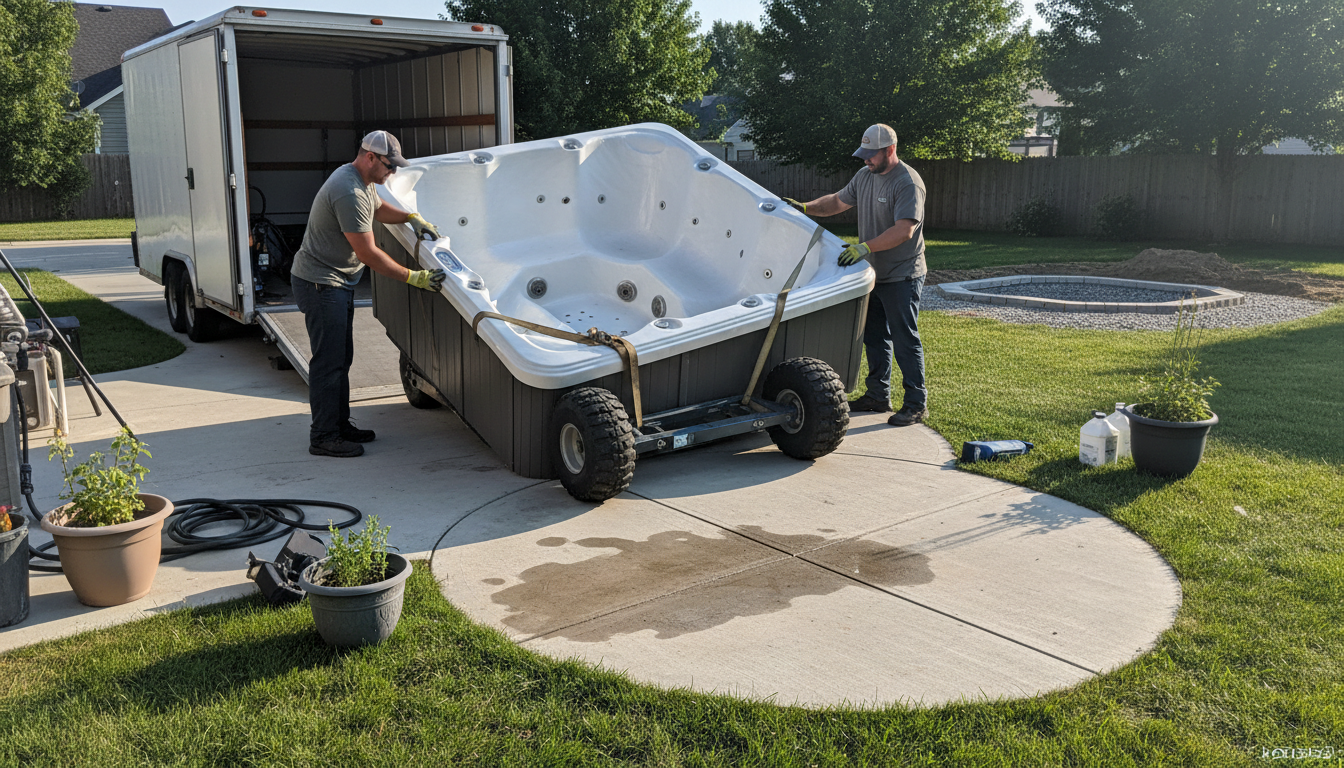
You’ve finally found the perfect spot for your hot tub – or you’re hauling it to a new house and you’d rather not leave it behind. Then you start calling around for quotes and get numbers all over the map, from “we can do it for $200” to “that’ll be $1,400 before the crane fee.” What’s going on?
Hot tub moving costs typically range from $150 to $1,500 or more, depending on distance, access difficulty, tub size, and whether electrical disconnect or crane service is involved. According to hot tub moving specialists, most local moves land between $300 and $800. This article walks through every cost factor, shows you a realistic worked example, and flags the mistakes that turn a $400 job into a $1,200 one.
The Base Moving Fee: What’s Included and What’s Not
Most professional hot tub movers charge a base rate that covers labor (typically a two- to four-person crew), a flatbed or enclosed truck, moving straps, and basic equipment like furniture dollies or skid boards. That base rate usually runs $200 to $600 for a local move within 25 miles. Beyond 25 miles, expect a per-mile charge of roughly $2 to $5 on top of the base fee, which means a 75-mile move can add $150 to $375 to your bill before any other variables enter the picture.
What the base rate almost never includes: crane service, electrical disconnection, permits, a new concrete pad at the destination, or any landscaping repairs if the crew damages your lawn rolling the tub out. Get a line-item quote, not a single number, so you know exactly what you’re comparing between companies.
Access Difficulty: The Biggest Price Variable
The single factor that blows up hot tub move budgets more than anything else is access – or the lack of it. A hot tub sitting on a ground-level patio with a wide gate and a flat driveway is about as easy as it gets. Everything else costs more. Hot tub relocation companies generally price jobs based on how many “problem points” exist between the tub’s current spot and the truck.
- Narrow gates or fences: Anything under 36 inches wide usually means a panel has to come off the fence, or the tub has to go over it. Add $100 to $300 for fence removal and reinstallation.
- Stairs or elevation changes: Each set of steps adds risk and labor. Expect $75 to $200 per staircase involved.
- Soft or uneven ground: Wet grass, gravel, or slopes require extra equipment and slower movement, typically adding $75 to $150 to the job.
- Crane requirement: If there’s no path at ground level, a crane lift over a wall or roof costs an additional $400 to $800 on top of the base moving fee. A detailed hot tub moving cost guide notes that crane surcharges are one of the most commonly overlooked expenses in initial quotes.
- Urban locations: Street parking restrictions, permits to block a lane, or elevator-only building access all add logistics costs ranging from $50 to $200.
A Worked Example: Moving a 6-Person Spa 15 Miles
Say you have a 6-person hard-shell hot tub sitting on a patio behind your house. The backyard gate is 42 inches wide, there’s a single step down from the patio, and your new place is 15 miles away with decent access. Here’s what that realistically looks like, priced out:
- Base moving fee (3-person crew, flatbed): $450
- Step surcharge (1 step at origin): $100
- Mileage (15 miles, included in base for most local movers): $0
- Electrician disconnect at origin: $175
- Electrician reconnect at destination: $250
- Total: approximately $975
That’s before any surprises. If your new backyard turns out to have a 30-inch gate and the crew has to tip the spa on its side and carry it through, tack on another $150 to $250. The lesson: walk both sites carefully before the movers show up, and share photos or videos with your mover in advance so they can quote accurately.
Electrical Costs: The Bill Most People Forget
Hot tubs run on 240V dedicated circuits. When you move one, that circuit doesn’t come with it. You need a licensed electrician to disconnect the supply safely at the old location and to run new wiring, connect the GFCI breaker, and inspect the setup at the new one. This is not optional and not something a general handyman should handle.
Disconnect fees typically run $100 to $300. Reconnection at the new location, which may involve running new conduit and setting a new breaker, usually costs $150 to $400. If your new location doesn’t have a nearby subpanel and the electrician has to run a long wire run, that number can climb to $600 or more. Some jurisdictions require a permit for new electrical connections, adding another $50 to $150. Budget $400 to $700 for electrical as a combined line item and you’ll be in the right ballpark for most moves. Hot Spring Spas recommends getting the electrical estimate before you finalize your moving budget because it’s often the cost that surprises people the most.
What About Moving a Hot Tub During a Home Sale?
If you’re selling your home and want to take the hot tub with you, the timing and logistics get more complicated. First, check your purchase contract – if the listing included the hot tub, removing it may require negotiation or a credit to the buyer. Even if it’s legally yours to take, plan to have it removed before closing day so there’s no dispute about the condition of the deck or pad it was sitting on.
Buyers and sellers often underestimate how much a hot tub relocation affects a real estate deal. Realtors dealing with hot tub negotiations note that it’s common for sellers to offer a cash credit rather than deal with the logistics of moving the spa, especially if it’s an older unit. If your tub is more than 10 to 12 years old, honestly weigh the cost of moving it against its current market value. A 12-year-old hot tub might fetch $500 to $2,000 used, and if the move costs $900, you’re breaking even at best.
DIY Hot Tub Moving: When It Makes Sense and When It Doesn’t
A drained hard-shell hot tub weighs between 600 and 900 lbs for most 4- to 6-person models. That’s manageable with four strong people, the right equipment (appliance dollies rated for 1,000+ lbs, moving straps, plywood sheets to protect the deck), and a completely flat path. If all those conditions are true, a DIY move can cut your bill to the cost of truck rental ($100 to $200 for a flatbed or enclosed trailer) plus time and beer money.
The risk is that most people discover mid-move that their conditions are not all perfect. A slight slope, a tight turn, or a patch of soft ground turns a controlled slide into a dropped 800-lb shell. Cracked acrylic shells are expensive to repair – sometimes $300 to $700 – and a back injury is worse. Unless the move is a true short shuffle on flat, hard ground, hiring professionals is the smarter bet. And once the tub is in its new home, you’ll want to check your water chemistry before firing it back up; AquaDoc makes a complete startup chemical kit that covers the first few weeks of balanced, sanitized water after a refill.
If you’re also dealing with repairs around the time of the move, it’s worth knowing what component replacements cost beforehand – for example, understanding hot tub spa pack replacement costs can help you decide whether a tub is worth moving or replacing entirely before you spend money on the logistics.
How to Get a Fair Quote
Getting accurate quotes comes down to giving movers accurate information. Before you call, photograph both locations, measure gate widths, count steps, check whether the new pad is concrete or wood decking, and know your tub’s make, model, and approximate weight. The more detail you give, the more accurate the quote – and the less likely you are to get hit with on-site surcharges.
- Get at least two quotes: Price differences of $200 to $300 between companies on the same job are common.
- Ask if the quote is all-inclusive: Confirm that fuel, crew size, mileage, and any access surcharges are in the number they give you.
- Confirm insurance: Ask whether the mover carries liability coverage for property damage. If they don’t, you’re on the hook if they crack your tub or damage your fence.
- Time it right: Weekday moves are often 10 to 15 percent cheaper than weekend slots.
Also consider the condition of your jets and internal components before you move. Relocation is a good time to assess whether anything needs replacing, since the tub will be drained anyway. A quick read on swim jet vs therapy jet replacement costs can help you plan any repairs alongside the move rather than dealing with them separately later.
Frequently Asked Questions
How much does it cost to move a hot tub?
Most local hot tub moves cost between $300 and $800 for a professional crew, covering labor, truck, and standard equipment. Add $400 to $700 for electrical disconnect and reconnect, and factor in crane fees ($400 to $800) if access requires it. The full all-in cost for a typical local move with electrical runs $700 to $1,500.
Can I move a hot tub myself to save money?
You can DIY a hot tub move if the path is flat, hard, and fully accessible, and if you have four capable people and proper equipment. A drained 6-person hard-shell tub weighs 600 to 900 lbs, so you’ll need heavy-duty dollies rated for at least 1,000 lbs. Truck or trailer rental runs $100 to $200. For anything more complex than a flat shuffle, hire a professional – the risk of shell damage or injury usually outweighs the savings.
What does a crane cost to move a hot tub over a fence or wall?
Crane service for a hot tub lift typically adds $400 to $800 to the moving bill. Some companies include smaller equipment lifts in their base rate, so always confirm upfront whether your site requires a crane and whether that’s covered or extra. Get it in writing before the crew shows up.
Do hot tub movers handle the electrical disconnect and reconnect?
No – electrical work on a 240V circuit must be done by a licensed electrician, not the moving crew. Budget $100 to $300 for disconnection and $150 to $400 for reconnection. Some areas require permits for new connections, which add another $50 to $150 to that number.
How much does it cost to move a hot tub to a new house across town?
A cross-town move under 25 miles typically runs $400 to $800 for the physical move, plus $400 to $700 for electrical, putting the realistic all-in budget between $800 and $1,500. Access issues at either end can push the number higher. Always walk both sites before booking and share photos with your mover so they can price the job accurately.