
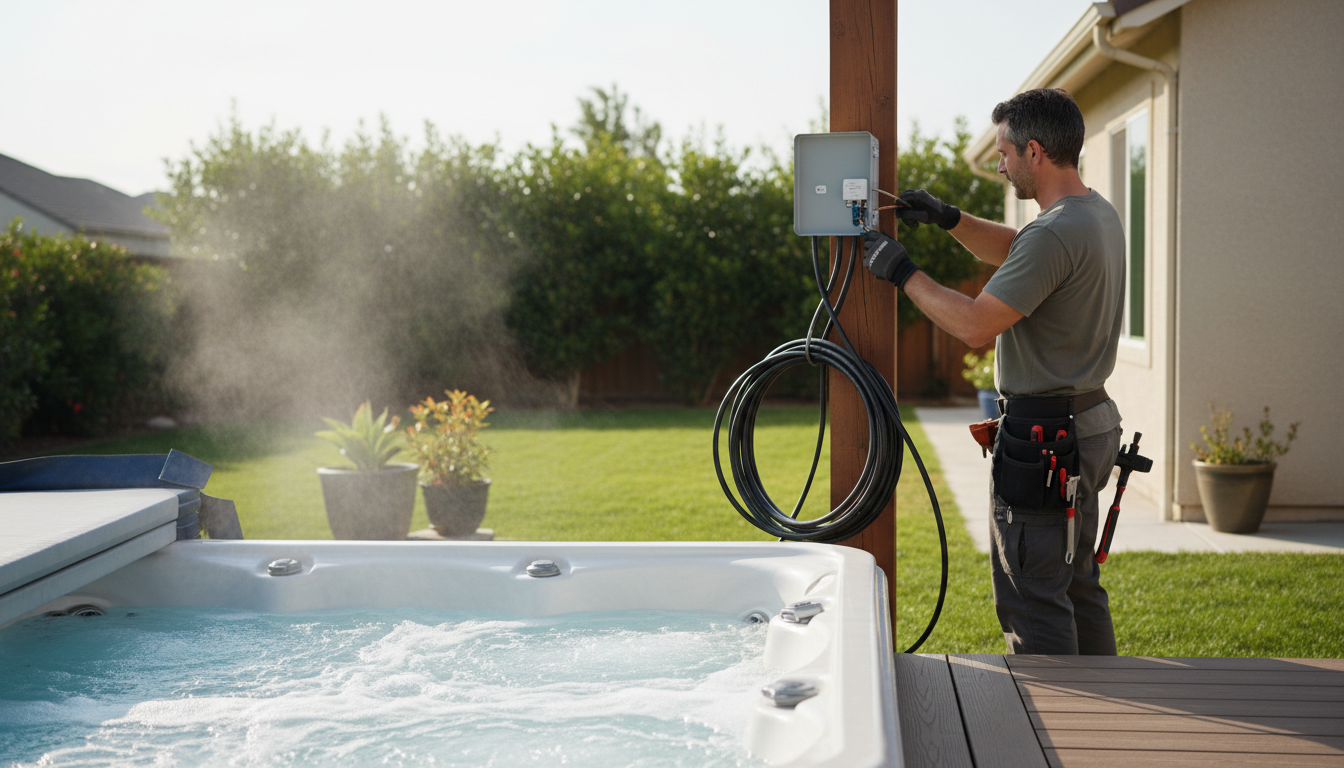
Adding a 240V dedicated circuit for a hot tub costs $800 to $2,500 installed, with most homeowners landing somewhere between $1,000 and $1,600 for a standard setup where the electrical panel already has room and the tub sits within 50 feet of the house. That range jumps significantly if your panel needs an upgrade or you’re running conduit across a long backyard. The good news is that once you understand what drives the price, the quote your electrician gives you will make a lot more sense.
If you’ve ever watched an electrician flip open your panel and stare silently for a moment before sighing, you know that sinking feeling. Getting a hot tub wired is not complicated work for a licensed pro, but it involves more moving parts than people expect: breaker size, wire gauge, conduit runs, disconnect boxes, GFCI protection, trenching, and permits. This article walks through every cost factor so you can budget accurately and ask the right questions before anyone picks up a shovel.
What the Total Price Actually Includes
A complete 240V hot tub circuit install covers several distinct pieces of work, and quotes can look very different depending on what each contractor bundles in. Here is what a full job typically includes:
- Panel work: Adding a 50-amp double-pole GFCI breaker to your existing panel, assuming a slot is available. This alone runs $200 to $400 in parts and labor.
- Wire run: Running 6-gauge wire (the minimum for a 50-amp circuit) from the panel to the disconnect box. Wire costs $1 to $2 per foot, and a 50-foot run adds $50 to $100 in materials before labor.
- Conduit: Where wire runs above ground or through a wall, it goes inside conduit. PVC conduit is standard for underground runs. Expect $1 to $3 per foot for materials.
- Disconnect box: National Electrical Code requires a 120V-rated disconnect within sight of the hot tub, typically 5 to 10 feet away. The box itself costs $50 to $150.
- GFCI breaker: A 50-amp double-pole GFCI breaker costs $60 to $150 depending on brand and panel compatibility.
- Permit and inspection: Almost every municipality requires a permit for this work. Permit fees run $50 to $200 in most areas.
- Labor: Licensed electrician labor runs $75 to $150 per hour. A clean, simple job takes 4 to 6 hours; a complex one can run 8 hours or more.
What Pushes the Cost Higher
The biggest single cost driver is whether your electrical panel can handle the new circuit. A modern 200-amp panel with open slots is a quick, inexpensive job. An older 100-amp panel that is already full is a different story entirely. A panel upgrade from 100 to 200 amps adds $1,500 to $3,500 to the project, completely independent of the hot tub wiring itself. If your electrician tells you that you need a panel upgrade, get a separate quote for that work so you understand what you’re comparing.
Trench distance is the second major variable. If your hot tub pad is 20 feet from the house, trenching is minimal. If it’s 80 feet out in the yard, you’re looking at a half-day of digging, conduit, and wire that can add $500 to $1,000 to the bill. Underground conduit must be buried at least 6 inches deep for rigid metal conduit or 24 inches deep for PVC, per NEC requirements. Some electricians use a trenching machine, which is faster; others do it by hand, which takes longer. Either way, you are paying for that time.
Local labor rates vary enough to matter. An electrician in a rural Midwest market might charge $75 per hour; one in a major metro on either coast can run $130 to $150 per hour. That difference alone accounts for $300 to $600 on a 6-hour job. Always get at least two quotes, and make sure both include the permit fee so you are comparing apples to apples.
A Worked Example: Typical Suburban Install
Say you have a 200-amp panel with two open slots, your hot tub pad is 40 feet from the house, and your local permit fee is $100. Here is how that job prices out:
- 50-amp GFCI breaker: $100
- 6-gauge wire, 50 feet: $75
- PVC conduit, 40 feet underground: $80
- Disconnect box and hardware: $120
- Permit: $100
- Labor, 5 hours at $100/hour: $500
- Total: approximately $975
Add a panel upgrade or double the trench run and that same job crosses $2,000 easily. That is the range in action: simple jobs sit near $900 to $1,100, complex jobs sit near $1,800 to $2,500.
Cost Comparison: Common Scenarios
| Scenario | Estimated Cost | Main Cost Driver |
|---|---|---|
| Panel has open slots, tub within 30 ft | $800 to $1,200 | Labor and permit only |
| Panel has open slots, tub 50 to 80 ft away | $1,200 to $1,800 | Trenching and long wire run |
| Panel full, needs tandem breaker or sub-panel | $1,500 to $2,200 | Sub-panel or load calculation work |
| Full panel upgrade (100A to 200A) required | $2,500 to $6,000 combined | Panel upgrade plus circuit install |
The panel upgrade row deserves a second look. If your home still runs on a 100-amp service and you are adding a hot tub that draws 40 to 50 amps continuously, an upgrade is not optional. It is a safety and code requirement, not an upsell. Budget for it separately and treat the hot tub wiring as a second line item so the numbers stay clear.
Permits, Inspections, and Why You Cannot Skip Them
A 240V hot tub circuit is not a job you pull from a permit to save $100. Most municipalities require an electrical permit, and an inspector must sign off before the tub goes live. The reason matters: hot tubs operate at 240V in a wet environment, and a wiring error can be fatal. The permit process exists to catch those errors.
Skipping permits creates real financial risk too. If you file a homeowner’s insurance claim related to the hot tub (electrical fire, electrocution injury, property damage) and the circuit was unpermitted, your insurer can deny the claim. Some lenders and appraisers also flag unpermitted electrical work when you sell. The $50 to $200 permit fee is not optional; build it into every quote you request.
What You Can Do to Keep Costs Down
You cannot legally do the wiring yourself in most states, but you can reduce the overall bill in a few practical ways. First, place the hot tub as close to the electrical panel as the site allows. Every 10 feet of additional wire run adds materials and labor. Second, have the conduit trench dug before the electrician arrives if your municipality allows it (confirm first). Digging your own trench can save $150 to $300. Third, if you are also planning other electrical work, bundling it with the hot tub circuit saves a mobilization charge, typically $50 to $150.
When you are budgeting for a new hot tub installation, it helps to look at the full picture of what setup costs. If you are also relocating the tub to a new spot on the property, the Hot Tub Moving Cost: What You’ll Actually Pay breakdown on this site puts realistic numbers on that piece of the project. Electrical and moving costs together often surprise people more than the tub itself did. And once your tub is wired and running, keeping the spa pack in good shape is the next thing to budget for: the Hot Tub Spa Pack Replacement Cost: What You’ll Actually Pay guide covers what that component costs when it eventually needs replacing.
One thing that is easy to overlook in all of this: keep your water chemistry balanced from day one so you are not compounding electrical component wear with chemical damage. AquaDoc makes a hot tub startup kit that pool and spa owners use specifically to dial in chemistry during the first fill, which is when scale and pH problems tend to get baked in.
Frequently Asked Questions
How much does it cost to install a 240V dedicated circuit for a hot tub?
Most homeowners pay $800 to $2,500 for a licensed electrician to install a 240V dedicated circuit for a hot tub. The wide range reflects differences in panel capacity, trench distance, local permit fees, and regional labor rates. A simple suburban install with a ready panel typically lands around $900 to $1,200.
What size breaker do I need for a 240V hot tub circuit?
Most 240V hot tubs require a 50-amp double-pole GFCI breaker, though some smaller models specify a 40-amp breaker. Always check your hot tub’s nameplate or owner’s manual before purchasing the breaker, because using an undersized breaker will cause repeated trips and can damage the spa pack over time.
Do I need a permit to add a 240V hot tub circuit?
Yes, in virtually every jurisdiction a permit is required to install a dedicated 240V circuit for a hot tub. Permit fees typically run $50 to $200, and an inspection is required before you use the tub. Skipping the permit can void your homeowner’s insurance and create serious liability exposure if anything goes wrong.
How long does it take an electrician to wire a hot tub?
A straightforward hot tub wiring job takes 4 to 8 hours for a licensed electrician when the panel has open capacity and the tub sits within 50 feet of the house. Add half a day or more if trenching is involved or if the panel needs a sub-panel or upgrade to accommodate the load.
Can I install a 240V hot tub circuit myself to save money?
In most U.S. states and Canadian provinces, 240V hot tub wiring must be performed by a licensed electrician and inspected before use. DIY wiring on this circuit type is prohibited in many jurisdictions and can void both your homeowner’s insurance and your tub’s warranty. This is one job where hiring a licensed pro is not optional.
A 240V dedicated circuit for a hot tub runs $800 to $2,500 installed for most homeowners, with the final number coming down to panel capacity, trench length, and local labor rates. Get two quotes, make sure both include the permit, and confirm the electrician is licensed to pull that permit in your municipality.