
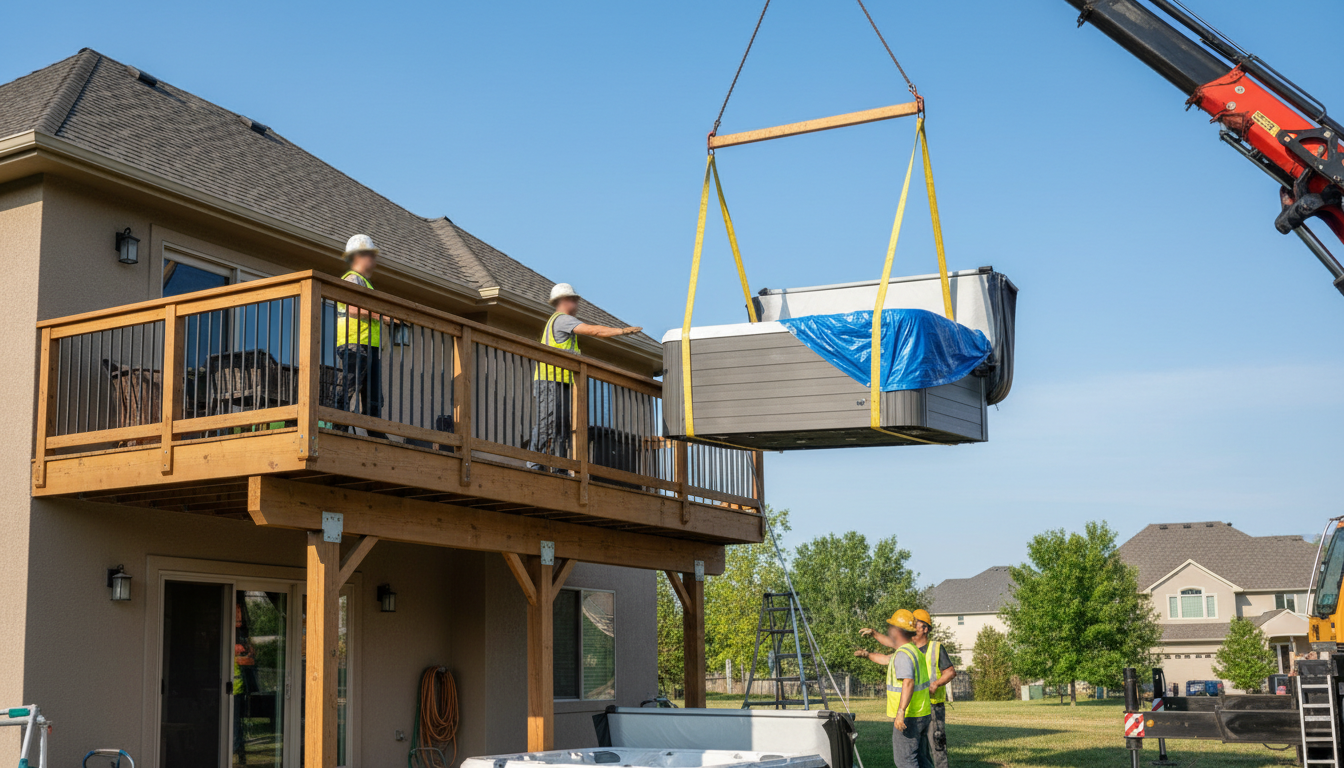
Relocating a hot tub to a second-story deck typically costs $1,500 to $6,000 or more for the full project, depending on the crane required, the structural condition of your deck, electrical work, and local permit fees. The lift and move alone runs $500 to $2,500, but that number rarely tells the whole story once structural reinforcement and a new 240V hookup enter the picture.
If you’ve ever gotten a quote for “just moving the tub” and watched the number balloon before the truck even showed up, you’re not alone. Second-story placements involve a completely different set of trades, risks, and approvals compared to a standard ground-level move. This article walks through every cost component, what actually drives the price up, and the mistakes that catch owners off guard. For a broader look at what professional hot tub moves cost across different scenarios, the Hot Tub Moving Cost: What You’ll Actually Pay guide is worth reading alongside this one.
Why Second-Story Moves Cost More Than Ground-Level Relocations
A ground-level hot tub move is mostly a logistics problem: get a crew, rent a dolly or skid steer, and haul the tub across a flat surface. A second-story deck move is a structural and rigging problem. The tub has to clear the roofline or deck railing, be held in the air by a crane, and land precisely on a surface that may not have been designed to hold it. Every one of those variables adds money.
Hot tubs are deceptively heavy. An empty 6-person acrylic shell weighs 700 to 1,000 lbs on its own. Fill it with water (roughly 400 to 600 gallons depending on size) and add occupants, and you’re looking at 3,500 to 6,000 lbs of live load sitting on a small footprint. That’s a physics problem your deck framing has to answer before anything else moves forward.
The Crane Rental: Your Biggest Single Line Item
A crane or boom truck is almost always required for second-story placements. Hot tubs cannot safely be carried up stairs at that weight, and manual rigging systems over a deck railing invite injury and damage. Crane rental for a residential lift runs $400 to $900 for a half-day, and you’ll often pay for a minimum call-out of four hours even if the actual lift takes 45 minutes.
The crane cost is affected by site access. If the truck can park close to the house and has clear overhead clearance (no utility lines, no tree canopy), you’re in the lower range. A tricky lot with overhead wires, limited street access, or a long reach to the deck can push crane costs to $1,200 or higher because a larger rig is needed. Always have the crane operator do a site visit before you book.
Structural Engineering and Deck Reinforcement
This is where second-story hot tub projects get expensive in a hurry. A typical residential deck is built to handle 40 to 60 lbs per square foot, which covers furniture, people, and a grill. A filled hot tub sitting on a 7×7-foot footprint exerts roughly 100 to 125 lbs per square foot, sometimes more. That’s roughly double what your deck was designed for, and the consequences of getting it wrong are catastrophic.
A structural engineer site visit costs $300 to $700 and produces a written assessment of what your existing framing can handle. If reinforcement is needed (and it usually is for older or standard-grade decks), expect to pay:
- Sister Joists: Adding doubled joists alongside existing ones runs $500 to $1,500 for a typical hot tub footprint, depending on joist depth and access from below.
- Beam Replacement or Addition: If the primary beam under the deck section is undersized, replacing or supplementing it runs $1,000 to $3,000 including labor and materials.
- Post and Footing Work: New point-load posts down to concrete footings can run $800 to $2,500 per post, and you may need two or more directly under the tub’s corners.
- Decking Surface Replacement: If you need to open the deck surface to access framing, re-decking a 10×10 area in composite runs $600 to $1,500 depending on material.
Total structural reinforcement costs for a deck that needs real work: $1,500 to $5,000, and that’s before anyone has touched the hot tub itself.
Electrical Work for a Second-Story Install
Moving a hot tub isn’t just moving a tub. It’s moving an appliance that needs a dedicated 240V, 50-amp or 60-amp GFCI-protected circuit. If your existing ground-level electrical hookup was wired through the house or sub-panel to a location near the original pad, running new conduit up to a second-story deck is a separate job entirely.
A licensed electrician typically charges $400 to $1,200 to run a new 240V circuit from the main panel to a second-story deck location, depending on run length, panel capacity, and whether conduit needs to go through finished interior walls. Add $100 to $200 for the disconnect box itself. Some municipalities require the electrical work to be inspected separately, which adds a permit fee of $50 to $150.
Worked Example: A Real Second-Story Move Budget
Say you have a 7-year-old 6-person hot tub in your backyard and you want it on the second-story deck off your master bedroom. Here’s how a realistic budget builds up:
- Moving crew and rigging: $600 for a 3-person crew with equipment
- Crane rental (half-day, clean site access): $650
- Structural engineer assessment: $450
- Deck reinforcement (sister joists plus two new posts and footings): $2,800
- Electrician (new 240V run, 35 feet of conduit): $750
- Building and electrical permits: $250
- Total: $5,500
That’s a realistic mid-range number for a project without major surprises. If your deck is newer and already engineered for a hot tub, you might land closer to $2,000. If the deck needs significant structural work and the crane site is difficult, $8,000 is not out of the question.
Permits and Inspections: Don’t Skip This Step
Most jurisdictions require at least an electrical permit for the 240V hookup, and a building permit if any structural work is performed on the deck. Some cities also require a hot tub placement permit that triggers a barrier or fence inspection for child safety compliance. Permit fees range from $75 to $400 depending on scope and location.
Skipping permits is a mistake that catches up with homeowners at resale. An unpermitted structural modification to a load-bearing deck, or an uninspected electrical circuit, can derail a home sale or trigger expensive remediation. Call your local building department before scheduling anything.
Common Mistakes That Drive the Cost Up
- Skipping the structural assessment: Ordering the crane before getting an engineer’s report means you might lift a tub onto a deck that can’t hold it. The engineer visit pays for itself.
- Underestimating crane access: Power lines, trees, and narrow driveways all require a larger or more specialized rig. Walk the site with the crane company before booking.
- Assuming the old electrical circuit reaches: The disconnect at your old pad location almost never reaches a second-story deck. Budget for new wire from the start.
- Forgetting the cover and lifter: Your existing cover lifter probably won’t work on a deck with railing on three sides. A new cover lifter costs $150 to $400 and is easy to overlook in the initial budget.
Is the Relocation Worth It Financially?
The move makes financial sense when the hot tub is high-value (think a tub that retailed for $8,000 or more), relatively new (under 7 to 8 years old), and the deck work is modest. If the tub is older and the deck needs major structural investment, run the numbers against buying new. Entry-level hard-shell hot tubs start around $3,000 to $5,000, and a new installation on a properly reinforced deck can sometimes land cheaper than relocating an aging unit. If you’re also dealing with aging internal components, checking hot tub spa pack replacement costs before committing to the move is a smart step, since a spa pack replacement runs $500 to $1,500 and may change the math on whether the tub is worth relocating at all.
AquaDoc makes a spa water care kit that pool and hot tub owners use to get chemistry dialed in after a move, since draining and refilling during relocation resets your water balance entirely and you’ll want to start fresh with a proper chemical baseline.
Frequently Asked Questions
How much does it cost to move a hot tub to a second-story deck?
Total costs typically run $500 to $2,500 for the move itself, but structural deck reinforcement adds another $1,000 to $5,000 or more depending on your deck’s current condition. A crane rental alone can run $400 to $900 for a half-day. Budget at least $2,000 to $4,500 for the full project before the first quote arrives.
Do I need a crane to lift a hot tub to a second-story deck?
In most cases, yes. Hot tubs weigh 500 to 800 lbs empty, and a full-size 6-person model can exceed 1,000 lbs dry. Stairs and manual rigging are rarely viable at that weight, so a crane or boom truck is the standard method for second-story placements.
Does a second-story deck need to be reinforced before placing a hot tub on it?
Almost certainly. A filled hot tub exerts 100 to 125 lbs per square foot on the structure beneath it, while a typical residential deck is designed for 40 to 60 lbs per square foot. A structural engineer ($300 to $700 for a site visit and report) should assess the deck before you move anything.
What permits are required to place a hot tub on a second-story deck?
Permit requirements vary by municipality, but most jurisdictions require an electrical permit for the 240V hookup and a building permit if structural modifications are made to the deck. Some areas also require a separate permit for the hot tub itself. Call your local building department before scheduling the move.
Is it cheaper to buy a new hot tub than to relocate an existing one to a second-story deck?
If your deck needs major structural work, it can be. A full project (move, crane, structural reinforcement, electrical) can reach $5,000 to $8,000 or more. Entry-level hot tubs start around $3,000 to $5,000 new, so run both numbers before deciding. The relocation makes financial sense mainly when the tub itself is high-value or less than 5 to 7 years old.
Moving a hot tub to a second-story deck is a $2,000 to $6,000 project for most homeowners once crane, structural work, and electrical are factored in. Get the structural engineer assessment first, and every other decision gets easier.