
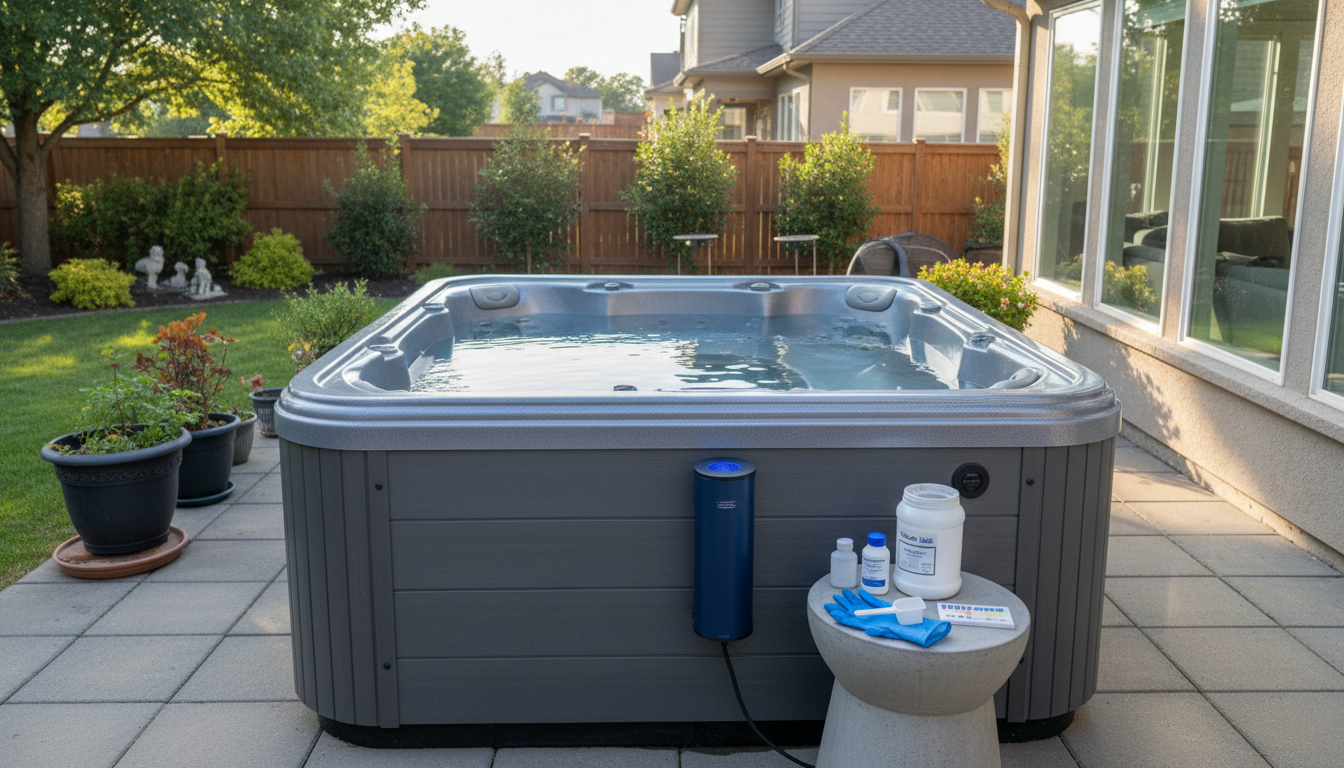
You are standing next to your compact two-person hot tub with a bag of bromine in one hand and absolutely no idea how much of it to dump in before you button everything up for the season. If your tub also has a UV sanitizer system, the question gets even murkier, because half the advice online is written for chlorine spas without any supplemental sanitizer at all.
Here is the direct answer: when closing a 2-person hard-shell hot tub (typically 200 to 350 gallons) with a UV system, dose the water to reach 10 ppm free bromine as a closing shock. For a 300-gallon tub starting at 2 ppm, you need roughly 1.5 to 2 oz of granular bromine shock (sodium dichloroisocyanurate or potassium monopersulfate-activated bromide). The UV lamp does not leave a residual, so this chemical dose is still non-negotiable. This article walks through the full closing sequence, the exact math, what the UV system changes (and what it does not), and the mistakes that cause cracked fittings and funky-smelling water come spring.
What the UV Sanitizer Actually Does (and Does Not Do) at Closing
A UV sanitizer works by running water past a germicidal lamp inside a small chamber. It destroys pathogens on contact with great efficiency, which means you can operate your bromine level lower during the season, often in the 2 to 3 ppm range instead of the standard 3 to 5 ppm. That is a real benefit when the tub is running daily. At closing, though, it matters not at all. The UV lamp only treats water that flows through the chamber. Once circulation stops, there is zero residual UV effect in the shell, the jets, or the plumbing. Any biofilm or bacteria sitting in a stagnant jet line is completely unaffected by the UV system. This is why the closing chemical dose for a UV-equipped tub is identical to the closing dose for a conventional bromine tub: you need a true chemical residual to protect the plumbing through weeks or months of idle time.
Calculating Your Exact Bromine Closing Dose
The target for a closing shock is 10 ppm free bromine. That is roughly double the high end of normal operating range, and the purpose is to give every surface, fitting, and jet passage a final sanitizing surge before the water sits. Here is how to work out your specific dose.
First, test your current free bromine level. Say your 300-gallon tub reads 2 ppm before you start. You need to raise it by 8 ppm. A general rule for granular bromine shock (sodium bromide activated with an oxidizer, or a combined bromine granule product) is that 1 oz per 300 gallons raises free bromine by approximately 4 to 5 ppm. So for an 8 ppm increase in a 300-gallon tub, you are looking at 1.5 to 2 oz of product. If your tub is on the smaller end at 220 gallons and your starting bromine is already at 4 ppm, you only need a 6 ppm bump, and 1 to 1.25 oz will get you there. Always use a reliable test strip or drop kit to verify before and after, never guess.
If you have been using bromine tablets in a floater as your primary sanitizer alongside the UV lamp, check whether you have an active bromide bank built up. A tub with a healthy bank (the residual bromide ions left behind from prior tablet use) will respond faster to oxidizer shock than a tub that has been reset recently. If your tub is bromine-fresh, you may need to add a sodium bromide bank dose first, typically 1 to 2 oz per 300 gallons, before the shock will register as free bromine on your test.
Step-by-Step Closing Sequence for a UV-Equipped 2-Person Hot Tub
- Step 1: Balance the water chemistry first. Target pH 7.4 to 7.6 and total alkalinity 80 to 120 ppm before adding any sanitizer. Bromine works far less effectively outside that pH window, and water that sits at the wrong pH all winter can stain or etch the acrylic shell.
- Step 2: Add the bromine closing shock. With the jets running, add your calculated dose of granular bromine shock, 1.5 to 2 oz for a 300-gallon tub starting at 2 ppm, directly to the water near a jet return. Never add chemicals to the skimmer basket.
- Step 3: Run the jets for 15 to 20 minutes. This pushes the bromine-rich water through every jet line, massaging fitting, and plumbing loop. That 15-to-20-minute window is what separates a proper closing from one that leaves bacteria hiding in a neglected jet port all winter.
- Step 4: Test and confirm 10 ppm. Before draining, verify the free bromine reading hits your target. If it falls short, add another 0.5 oz and circulate for five more minutes.
- Step 5: Turn off and disconnect the UV system. Power down the UV lamp per the manufacturer’s instructions. Most lamps should not remain energized without water flow. Remove the lamp cartridge if your system calls for winter storage indoors; UV quartz sleeves can crack in a freeze.
- Step 6: Drain the tub completely. If you are in a freeze-risk climate (any area that sees below 32°F), drain every drop. Partial draining is not enough; residual water in jet lines will freeze and crack PVC fittings.
- Step 7: Blow out the jet lines. Use a wet/dry shop vac set to blow mode on each jet port for 20 to 30 seconds. This clears water that gravity alone will not remove from horizontal runs and U-bends in the plumbing.
- Step 8: Wipe down the shell and cover. Let the shell air-dry, then cover with your insulated hard cover. A properly fitted cover is your first line of defense against debris, UV degradation, and heat loss if you plan to refill early in spring.
How the UV System Changes Your Seasonal Chemistry Strategy
During normal operation, a UV system lets you run bromine at the lower end of the acceptable range, 2 to 3 ppm, because the lamp handles a significant portion of the pathogen load. That is worth noting because it means your bromide bank may be thinner at closing time than a tub that has been running tablets heavily all season. If you have been dialing back chemical use to let the UV do its job, test your bromide reserve before closing and add a sodium bromide supplement if needed. Without a good bank, the shock dose will convert and dissipate quickly instead of building a lasting 10 ppm reading. AquaDoc makes a bromine bank booster that pool and spa owners use specifically for this situation, adding it before the shock so the oxidizer has ions to convert into active bromine.
The UV lamp itself has a finite lifespan, typically 12 to 18 months of regular use. If your lamp is nearing that range, closing time is a good moment to swap it out so you have a fresh lamp ready when you refill in spring. Installing a new lamp into a cold, dirty system is harder than doing it cleanly during a dry closing.
Common Closing Mistakes That Come Back to Haunt You
- Skipping the shock because the UV handles it: As covered above, UV provides zero chemical residual. This is probably the most common mistake UV hot tub owners make at winterizing time, and it is the one most likely to result in a biofilm-coated plumbing system and cloudy, foul-smelling water when you refill in spring.
- Adding shock without balancing pH first: Bromine shock added to water at pH 8.0 or above works at a fraction of its rated efficiency. Balance first, then shock, never the reverse.
- Not circulating long enough: Adding the closing dose and immediately draining means the chemical never reached the jet lines. Run the jets for the full 15 to 20 minutes even if you are eager to get the job done.
- Leaving the UV lamp installed through a hard freeze: The quartz sleeve around most UV bulbs is glass. Trapped water or repeated freeze-thaw cycles can crack it. Remove and store the lamp indoors if your manufacturer recommends it.
- Partial drain in freeze country: Even 2 inches of water left at the bottom of a 2-person tub weighs over 30 lbs and contains enough moisture to migrate into jet lines and freeze solid. Drain completely and blow out the lines.
If you have ever dealt with a situation where your sanitizer level drops to zero within hours of dosing even when the tub is in regular use, that biofilm problem is worth diagnosing before closing. Why your hot tub won’t hold a sanitizer reading is a common cause of wasted chemical at closing too, since a tub with heavy biofilm will consume that 10 ppm shock dose before it ever reaches the jet lines.
Quick Reference: Closing Dose by Tub Size and Starting Bromine Level
| Tub Volume | Starting Bromine (ppm) | ppm Increase Needed | Granular Bromine Shock Needed |
|---|---|---|---|
| 200 gallons | 2 ppm | 8 ppm | 1.0 to 1.3 oz |
| 250 gallons | 2 ppm | 8 ppm | 1.3 to 1.6 oz |
| 300 gallons | 2 ppm | 8 ppm | 1.5 to 2.0 oz |
| 300 gallons | 4 ppm | 6 ppm | 1.0 to 1.5 oz |
| 350 gallons | 2 ppm | 8 ppm | 1.8 to 2.3 oz |
These figures assume a standard granular bromine shock product running approximately 4 to 5 ppm of bromine increase per ounce per 300 gallons. Always verify with a test kit after dosing since product concentration varies by brand and formulation.
Frequently Asked Questions
How much bromine do I add when closing a 2-person hot tub?
Target 10 ppm free bromine as a closing shock. For a 300-gallon tub starting at 2 ppm, that means adding roughly 1.5 to 2 oz of granular bromine shock with the jets running. Smaller tubs at 200 gallons need 1 to 1.3 oz for the same starting level. Always test before and after to confirm you hit the target.
Do I still need to shock a hot tub that has a UV sanitizer when closing it?
Yes, without exception. The UV lamp only treats water actively flowing through its chamber and leaves no chemical residual anywhere in the plumbing or shell. Once circulation stops, the UV provides zero protection. A 10 ppm bromine closing dose is required regardless of whether your tub has a UV system.
Should I drain my 2-person hot tub or leave water in it when closing for winter?
Drain completely if you are in a freeze-risk area (below 32°F). Water left in jet lines and fittings will freeze and crack PVC plumbing even if the main shell is drained. After draining, blow out every jet port with a shop vac on blow mode for 20 to 30 seconds each.
What bromine level should I target before closing a hot tub?
The closing target is 10 ppm free bromine, which is intentionally above the normal operating range of 3 to 5 ppm. The overshoot provides a final sanitizing surge to kill any bacteria or biofilm before the water sits idle. After 15 to 20 minutes of jet circulation at that level, you can proceed with draining.
How long do I run the jets after adding closing bromine to a hot tub?
Run the jets for 15 to 20 minutes after adding the bromine shock. This is long enough to push the chemical through every jet line, return fitting, and plumbing loop in a typical 2-person tub. Skipping this step means the sanitizer stays in the main body of water and never reaches the jet plumbing where biofilm actually hides.
For a 2-person hard-shell tub with a UV sanitizer, closing bromine comes down to one number: get the water to 10 ppm, run the jets for 15 to 20 minutes, then drain completely and blow out the lines. The UV system is a great operating tool but it has no role in protecting an idle tub through winter.