
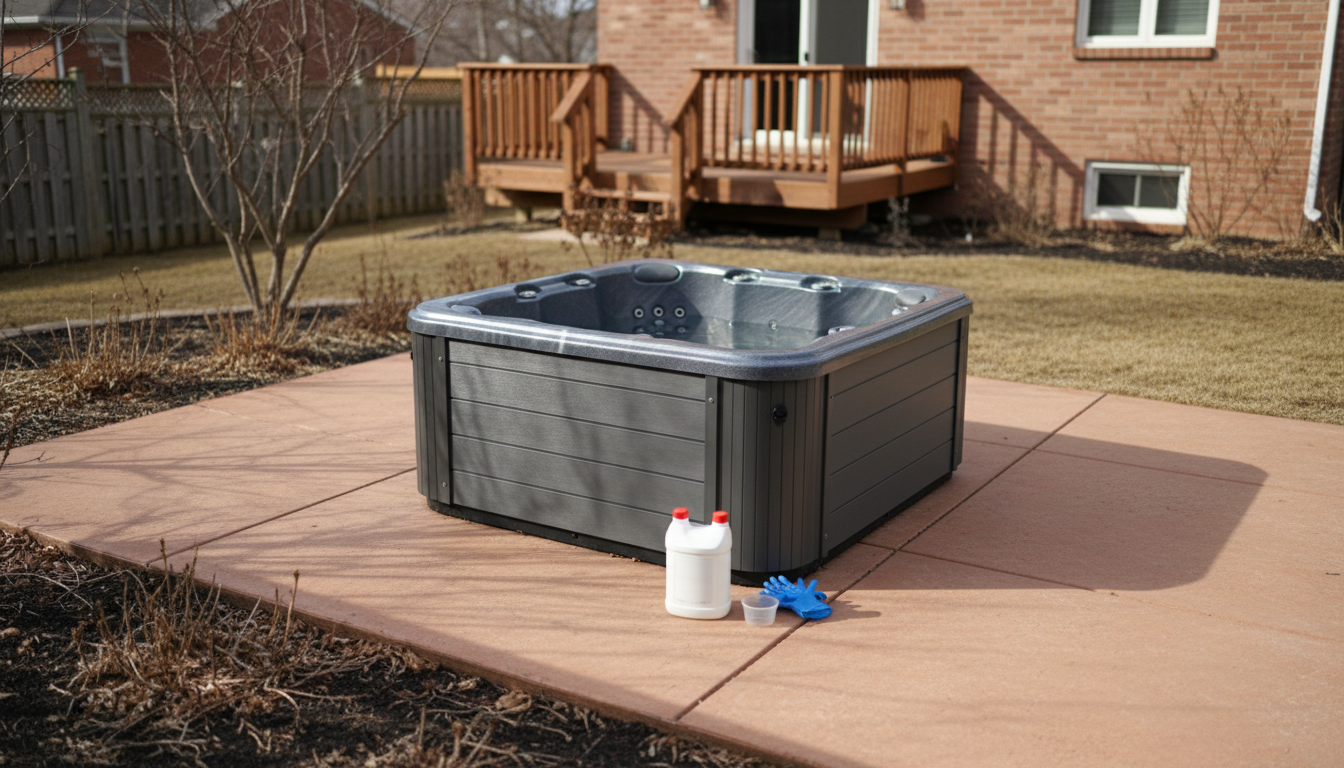
You test the water before shutting down your 2-person plug-in hot tub for winter, and the test strip turns that deep, unhelpful purple that means alkalinity is somewhere above 180 ppm. Now what? Adding too little acid leaves scale-forming water sitting in your jets and pump all winter. Adding too much and you drain water that could corrode the fittings before freeze-up.
For a standard 2-person plug-in hot tub holding roughly 250 gallons, with total alkalinity above 160 ppm and pH above 7.8, you need approximately 1.5 to 2 ounces (3 to 4 tablespoons) of full-strength muriatic acid per treatment round, repeated in steps until pH lands between 7.2 and 7.4 and alkalinity sits at 80 to 100 ppm. This article walks through why those targets matter for a closing, how to calculate your specific dose, and the step-by-step process for getting there safely before you drain and button everything up.
Why High Alkalinity Is a Closing Problem, Not Just a Chemistry Problem
Alkalinity is the buffer that keeps pH from swinging wildly. When alkalinity is high, pH wants to climb right along with it, and water that closes at pH 8.2 and alkalinity 200 ppm does not just sit there neutrally. It deposits calcium carbonate scale on every surface it touches: jet nozzles, the pump impeller, the heater element, and the plumbing fittings inside your spa pack. Over a four-to-five-month winter, that scale builds up and can be nearly impossible to dissolve without an acid wash in spring.
A 2-person plug-in hot tub is especially prone to this because the water volume is small (most models hold 200 to 300 gallons) and the jet-to-water ratio is high. Every square inch of internal surface stays in contact with that high-pH water the entire time the tub is closed. Getting alkalinity down before you drain takes 30 minutes. Descaling a pump housing in March takes considerably longer.
What Target Levels Actually Look Like at Closing
Normal operating ranges for a hot tub are pH 7.4 to 7.6 and alkalinity 80 to 120 ppm. For a closing treatment, aim slightly lower: pH 7.2 to 7.4 and alkalinity 80 to 100 ppm. The reason is drift. Once you close the tub, outgassing stops, bather input stops, and pH tends to creep upward over months. Starting a little lower gives you a buffer so that by spring, water chemistry is still somewhere reasonable rather than at pH 8.5.
If you are also closing other equipment this season, the same principle applies to larger spas: the guide on hot tub questions answered with real stories and science covers how alkalinity and pH interact across different tub sizes in more detail.
How Much Muriatic Acid a 250-Gallon Hot Tub Actually Needs
The math here is simpler than it looks. A rough industry benchmark is that 1 fluid ounce of 31.45% muriatic acid lowers total alkalinity by about 10 ppm in 250 gallons of water. That means:
- Alkalinity at 160 ppm, target 100 ppm: You need to drop 60 ppm, which means approximately 6 ounces total, added in two or three rounds.
- Alkalinity at 200 ppm, target 100 ppm: You need to drop 100 ppm, which means approximately 10 ounces total, again spread across multiple rounds.
- Alkalinity at 180 ppm, target 90 ppm: About 9 ounces total, dosed in increments of 2 to 3 ounces with retesting in between.
Never add the full calculated dose at once. In a 250-gallon tub, adding 10 ounces of acid in one shot can drop pH so sharply it goes below 7.0 before the alkalinity reaches your target. Cap each addition at 2 ounces maximum, run the jets for 15 to 30 minutes, retest, and repeat.
Step-by-Step: Lowering Alkalinity Before You Drain
- Test the water first. Use a reliable test kit or strips to get your current pH and total alkalinity readings. Write them down so you can track progress.
- Heat the water to 80 to 90°F. Acid distributes and reacts more evenly in warm water. Do not treat cold water sitting in a tub you have already started to cool down.
- Turn the jets on at full circulation. You want the acid to mix throughout the entire volume, not sit in one spot near the return jet.
- Measure the acid carefully. Use a plastic measuring cup dedicated to chemicals. Muriatic acid will destroy metal containers and stain concrete permanently.
- Pour the acid directly into the water near a return jet. Never add acid to a bucket of water you then pour in. Pour the measured amount slowly, aimed at the moving water coming from a jet so it disperses immediately.
- Wait 15 to 30 minutes, then retest. Check both pH and alkalinity. If alkalinity is still above 100 ppm and pH is above 7.4, add another 1 to 2 ounce dose and wait again.
- Stop when pH hits 7.2 and alkalinity is between 80 and 100 ppm. At that point, run the jets for a final 10 minutes, then proceed to your drain and winterize routine.
Safety Rules That Actually Matter in a Small Space
Muriatic acid fumes are concentrated and unpleasant, and a 2-person plug-in tub is often sitting on a small deck or patio with no airflow. Always treat with the cover off and stand upwind of the tub while pouring. Wear chemical-resistant gloves and eye protection every time, without exception. Keep a garden hose nearby in case of skin contact. AquaDoc packages its muriatic acid with a built-in drip-resistant spout for exactly this kind of small-volume precision dosing, which matters when you are working in 1 to 2 ounce increments in a confined space.
Never mix muriatic acid with any other chemical, including shock or sanitizer. If you plan to add a closing sanitizer dose after balancing, wait until the pH and alkalinity are stable, then add the sanitizer separately. Mixing acid and chlorine in a small tub produces chlorine gas at concentrations that are genuinely dangerous.
Common Mistakes That Undo Your Work
- Retesting too soon: Alkalinity needs at least 15 minutes of full circulation to stabilize after an acid dose. Testing at 5 minutes gives a false low reading that leads to over-acidifying.
- Using diluted acid: Pool supply stores sell muriatic acid in both 31.45% (full strength) and 20% (diluted) formulations. The doses in this article assume full strength. If you are using 20% acid, increase the volume by roughly 50%.
- Skipping the closing balance because you are draining anyway: Even if you are fully draining and blowing out the lines, residual water sits in the pump volute, the heater manifold, and the jet housings. High-pH water in those small pockets over winter is enough to deposit scale that causes problems at startup in spring.
- Closing with alkalinity too low: Below 60 ppm, water becomes corrosive to the acrylic shell and metal fittings. If you overshoot and drop alkalinity below 70 ppm, add a small dose of baking soda (1 tablespoon at a time) to bring it back into range before draining.
What Comes After the Chemistry
Once your pH and alkalinity are in range, your closing checklist still has a few items. Add a closing sanitizer dose (a final shock treatment sized for your 250-gallon volume), let the jets run for 20 minutes, then begin draining. On a plug-in tub, use a wet-dry shop vac to blow out the jet lines and clear any residual water from the pump housing before temperatures drop. If you are in a climate that sees hard freezes, even a small volume of water trapped in a jet body can crack it. For more on keeping a small hot tub in good shape when temperatures fall, the guide on winter hot tub use and keeping soaking when it is freezing outside is worth reading before you decide whether to close or winterize in place.
Frequently Asked Questions
How much muriatic acid do I add to a 2-person hot tub with high alkalinity before closing?
For a 2-person plug-in hot tub holding around 250 gallons with alkalinity above 180 ppm and pH above 7.8, start with 1.5 to 2 ounces (about 3 to 4 tablespoons) of full-strength muriatic acid per treatment. Retest after 30 minutes of jet circulation and repeat in 1 to 2 ounce doses until pH reaches 7.2 to 7.4 and alkalinity reaches 80 to 100 ppm. Never add the full calculated dose at once in a small tub.
What should pH and alkalinity be before winterizing a hot tub?
Target pH between 7.2 and 7.4 and total alkalinity between 80 and 100 ppm before closing. These targets run slightly lower than normal operating ranges because pH drifts upward naturally when water sits undisturbed in a sealed tub over several months of winter.
Can I just drain a 2-person hot tub without balancing the water first?
You can drain without balancing, but residual water stays trapped in jet bodies, the pump housing, and the heater manifold regardless of how thoroughly you drain. High-alkalinity, high-pH water in those pockets over winter deposits calcium scale that is hard to remove in spring. Thirty minutes of balancing before you drain is worth the effort.
How long does muriatic acid take to lower alkalinity in a 250-gallon hot tub?
Muriatic acid begins reacting within seconds of hitting the water, but alkalinity readings do not stabilize until the water has fully circulated, which takes 15 to 30 minutes in a 250-gallon tub with jets running. Retest at 30 minutes, not sooner, to avoid adding more acid than you actually need.
Is muriatic acid or dry acid better for lowering alkalinity before closing a hot tub?
Muriatic acid is the better choice for a closing treatment. It drops alkalinity faster, costs less, and does not add sulfates to water that is about to sit closed for months. Dry acid (sodium bisulfate) works fine during the season but accumulates sulfates over time, which can become corrosive in a sealed tub. Use muriatic acid for the closing dose.
The bottom line: for a 250-gallon 2-person plug-in hot tub with alkalinity above 160 ppm, plan on 6 to 10 total ounces of full-strength muriatic acid added in 1 to 2 ounce increments until you reach pH 7.2 to 7.4 and alkalinity 80 to 100 ppm. That is the chemistry that keeps your tub in good shape all winter and makes spring startup quick instead of miserable.