
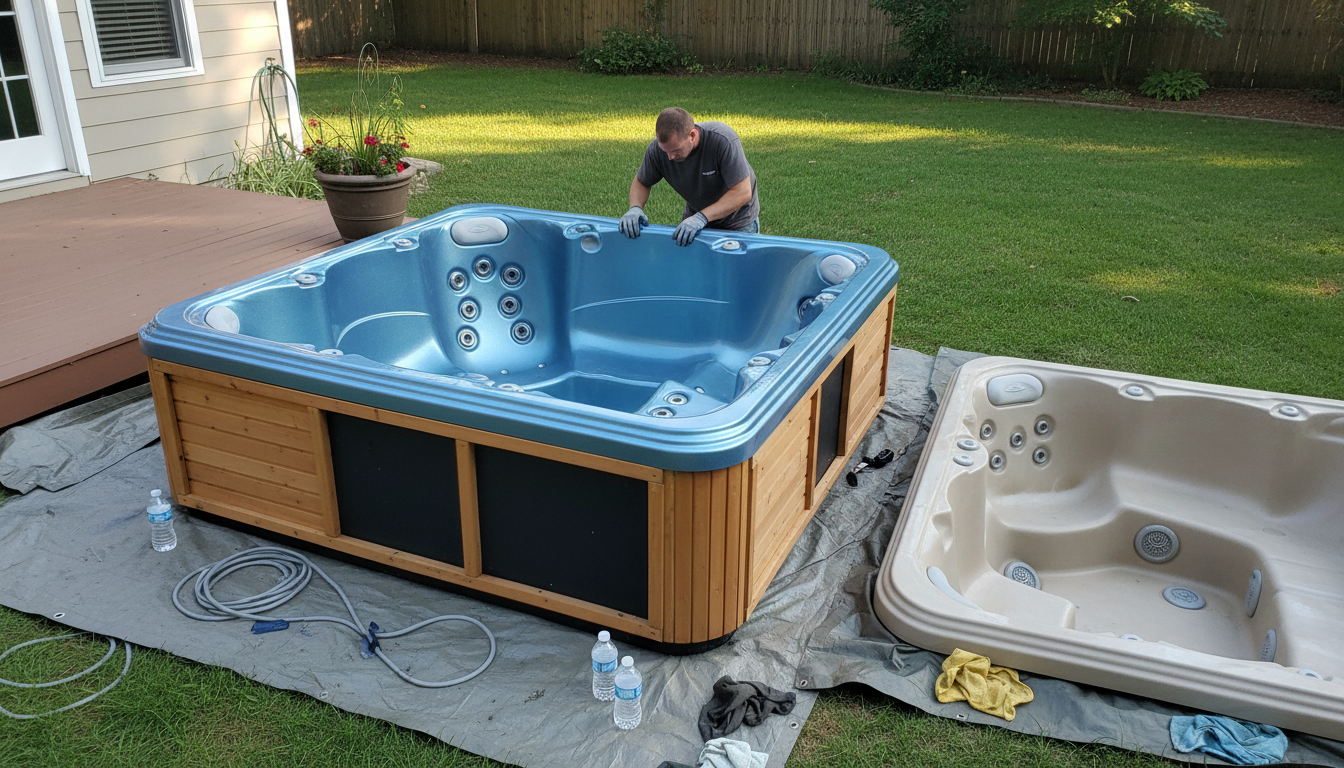
You noticed a crack spreading across the footwell, or maybe the shell has gone from glossy to chalky and started delaminating around a jet. Whatever brought you here, you’re now staring down a repair estimate that feels uncomfortably close to what you paid for the tub in the first place.
Replacing the acrylic shell on a 4-person 110V plug-in hot tub costs between $1,000 and $4,500 fully installed, with most homeowners landing somewhere in the $1,500 to $2,800 range. The shell itself accounts for $600 to $2,500 of that, and labor adds another $400 to $2,000 depending on how complex the disassembly is. This guide walks through every factor that moves that number, what cheaper alternatives exist, and how to decide whether a shell swap actually makes sense for a plug-in spa in this price category.
Why Shell Replacement on a 110V Plug-In Spa Is Complicated
A 4-person 110V plug-in spa sits in an awkward middle ground. These tubs are real hot tubs with acrylic shells molded over a fiberglass or ABS backing, but they are sold at consumer-grade price points ($1,500 to $3,500 retail) that assume modest lifespans. When a premium 240V spa needs a shell, the math can still pencil out because the tub is worth $8,000 to $20,000. On a plug-in unit worth $2,000, spending $2,500 on a shell swap is harder to justify.
The disassembly process is also more involved than it looks. Replacing the shell means disconnecting every jet fitting, the pump plumbing, the heater, and often the topside control panel. Labor hours add up fast, especially if the cabinet (the exterior wood or synthetic frame) has to come apart to free the old shell. Shops that work primarily on 240V spas sometimes charge higher flat rates on plug-in models simply because the parts sourcing is harder.
Shell Cost: What You’re Actually Paying For
The acrylic shell itself is the biggest variable. Here’s what drives the price:
- OEM vs. Aftermarket: An original shell from the tub’s manufacturer (if they still stock it) runs $1,200 to $2,500 for a 4-person size. Aftermarket shells from third-party fabricators cost $600 to $1,400, but fit tolerances vary and jet hole placement may not be exact.
- Acrylic Thickness: Budget plug-in spas use 3 to 6 mm acrylic. Replacement shells in that thickness range cost less, but thicker aftermarket upgrades (8 mm) add $200 to $400 to the shell price and meaningfully extend lifespan.
- Color and Finish: Standard white and grey shells are the cheapest. Custom colors or stone-look finishes add $150 to $400, and matching an unusual factory color from a discontinued model can be nearly impossible.
- Discontinued Models: Many entry-level 110V spas are discontinued within 3 to 5 years of sale. If your tub’s OEM shell is no longer available, you’re relying on a fabricator to custom-mold from measurements, which can push the shell price to $2,000 or more on its own.
Labor Cost: Where the Bill Grows
Shell labor runs $400 to $2,000 depending on your region and the shop’s hourly rate (typically $85 to $150 per hour). A straightforward swap on a common model takes 4 to 8 hours. A tub with a damaged cabinet, corroded fittings, or unusual jet layout can stretch to 12 to 16 hours. That’s where the high end of the range comes from.
Getting the tub to a service facility instead of having a tech come to you can cut $150 to $300 off the bill, but moving a loaded spa has its own costs. If you’re budgeting for transport, the guide on Hot Tub Moving Cost: What You’ll Actually Pay breaks down what you’ll spend getting the tub to and from a shop.
One mistake owners make is getting only one quote. Pricing on shell replacement varies enormously. A local spa repair specialist may charge half what a big service chain quotes, simply because they source shells differently and carry lower overhead. Get at least three written estimates before committing. As one resurfacing specialist notes, high quotes for acrylic work are common and very negotiable when you shop around.
A Real Cost Example
Say you own a 4-person 110V plug-in spa that retailed for $2,200 four years ago. The shell has a 6-inch stress crack running from one jet collar toward the footwell. Here’s what a realistic repair estimate looks like:
- Aftermarket replacement shell (6 mm, grey): $950
- Labor at $110/hr for 7 hours: $770
- Jet fittings, O-rings, and seals replaced during disassembly: $120
- Total: approximately $1,840
A tub in that condition with a cracked shell might sell used for $400 to $700. At $1,840 to repair, you’re spending 2.6 times its current resale value. That math pushes most owners toward either resurfacing or full replacement.
Resurfacing vs. Full Shell Replacement
Before committing to a full swap, find out whether resurfacing is an option. Acrylic resurfacing fills surface cracks, corrects fading, and repairs delamination in the gel coat without removing the shell at all. Cost runs $300 to $800 for a 4-person tub. The catch is that resurfacing only works when the underlying fiberglass or ABS structural layer is intact. A crack that has propagated through the structural backing, or a shell that flexes visibly under hand pressure, cannot be resurfaced safely.
For guidance on the broader range of repair costs you might encounter on a plug-in or hard-shell spa, this repair cost breakdown covers everything from pump replacements to structural fixes with realistic price ranges.
| Repair Option | Typical Cost | Best For | Lifespan Added |
|---|---|---|---|
| Gel coat patch (DIY kit) | $30 to $80 | Hairline surface scratches only | 1 to 3 years if done correctly |
| Professional resurfacing | $300 to $800 | Surface cracks, fading, minor delamination | 5 to 10 years |
| Full shell replacement | $1,000 to $4,500 | Structural cracks, through-shell damage | 10 to 20 years |
| Full tub replacement | $1,500 to $3,500 (new plug-in) | Older tub, multiple failing components | New tub lifespan |
Why These Differences Matter for Your Decision
The table above makes the decision clearer than any rule of thumb. If the damage is cosmetic, spend $300 to $800 on resurfacing and protect the investment with a quality cover and balanced water chemistry. If the shell is structurally compromised but every other component (pump, heater, jets, control board) is in good shape, a full shell replacement at $1,000 to $2,500 can make sense, especially if the tub is only 2 to 4 years old. If the tub is 7-plus years old and you’re also looking at a failing pump or a worn spa pack alongside the shell damage, buying a new unit usually costs less than repairing all three. You can get a read on whether a repair-or-replace decision is close by reviewing this repair versus replace guide that walks through the value calculation step by step.
One component to inspect while the shell is being assessed: if your jets are also deteriorating, bundling jet replacement with a shell job saves a separate service call. The cost comparison between swim jets and therapy jets is covered in the Swim Jet vs Therapy Jet Replacement Cost guide if you want to know what adding that work costs before you get your quote.
How to Protect Your Shell and Avoid Repeat Damage
After spending $1,500 or more on a new or resurfaced shell, the last thing you want is to repeat the cycle in three years. The four most common causes of premature shell failure are UV exposure without a cover, pH that runs chronically low (below 7.0 corrodes the gel coat from the inside), leaving the tub empty while the heater cycles, and impact from hard objects dropped into the tub. Keeping water chemistry balanced is the cheapest form of shell insurance: pH between 7.4 and 7.6, alkalinity at 80 to 120 ppm. AquaDoc’s test strips are what many plug-in spa owners use to stay on top of those numbers between full water changes, because a five-second test twice a week catches a pH drop before it etches the surface.
Frequently Asked Questions
How much does it cost to replace the acrylic shell on a 4-person 110V hot tub?
Expect to pay $1,000 to $4,500 fully installed, depending on shell sourcing and labor rates in your area. The shell itself typically runs $600 to $2,500 for a standard 4-person size, with labor adding another $400 to $2,000. Most owners of common mid-range plug-in spas land in the $1,500 to $2,800 range.
Is it worth replacing the acrylic shell on a plug-in 110V spa?
Usually not, unless the tub is relatively new and every other component is working. Most 4-person 110V plug-in spas retail for $1,500 to $3,500 new, so a full shell replacement can cost as much as or more than the tub is worth. Resurfacing a surface crack or buying a replacement unit are both worth pricing out first.
Can you resurface a hot tub acrylic shell instead of replacing it?
Yes, for surface cracks, fading, or minor gel coat delamination, professional acrylic resurfacing costs $300 to $800 and restores the shell without a full swap. It only works when the structural fiberglass or ABS layer underneath is intact. Have a technician assess the damage before committing to either option. You can find more detail on typical repair pricing at this hot tub repair cost guide.
What causes an acrylic shell to crack or blister on a plug-in hot tub?
The most common causes are impact damage, UV degradation from sun exposure without a cover, long-term chemical imbalance that weakens the gel coat, and temperature stress from leaving the tub empty while heated. Entry-level 110V spas use thinner acrylic (3 to 6 mm) that is more vulnerable to all of these than the 8 to 10 mm shells on premium models.
How long does an acrylic hot tub shell last before it needs replacement?
A well-maintained acrylic shell typically lasts 10 to 20 years. Shells on 110V plug-in spas often show wear sooner because thinner acrylic and lower-grade gel coats are common at entry-level price points. Consistent water chemistry and a fitted cover are the two factors that most reliably push shell life toward the upper end of that range.
For a 4-person 110V plug-in spa, a full acrylic shell replacement costs $1,000 to $4,500 installed, and the repair-or-replace math rarely favors it unless the tub is nearly new. Get the shell professionally assessed first: a $500 resurfacing job may solve the same problem for a fraction of the cost.