
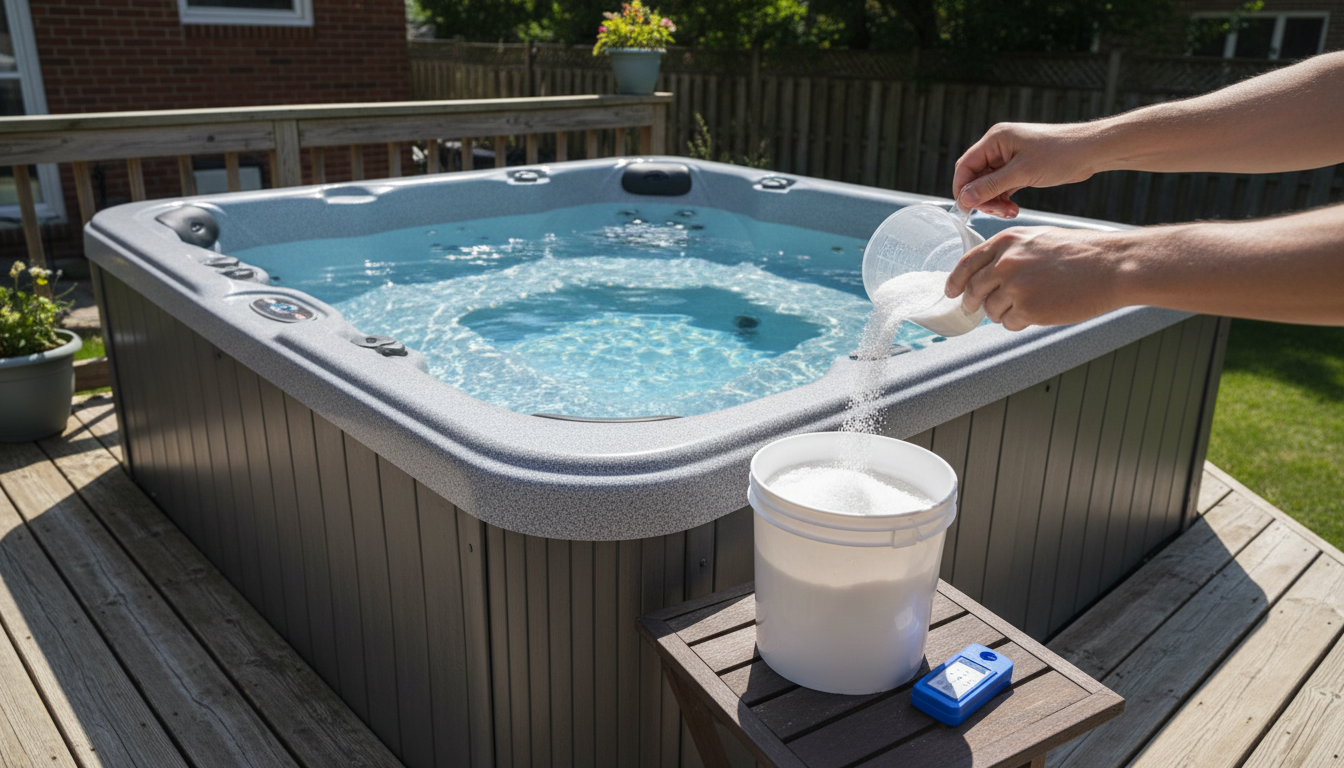
You pull the cover off your 6-person hot tub after a couple of weeks away, take one look at the water, and realize you have absolutely no idea what to add or how much. Is it still safe? Does it need a full shock? Or just a top-up?
Here is the direct answer: a 6-person hot tub holding roughly 350 to 400 gallons needs 2 to 3 teaspoons (1 to 1.5 oz) of granular dichlor as a restart dose after sitting unused for two weeks. That gets free chlorine up to the 3 to 5 ppm target range for a hot tub, gives the sanitizer time to work, and clears out any bacteria or biofilm that built up while the cover was on. This article walks through the exact math, the right sequence of steps, and the mistakes people commonly make when restarting a tub after a break.
Why Two Weeks Changes Things
A covered hot tub is not a sterile environment. Even with the heater holding temperature and no one using it, bacteria can multiply in the water, and any residual chlorine left before you left will have degraded. Dichlor breaks down faster at higher water temperatures: at 104°F, chlorine has a half-life of only a few hours in an unprotected tub. After 14 days, you should assume free chlorine is at or near zero, regardless of what you dosed before you left.
On top of that, a warm, covered hot tub is a good environment for biofilm to develop inside jet lines and plumbing. A restart dose is not just about hitting a number on a test strip. It is about running enough sanitizer through the system to knock out anything that settled in while the tub was idle.
How Much Dichlor: The Worked Example
Most 6-person hot tubs hold between 320 and 425 gallons. A common midpoint is 380 gallons, so use that as your baseline. The math below scales easily if your tub is on the smaller or larger end.
Granular dichlor (sodium dichloro-s-triazinetrione) typically runs about 56% available chlorine by weight. To raise free chlorine by 1 ppm in 1,000 gallons, you need roughly 0.13 oz of 56% dichlor. For a 380-gallon tub, the formula looks like this:
- Gallons: 380
- Target chlorine increase: 4 ppm (from assumed zero to the middle of the 3 to 5 ppm target range)
- Dose needed: 380 / 1,000 x 0.13 oz x 4 = roughly 0.20 oz, or about 1.2 teaspoons
That is the minimum for a routine dose when water quality is known to be good. Because you have had two weeks of idle time, bump that up by 50% to account for any organic load and potential biofilm. That puts you at 1.8 to 2.5 teaspoons, which rounds cleanly to the 2 to 3 teaspoon range stated above. If your tub holds closer to 425 gallons, go with the full 3 teaspoons. If it is closer to 300 gallons, 2 teaspoons is enough to start.
AquaDoc’s granular dichlor is measured and dosed the same way: add it to the water while the jets are running, never drop it directly onto the shell or in the skimmer basket without water flowing.
Step-by-Step Restart Process
- Step 1: Test the water first. Before adding anything, test for free chlorine, pH, and total alkalinity. If free chlorine somehow reads above 1 ppm, your restart dose will be smaller. Ideal pH for dichlor to work efficiently is 7.4 to 7.6. If pH is above 7.8, the chlorine you add will be far less effective, so adjust pH before dosing.
- Step 2: Turn the jets on high. This circulates the water and helps the dichlor dissolve and spread evenly. It also flushes the plumbing lines, which is where biofilm hides.
- Step 3: Pre-dissolve the dichlor (optional but smart). Measure your dose, stir it into a cup of warm water from the tub, then pour the solution into the water with the jets running. Pre-dissolving eliminates any risk of granules sitting on the shell and bleaching the surface.
- Step 4: Let the tub run for 20 minutes. Keep the jets going so the sanitizer circulates through every line.
- Step 5: Test again. Check free chlorine. If it reads between 3 and 5 ppm, you are in good shape. If it is below 3 ppm, add another half-teaspoon, run the jets for another 10 minutes, and retest. If it is above 5 ppm, just wait. Chlorine in a warm hot tub dissipates quickly.
- Step 6: Do not get in until free chlorine is 3 to 5 ppm. Above 5 ppm can cause skin and eye irritation. Below 1 ppm and the water is not properly sanitized.
What to Watch Out For
Two weeks of inactivity creates a specific set of conditions that trip people up. Here are the most common mistakes and what they actually cause:
- Dosing without testing pH first: At pH 7.8 or higher, only about 24% of your chlorine is in the active hypochlorous acid form. At 7.4, it is closer to 66%. Skipping the pH test can mean you add the right amount of dichlor and still end up with an under-sanitized tub because the chemistry is working against you.
- Adding dichlor to a dry skimmer or undiluted onto the shell: Concentrated granules can bleach acrylic shells and damage the finish. Always dissolve first or pour directly into water flowing past the return jet.
- Assuming the cover kept the water clean: Covers keep debris out, but they trap heat and create a low-oxygen environment that actually favors anaerobic bacteria. Two weeks is long enough for colonies to establish, especially in jet lines.
- Ignoring the CYA buildup over time: Dichlor contains cyanuric acid (CYA) as a byproduct of its chemistry. Each dose adds a small amount of CYA, roughly 9 ppm per pound in a small tub. Over months of regular use, CYA accumulates and begins to neutralize chlorine. If you have been using dichlor as your primary sanitizer for more than three months without draining, test CYA. If it is above 50 ppm, plan a partial or full drain. This is one reason many hot tub owners switch to trichlor-free alternatives or drain on a 90-day schedule.
If you have recently gone through the hassle of moving your tub and are doing a full refill, the dosing math here applies to any fresh fill too. And if you find yourself deep in a hot tub maintenance project and wondering about bigger equipment decisions, the guide on hot tub spa pack replacement cost covers what it actually costs when the control system needs attention.
Comparison: Dichlor Dose by Hot Tub Size
| Hot Tub Size | Typical Gallons | Restart Dose After 2 Weeks | Weekly Maintenance Dose |
|---|---|---|---|
| 2-person plug-in | 150 to 200 gal | 1 teaspoon | 0.5 teaspoon |
| 4-person hard-shell | 250 to 300 gal | 1.5 teaspoons | 1 teaspoon |
| 6-person hard-shell | 350 to 425 gal | 2 to 3 teaspoons | 1.5 to 2 teaspoons |
| 8-person hard-shell | 475 to 600 gal | 3 to 4 teaspoons | 2 to 2.5 teaspoons |
Why These Numbers Matter
The table above is a starting point, not a replacement for testing. Hot tub water is variable because bather load, water source, and temperature all affect how fast chlorine is consumed. A 400-gallon tub used by six people for an hour burns through sanitizer much faster than the same tub used by one person for 20 minutes. Use the restart dose to get into the target range, then let your test results tell you whether you need to dose more aggressively on a regular basis.
The weekly maintenance dose assumes you are testing after each use and adding chlorine to keep free chlorine between 3 and 5 ppm. If you test and the reading is already at 4 ppm, skip the dose that day. Over-chlorinating is a real thing, especially in a small body of warm water.
For context on how different jet configurations affect your overall hot tub maintenance decisions, the breakdown of swim jet vs therapy jet replacement costs is worth a look if you are evaluating a new setup or a repair.
Frequently Asked Questions
How much dichlor do I add to a 6-person hot tub after 2 weeks unused?
Add 2 to 3 teaspoons (roughly 1 to 1.5 oz) of granular dichlor to a typical 350 to 425 gallon 6-person hot tub as a restart dose after a two-week gap. Run the jets for 20 minutes, then test before use. If free chlorine reads below 3 ppm, add another half-teaspoon and retest in 30 minutes.
Can I get in a hot tub right after adding dichlor?
No. Wait at least 15 to 30 minutes after adding dichlor, then test the water. Free chlorine should be between 3 and 5 ppm before anyone enters. If it is still above 5 ppm, wait longer and retest every 30 minutes until it falls into range.
Does dichlor raise CYA in a hot tub over time?
Yes. Every pound of dichlor adds roughly 9 ppm of cyanuric acid to the water. In a small hot tub, CYA can climb to levels that interfere with chlorine effectiveness within a few months of regular use. The only fix is a partial or full drain, which is why most hot tub care guides recommend draining and refilling every 3 to 4 months.
What should free chlorine be in a hot tub before I get in?
Free chlorine should read between 3 and 5 ppm for safe, comfortable soaking. Below 1 ppm the water is under-sanitized. Above 5 ppm it can irritate skin and eyes. Always test with a reliable test strip or liquid drop test kit before entering after any chemical addition.
How much dichlor do I add to a 400-gallon hot tub weekly for maintenance?
A standard maintenance dose for a 400-gallon hot tub is about 1.5 to 2 teaspoons of granular dichlor per week under light to moderate use. Always test free chlorine before adding anything. If you are already at 4 ppm, skip the dose and retest the next day rather than adding more on a fixed schedule.
For a 6-person hot tub that has sat for two weeks, 2 to 3 teaspoons of granular dichlor gets you safely back into the 3 to 5 ppm free chlorine range. Test first, dose accordingly, run the jets, and test again before anyone gets in.