
You fill your inflatable hot tub, test the water, and the calcium hardness reads somewhere between 0 and 50 ppm because your tap water is genuinely soft. Now you’re staring at a tub of water that’s quietly corrosive, and a bag of calcium hardness increaser you’re not sure how much to use.
The short answer: in a 400-gallon inflatable hot tub filled with soft water starting near 0 ppm, you need roughly 3.5 oz (100 grams) of calcium hardness increaser to reach the low end of the target range (150 ppm), or about 5.8 oz (165 grams) to land at 250 ppm. The target range for any hot tub is 150 to 250 ppm. This article walks through exactly how to calculate your dose based on your actual starting level, how to add the product safely without clouding the water, and what happens if you overshoot.
Why Calcium Hardness Matters More in a Small Inflatable Tub
Calcium hardness measures how much dissolved calcium is in your water. When that number is too low, the water becomes chemically “hungry” and starts pulling calcium from whatever surface it touches. In a concrete pool that’s a slow process. In a 400-gallon inflatable tub with a thin PVC liner, plastic fittings, and a compact heater element, the corrosion is faster and the damage shows up sooner. As Spa Parts Experts explains, low hardness water aggressively attacks seals, jets, and internal plumbing – and soft water regions often land 50 ppm or lower straight from the tap.
The other reason small volume matters: every ounce of increaser you add has a bigger impact per gallon. A mistake that’s easy to correct in a 20,000-gallon pool can easily overshoot a 400-gallon tub into the 400+ ppm range where scale forms on your jets and heater. Precision counts more here than anywhere else.
How to Calculate Your Dose Based on Starting ppm
Calcium chloride (the active ingredient in virtually every calcium hardness increaser) raises hardness by approximately 14 ppm per 1 oz added to 400 gallons. That’s the number to build all your math from.
Here’s how to use it. First, test your water with a reliable test strip or a liquid drop test kit and get your current calcium hardness reading. Then subtract your current level from your target level. Divide that gap by 14, and you have the ounces needed.
Worked example – starting at 0 ppm, targeting 150 ppm:
- Gap: 150 – 0 = 150 ppm to raise
- Ounces needed: 150 / 14 = 10.7 oz? No – wait, let’s check the math against real dosing charts. For reference, the standard rate for calcium chloride is about 1.25 oz per 10 ppm per 1,000 gallons. At 400 gallons that scales to 0.05 oz per 10 ppm – or 0.5 oz per 100 ppm increase. So 150 ppm in 400 gallons = roughly 3.5 oz (about 99 grams).
- To hit 200 ppm from zero: approximately 4.6 oz (130 grams).
- To hit 250 ppm from zero: approximately 5.8 oz (165 grams).
If your tap water isn’t quite at zero – say it tests at 50 ppm, which is common in moderately soft regions – subtract that from your target before dosing. Targeting 200 ppm from a 50 ppm start means you only need to raise it 150 ppm, which is about 3.5 oz, not 4.6 oz.
Dose Reference Table by Starting Level
| Starting Calcium (ppm) | Target 150 ppm | Target 200 ppm | Target 250 ppm |
|---|---|---|---|
| 0 ppm | 3.5 oz / 99 g | 4.6 oz / 130 g | 5.8 oz / 165 g |
| 25 ppm | 2.9 oz / 82 g | 4.0 oz / 113 g | 5.1 oz / 145 g |
| 50 ppm | 2.3 oz / 65 g | 3.5 oz / 99 g | 4.6 oz / 130 g |
| 75 ppm | 1.7 oz / 48 g | 2.9 oz / 82 g | 4.0 oz / 113 g |
| 100 ppm | 1.2 oz / 34 g | 2.3 oz / 65 g | 3.5 oz / 99 g |
Why These Differences Matter
Even a 25 ppm difference in your starting point changes your dose by more than half an ounce, which sounds small until you realize that in 400 gallons, half an ounce moves calcium hardness by about 7 ppm. Over-dosing to 350 or 400 ppm means you’re suddenly fighting scale rather than corrosion. Test before you dose, not after.
How to Add Calcium Hardness Increaser Without Clouding the Water
Calcium chloride dissolves exothermically – it releases heat when it hits water. Dumping a full dose of dry powder directly into a small hot tub can cause a white cloudy haze that takes hours to clear, and in a worst case it can temporarily spike pH and create a calcium snowstorm. Here’s the right process:
- Measure your full dose using a kitchen scale in grams, not a scoop by volume. Calcium chloride granules can vary in density, so weight is more reliable than volume.
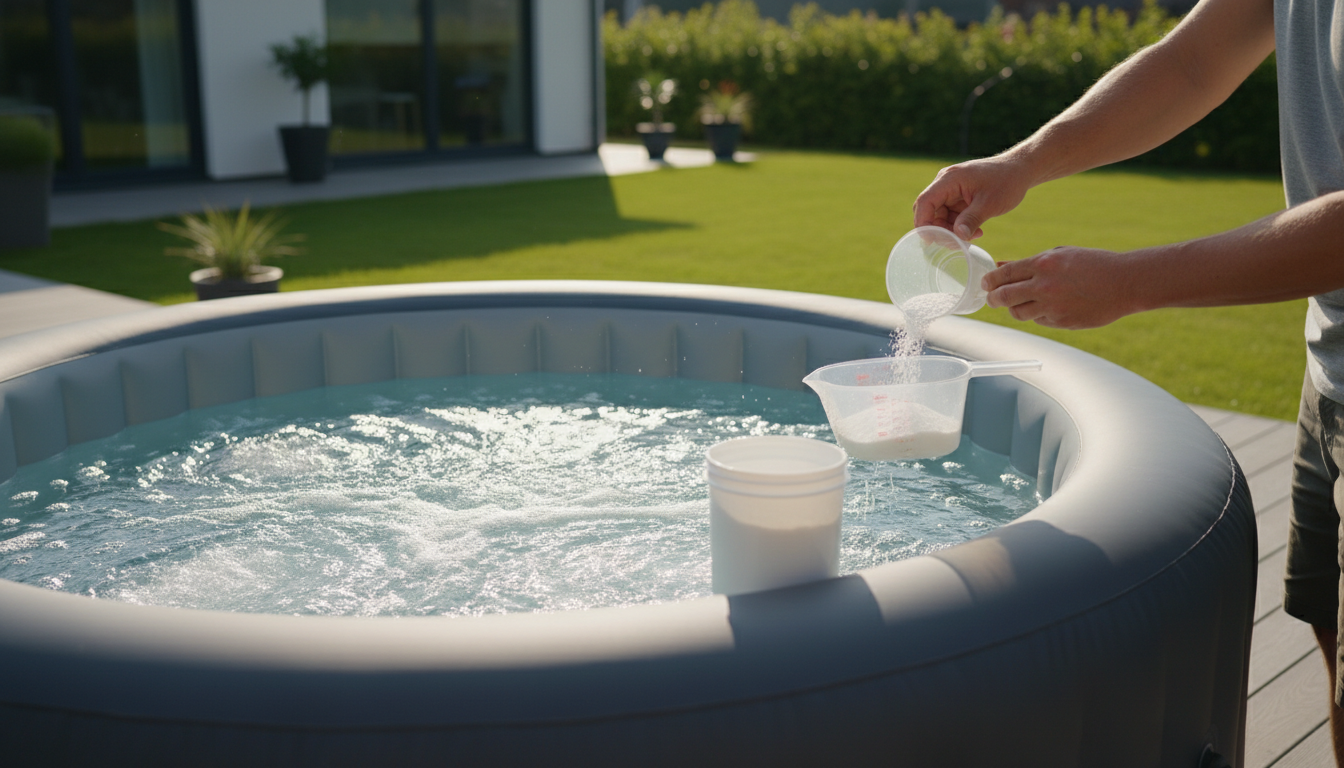
- Pre-dissolve in a bucket – fill a clean plastic bucket with about 1 gallon of warm water from the tub, then slowly stir in your calcium hardness increaser until fully dissolved. The water will heat up noticeably; that’s normal.
- Add in two or three increments, not all at once. For a total dose of 3.5 oz, add roughly 1.2 oz at a time.
- Pour slowly near a jet return while the jets are running. Running jets helps distribute the dose immediately and prevents hot spots of concentrated calcium.
- Run the jets for at least 15 to 30 minutes after each increment, then wait 1 hour before retesting.
- Retest and confirm before adding the next increment. Aim for a final reading of 150 to 250 ppm before declaring the job done.
AquaDoc’s calcium hardness increaser is a calcium chloride product that several hot tub owners use specifically because it’s formulated fine enough to dissolve quickly in small-volume spas – pre-dissolving in a bucket still applies, but you’re less likely to get undissolved particles sitting on the liner.
Common Mistakes to Avoid
- Skipping the pre-test: If you assume your soft-water tap fills at 0 ppm and it’s actually at 75 ppm, you’ll overshoot the 250 ppm ceiling on your first fill. Always test fresh fill water before adding anything.
- Adding the full calculated dose at once: Small tub volume means small margin for error. Add in thirds, retest between each addition.
- Using the wrong increaser: Calcium hardness increaser is calcium chloride. Some people accidentally grab a calcium hypochlorite shock product, which will raise calcium slightly but also spike chlorine to damaging levels. Read the label.
- Adjusting calcium while pH is off: If your pH is below 7.2, dissolved calcium is more likely to come out of solution and cause cloudiness. Bring pH into the 7.4 to 7.6 range before treating calcium. If cloudy water is already an issue alongside your hardness problem, the tips in this guide to cloudy hot tub water can help you sort out what’s actually driving it.
- Treating calcium last: Calcium hardness should be adjusted before you dose sanitizer or shock on a fresh fill. Adjust in this order: total alkalinity first, then pH, then calcium hardness, then sanitizer.
What Happens If Calcium Gets Too High
The flip side of soft water problems is overshooting into the 350 to 500 ppm range. At those levels, calcium scale deposits on heater elements, inside jets, and along the waterline. Scale acts as an insulator on heater coils and can shorten heater life significantly. As Seaway Pools and Hot Tubs notes, high calcium is one of the most common reasons hot tub heaters fail prematurely in hard-water regions – but it can happen just as easily if you over-correct soft water without retesting between doses.
If you do overshoot, the only real fix is a partial drain. In a 400-gallon tub, draining and refilling 100 gallons (25% of the water) with fresh soft water will reduce calcium hardness by about 25%. Drain 200 gallons and you cut it by roughly 50%. For the broader picture of how different chemicals interact during adjustments like this, the pool chemistry primer on ideal ranges and adjustment order on this site is worth reading even though it’s written for pools – the principles translate directly.
Frequently Asked Questions
How much calcium hardness increaser do I add to a 400-gallon hot tub?
For a 400-gallon hot tub starting at 0 ppm, add roughly 3.5 oz (about 99 grams) of calcium hardness increaser to reach 150 ppm. To hit 250 ppm from zero, add approximately 5.8 oz (165 grams) total, always in increments and retesting between additions.
What is the ideal calcium hardness level for an inflatable hot tub?
The target range is 150 to 250 ppm for any hot tub, including inflatables. Below 100 ppm the water is corrosive to the PVC liner and heater components. Above 350 ppm you’re in scale territory, which clogs jets and degrades heater efficiency.
How do I raise calcium hardness in a hot tub without clouding the water?
Pre-dissolve the calcium hardness increaser in a bucket of warm water before adding it to the tub – never pour the dry powder directly in. Add no more than one-third of your calculated dose at a time, run the jets for 15 to 30 minutes after each addition, and retest before adding the next increment.
What happens if calcium hardness is too low in an inflatable hot tub?
Water with very low calcium hardness (below 100 ppm) is chemically aggressive and pulls calcium from whatever it contacts. In an inflatable tub that means accelerated degradation of the PVC liner, plastic fittings, and heater elements, noticeably shortening the tub’s usable life.
Can I use pool calcium hardness increaser in a hot tub?
Yes. Calcium hardness increaser is calcium chloride whether the label says pool or spa, so the same product works in both. Use the same math: roughly 1 oz raises calcium hardness by about 14 ppm in a 400-gallon tub.
For a 400-gallon inflatable hot tub filled with soft water, add 3.5 to 5.8 oz of calcium hardness increaser (depending on how far below 150 ppm you’re starting), always dissolved in a bucket first and added in increments. Test before, dose carefully, and retest after each addition to stay inside the 150 to 250 ppm window.