
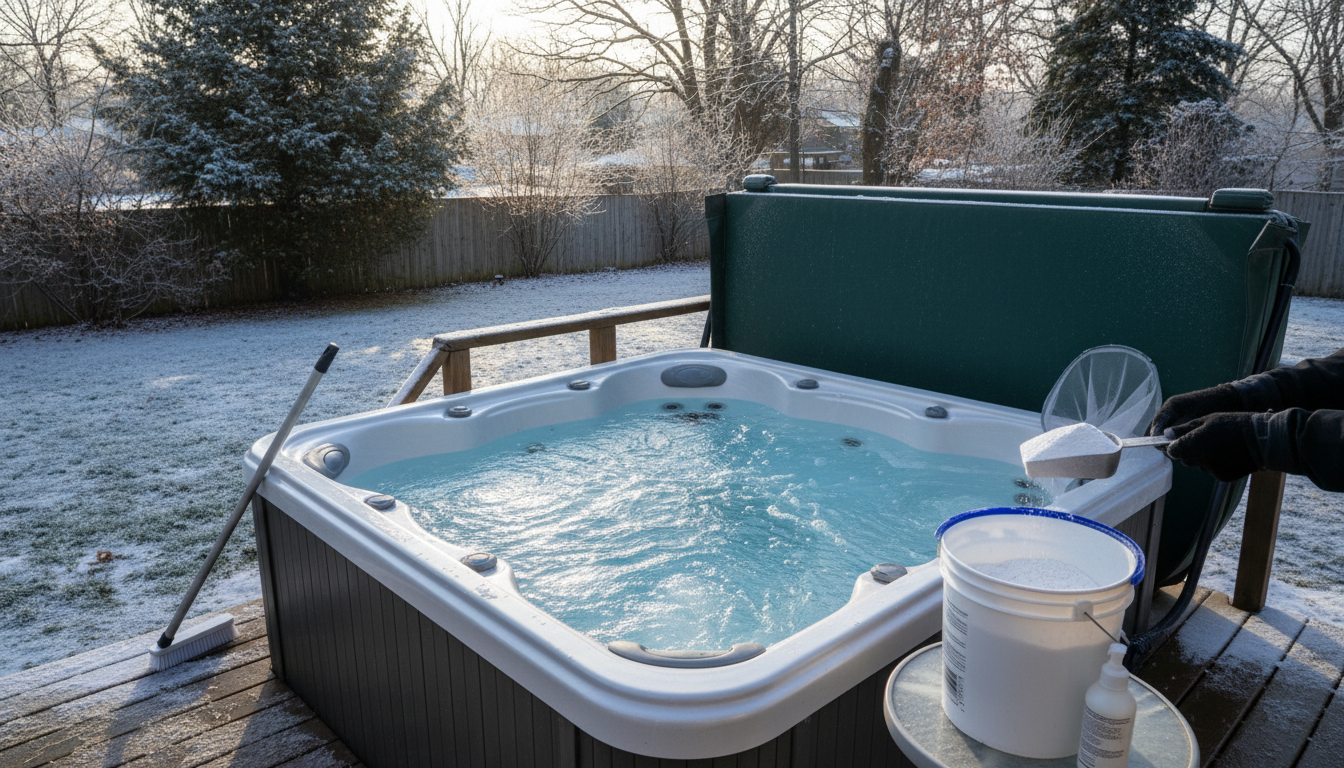
You’ve spent the season soaking, the nights are dropping below freezing, and now you’re standing next to your hot tub wondering exactly what chemicals go in before you pull the drain plug. Winterizing feels straightforward until you realize your tub runs on a salt system and every dosing chart you find was written for chlorine.
For a 2-person saltwater hot tub, the standard non-chlorine shock closing dose is 2 oz (57 grams) of potassium monopersulfate per 250 gallons, applied about 30 minutes before you drain. Most 2-person hard-shell saltwater tubs hold between 200 and 300 gallons, so a single 2-oz dose covers the typical range. This article walks through why you need it even with a salt system, how to calculate your exact tub volume, the step-by-step process, and what to do after the shock before the tub sits empty all winter.
Why a Saltwater Hot Tub Still Needs Non-Chlorine Shock at Closing
Salt chlorine generators (SCGs) do a reliable job keeping free chlorine in the 1 to 3 ppm range during the swimming season, but they have a blind spot: chlorine-resistant organics. Lotions, sweat, cosmetics, and body oils accumulate in the water and jet lines as compounds that chlorine oxidizes slowly or not at all. Those residues sit in the plumbing over winter, feeding biofilm growth and causing stubborn stains or odors when you refill in spring.
Non-chlorine shock – potassium monopersulfate, or MPS – is an oxidizer, not a sanitizer. It breaks apart those organic compounds chemically without adding more chlorine to the water. That matters at closing because you are about to drain, and a heavy chlorine spike before draining is both unnecessary and potentially problematic for drain-water disposal rules in some areas. MPS does the oxidizing work cleanly and dissipates quickly. As Action Spa Repair explains in their saltwater hot tub maintenance guide, shocking a saltwater hot tub regularly – including at closing – is essential even when the salt cell is functioning perfectly.
How Many Gallons Does a 2-Person Saltwater Hot Tub Hold?
The dose math only works if you know your actual volume. Most manufacturers list water capacity in the owner’s manual or on a plate near the equipment compartment, so check there first. If you cannot find it, the typical ranges by shell type are:
- 2-person hard-shell saltwater hot tub: 200 to 300 gallons, with 250 gallons being the most common midpoint.
- 2-person inflatable saltwater tub: 150 to 220 gallons, often closer to 170 to 180 gallons in practice.
- Compact 2-person acrylic spa: Some premium models with deep seats can hold up to 325 gallons.
When in doubt, use 250 gallons as your baseline – it keeps you within the safe dosing range for nearly every 2-person unit on the market. Overdosing by 20 to 30 percent with MPS will not harm the shell or equipment, but it is wasted product.
Calculating the Exact Non-Chlorine Shock Dose
The standard MPS closing dose is 2 oz per 250 gallons. Here is how that plays out across the realistic volume range for 2-person tubs:
| Tub Volume (gallons) | MPS Dose (oz) | MPS Dose (grams) | Notes |
|---|---|---|---|
| 150 | 1.2 oz | 34 g | Small inflatable or compact shell |
| 200 | 1.6 oz | 45 g | Lower end 2-person hard-shell |
| 250 | 2.0 oz | 57 g | Most common 2-person volume |
| 300 | 2.4 oz | 68 g | Larger 2-person or deep-seat model |
| 325 | 2.6 oz | 74 g | Premium compact acrylic spa |
Why These Differences Matter
At 150 gallons versus 325 gallons, you are looking at more than double the water volume, which means double the organic load and double the MPS needed to oxidize it. Using a flat “one scoop” approach regardless of volume is one of the most common closing mistakes. A 2-person tub at the high end of the range with under-dosed shock will leave residue in the jet lines over a five-month winter, which can mean a cloudy, funky-smelling refill next April.
If your water was heavily used in the final weeks of the season – frequent soaks, multiple people, a lot of product use – add 50 percent more MPS on top of the volume-based dose. Heavily loaded water warrants a heavier oxidizing treatment before the drain.
Step-by-Step: Applying Non-Chlorine Shock Before You Drain
- Test and balance the water first. Adjust pH to 7.2 to 7.6 and total alkalinity to 80 to 120 ppm before adding any shock. MPS works more effectively at proper pH, and balanced water is easier to deal with at spring refill if any moisture remains in the lines.
- Run all jets at full speed. Turn every jet zone on and remove the filter cartridge. Circulation distributes the shock evenly through the plumbing, not just the shell water.
- Measure and add the MPS. Pre-dissolve the powder in a bucket of warm water from the tub, then pour it slowly around the perimeter with the jets running. Never dump dry MPS directly onto the shell surface.
- Circulate for 20 to 30 minutes. This is the minimum time needed for the oxidizer to move through every jet line and foot well. Think of it as flushing the plumbing with an oxidizing rinse.
- Drain completely. Open the drain valve and let the tub empty fully. Use a shop vac to pull remaining water from the foot well and any low points in the shell.
- Clean and rinse the shell. Wipe down the acrylic with a spa-safe cleaner, then rinse with fresh water. Any residue left on the shell over winter can etch the surface.
- Blow out the jet lines. Use a shop vac on the blow setting or a small compressor at low pressure (under 30 PSI) to push remaining water out of each jet line and the heater loop.
- Cover and protect. Replace the cover and lock it down with the tie-down straps. A good cover lock keeps moisture and debris out of a dry shell all winter.
For a broader look at the full winterizing sequence, Polynesian Pool and Spa’s winterizing guide covers the equipment-side steps – blowers, heaters, and plumbing – that go alongside the chemical treatment covered here.
Common Mistakes to Avoid at Closing
- Skipping the shock entirely: The salt system running all season does not eliminate the need for a closing oxidizer. Biofilm and organic residue still accumulate, and they will sit in the lines all winter if you skip this step.
- Shocking then immediately draining: Give the MPS the full 20 to 30 minutes to work. Draining right after you add it means the oxidizer never reaches the far ends of the jet plumbing.
- Not removing the filter cartridge: Shocking with the cartridge in place wastes product and can degrade the filter media. Pull it first, clean it separately, and store it indoors for the winter.
- Leaving water in low spots: Even a small amount of water left in a jet line or the heater core will freeze, expand, and crack the component. A shop vac is not optional in a freeze-prone climate.
- Forgetting the salt cell: Rinse the salt cell with a diluted acid solution per the manufacturer’s instructions, then store it indoors if possible. Freezing destroys the electrode plates. Buds Pools’ closing guide covers equipment storage steps that apply well here.
One note on products: AquaDoc makes a potassium monopersulfate shock that pool and hot tub owners use specifically for this kind of pre-drain oxidizing treatment – it dissolves cleanly and is sized for small-volume applications like a 2-person tub, so you are not trying to measure a fraction of a large-format bag.
What Comes After the Chemical Step
Once the tub is drained, blown out, and covered, the chemical work is done for the season. But if you are not fully committing to a cold-weather closure and are instead thinking about keeping the tub running through winter, the calculus changes entirely – the guide to using your hot tub through freezing weather covers that approach, including how to manage chemistry in a tub that never fully cools down.
If you are closing and you have residual questions about sanitizer levels and what the water chemistry should look like at the point you start draining, understanding chloramine behavior is part of that picture. The piece on why that chlorine smell is not actually free chlorine explains the combined chlorine compounds that non-chlorine shock targets – useful context if you want to understand what the MPS is actually breaking apart.
Frequently Asked Questions
How much non-chlorine shock do I need for a 2-person saltwater hot tub?
Use 2 oz (57 grams) of potassium monopersulfate per 250 gallons when closing for winter. A standard 2-person saltwater hot tub holds 200 to 300 gallons, so one 2-oz dose covers the typical unit. If the water was heavily used near closing time or the water looks cloudy, increase the dose by 50 percent before draining.
Can I skip shocking my saltwater hot tub before closing it for winter?
No. Skipping the closing shock leaves organic waste and biofilm in the plumbing and shell, which causes staining, odor, and a difficult startup next spring. The shock oxidizes that residue before you drain, so the tub starts fresh on refill. The salt system does not substitute for this step.
How long after adding non-chlorine shock can I drain the hot tub?
Wait at least 20 to 30 minutes with the jets running at full speed before opening the drain valve. This circulation time allows the potassium monopersulfate to travel through every jet line and plumbing loop, not just the visible shell water. Draining sooner wastes the treatment.
Does a saltwater hot tub need non-chlorine shock at closing if the salt cell ran all season?
Yes. Salt chlorine generators produce free chlorine continuously but do not oxidize chlorine-resistant organics – lotions, sweat, and biofilm compounds – that build up over a season. Potassium monopersulfate clears exactly those residues. The two products do different jobs, and neither replaces the other at closing.
What is the difference between non-chlorine shock and regular shock for closing a hot tub?
Non-chlorine shock (potassium monopersulfate) oxidizes organic waste without adding chlorine, which is ideal before draining a saltwater tub. Regular shock such as calcium hypochlorite adds a large chlorine spike that is unnecessary at closing and can complicate drain-water disposal in some municipalities. For a pre-drain treatment, MPS is the cleaner choice.
A 2-person saltwater hot tub needs 2 oz of potassium monopersulfate per 250 gallons applied 30 minutes before draining – that one step protects your plumbing, shell, and salt cell from a season’s worth of accumulated organics sitting in the lines all winter.